
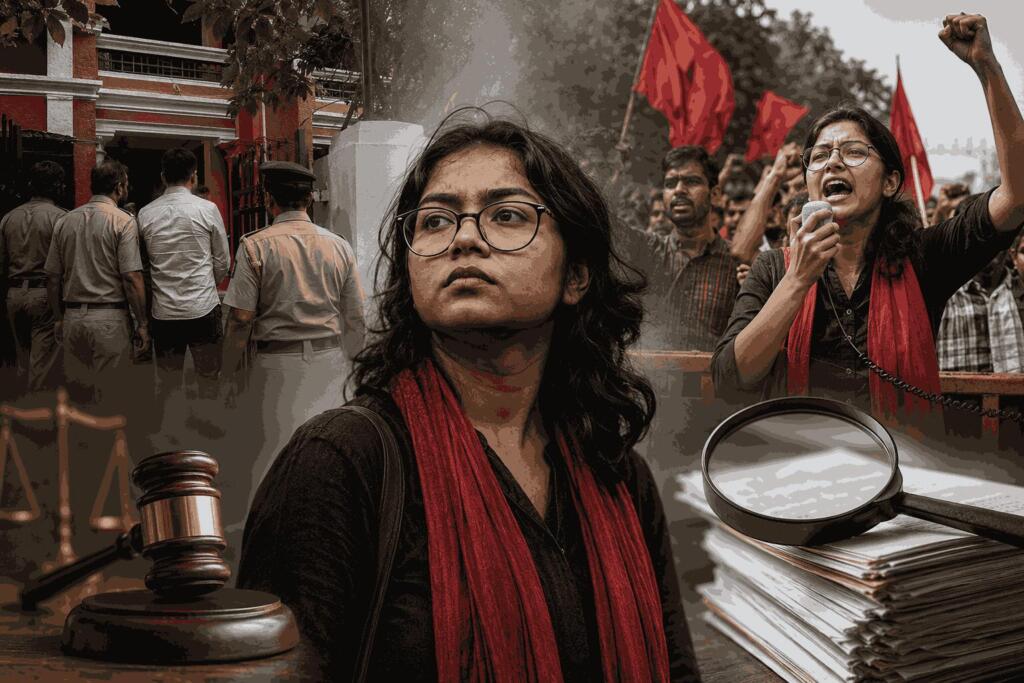
The attempted arrest of student leader Aishe Ghosh has become a flashpoint in India’s political discourse, with the Left narrative framing it as retaliation for her role in the recent Cockroach Janata Party (CJP) protests.
The attempted arrest of student leader Aishe Ghosh has become a flashpoint in India’s political discourse, with the Left narrative framing it as retaliation for her role in the recent Cockroach Janata Party (CJP) protests. However, court records and police statements reveal a different story: Ghosh was sought in connection with a 2021 protest outside Banga Bhawan, following repeated no-shows in court. This discrepancy underscores how the Left narrative has been skillfully twisted to serve a broader political agenda.
The origins of the legal trouble trace back to February 12, 2021, when members of the Students’ Federation of India (SFI) and the Democratic Youth Federation of India (DYFI) staged a demonstration outside Banga Bhawan, the West Bengal government’s residence in New Delhi. The protest was against alleged police action on Left-wing youth organisations in Kolkata over their opposition to the Citizenship Amendment Act-National Register of Citizens (CAA-NRC).
Delhi Police registered an FIR under sections 188 (disobedience to order duly promulgated by public servant), 34 (common intention), and 447 (criminal trespass) of the Indian Penal Code, citing violation of prohibitory orders in a restricted zone. A chargesheet was filed in February 2022, and the case has been pending trial since.
According to court records, Ghosh and her counsel failed to appear in court since August 2024, prompting the magistrate to issue multiple bailable warrants before escalating to a non-bailable warrant (NBW) in December 2025. The NBW was reissued on April 11, 2026, after previous attempts to serve it were unsuccessful. [
On July 28, 2026, Delhi Police visited the CPI(M)’s AK Gopalan Bhavan headquarters to execute the warrant. The party alleged an “illegal intrusion,” claiming officers arrived in plain clothes and without proper identification. Police, however, maintained they were simply executing a court order.
Within hours, the Left narrative seized the moment, portraying the police action as political vendetta linked to Ghosh’s visibility in the CJP-led Jantar Mantar protests. CPI(M) MP John Brittas, who was present during the police visit, claimed in Rajya Sabha that Ghosh’s “only mistake” was participating in the recent agitation. CJP spokesperson Ashutosh Ranka echoed this, warning of unprecedented protests if anything happened to her.
This framing ignored the five-year-old case and the court’s repeated attempts to summon Ghosh. Instead, the Left narrative presented her as a victim of state repression, deliberately omitting the legal context.
On July 29, 2026, the Patiala House Court stayed the NBW, granting Ghosh interim relief. Judicial Magistrate Vijayshree Rathore noted her counsel’s submission that she couldn’t appear on the last hearing date due to “unavoidable circumstances.” The court directed her to appear in person on the next date of hearing.
The stay order came amid heightened political rhetoric, with Opposition leaders demanding accountability for the police action. Union minister JP Nadda dismissed the allegations, calling it a “normal law-and-order activity.”
The Ghosh episode illustrates a recurring pattern: the Left narrative selectively highlights recent political activism while sidelining long-pending legal matters. By linking the arrest attempt to the CJP protests, the narrative paints a picture of targeted persecution, ignoring the court’s documented history of warrants due to non-appearance.
This tactic serves to mobilise sympathy and frame dissent as under threat, even when the legal process is routine. The Left narrative thrives on such simplifications, turning complex judicial procedures into binary tales of oppression and resistance.
The Ghosh case also highlights how legal processes can be weaponised in public discourse. While the Left narrative portrays the police action as an assault on democracy, the government and police maintain it was a routine execution of court orders.
This divergence reflects deeper tensions in India’s political landscape, where legal matters are often interpreted through partisan lenses. The Left narrative, in particular, has become adept at shaping public perception by emphasising emotional resonance over factual accuracy.
The attempt to arrest Aishe Ghosh was rooted in a 2021 protest case and repeated court absences, not her role in the CJP protests. Yet, the Left narrative successfully recast it as political retaliation, demonstrating its power to shape public discourse. As India grapples with polarised politics, understanding such narratives is crucial for separating fact from framing.