
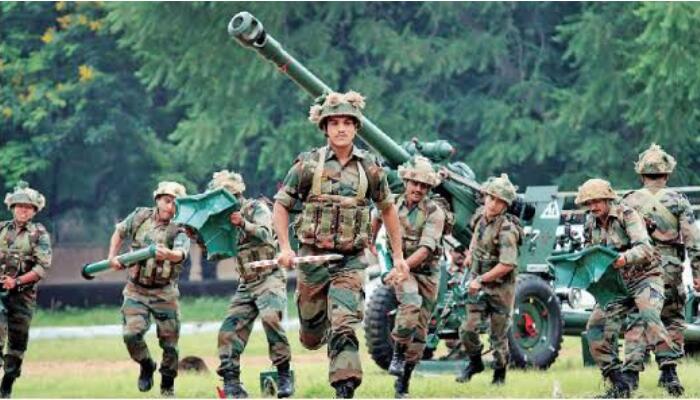
The Indian Army is set to operationalise its first Integrated Battle Groups (IBGs), marking one of the most significant transformations in its combat structure in decades. The move, which advances an earlier target, will see the Army begin deploying agile, brigade-sized formations capable of conducting both offensive and defensive operations without waiting for the mobilisation of an entire corps.
The first Integrated Battle Groups will be raised from the Panagarh-based XVII Corps, the Army’s Mountain Strike Corps responsible for operations along the China frontier. According to the existing plan, four IBGs and one dedicated Fire Support Group will be established under the XVII Corps, with each of the five formations headed by a Major General. Every IBG is also expected to have a Brigadier serving as its Chief Operations Officer.
The operationalisation of the IBGs represents the first implementation of a concept that has remained under discussion for nearly seven years. First proposed under one of the four restructuring studies initiated by former Army Chief General Bipin Rawat, the model has undergone multiple evaluations before finally moving towards operational deployment.
A force designed to fight independently
Each Integrated Battle Group will comprise more than 5,000 personnel drawn from 12 to 13 units, making it a self-contained fighting formation capable of operating independently across varied operational environments.
Every IBG will integrate infantry battalions, artillery regiments, elements of the Corps of Electronics and Mechanical Engineers, Combat Engineers, the Army Service Corps and a field hospital under a unified command structure. This integrated composition allows commanders to execute combined-arms operations without waiting for additional reinforcements from higher formations.
Unlike conventional force structures, where an entire corps must be mobilised before launching operations, an IBG can be deployed far more rapidly. This advantage is expected to prove particularly valuable in mountainous terrain, where speed of mobilisation and operational flexibility often determine tactical success. A corps can comprise nearly one lakh troops and requires considerably more time to deploy, whereas an IBG is designed to move quickly and sustain itself during operations.
Alongside the four IBGs, the Army will establish a dedicated Fire Support Group comprising artillery platforms. The formation is expected to function directly under the XVII Corps headquarters, and the Army’s newly created Divyastra batteries are also likely to be placed under it, strengthening long-range fire support and battlefield coordination.
Part of a wider military transformation
The creation of the IBGs forms part of a broader restructuring programme aimed at modernising the Army for future warfare. Along with the new battle groups, the Army is also raising Rudra brigades, Bhairav battalions, Divyastra batteries and Shaktibaan units.
While Rudra brigades will also integrate multiple combat elements under a Brigadier, they will continue to depend on their parent divisions for additional operational support. Integrated Battle Groups, by contrast, have been conceived as larger, self-sufficient formations capable of operating with significantly greater autonomy.
Military planners have maintained that the restructuring is based on capability development and capacity building rather than on any specific threat-based model. Even so, the reforms come at a time when rapid mobilisation and integrated combat capabilities have become increasingly important along India’s northern frontiers.
From concept to operational reality
The IBG concept was first tested by the IX Corps along the western border with Pakistan around 2019 but was never formally implemented. It was subsequently refined through multiple military exercises in the eastern theatre, including Exercise HimVijay in 2019, where its operational effectiveness in mountainous conditions was assessed.
Once operational, the Integrated Battle Groups are also expected to be deployable under India’s proposed theatre commands, giving the armed forces greater flexibility in future joint operations.
The reforms also mirror broader changes in regional military structures. Over the past decade, China has reorganised its People’s Liberation Army by replacing traditional divisions with smaller Combined Arms Brigades integrating armour, artillery, air defence and logistical support for faster, joint operations.
The operationalisation of the first Integrated Battle Groups therefore marks far more than the creation of another combat formation. It signals a doctrinal shift towards faster mobilisation, integrated warfare and greater operational agility, redefining how the Indian Army intends to prepare for and fight the wars of the future.