
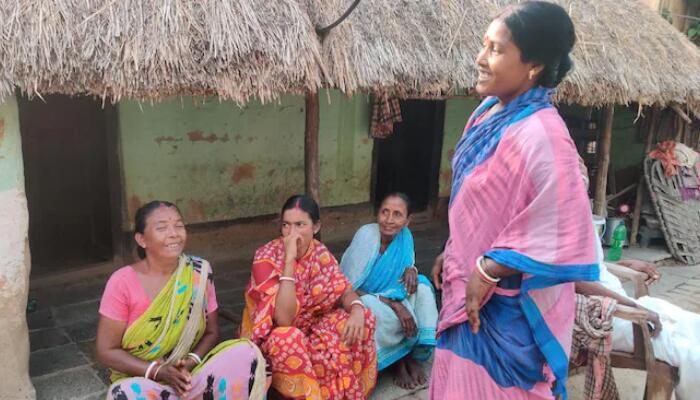
There are moments in public life when an individual biography begins to carry a wider political meaning. Kalita Majhi’s is one such case.
Before entering politics, she worked as a domestic helper across multiple households in West Bengal. Her earnings were modest, her work physically demanding, and her social visibility limited. Like millions in India’s informal workforce, her labour remained essential but largely unacknowledged, shaped by economic insecurity, long hours and absence of formal protection.
Over time, she moved into grassroots engagement and local organisational work, gradually entering the political mainstream. Her eventual rise to a ministerial position marks a significant transition from informal labour to formal authority, and is being viewed as a rare example of upward mobility within political life.
A Life Defined by Labour, Not Visibility
Kalita Majhi’s early years were shaped by sustained economic constraint and continuous domestic work. This was not a temporary phase but a long-term necessity across multiple households. Within this reality, financial insecurity and social invisibility were constant features of everyday life.
Despite these constraints, her gradual shift into public engagement reflects the pathways through which grassroots political participation often begins. Her rise into governance is therefore being understood not as an abrupt elevation but as the outcome of long-term engagement with local political and social structures.
Electoral Mandate and Political Rise
Kalita Majhi entered electoral politics after gaining visibility through grassroots organisational work. She went on to win her seat with a clear mandate from voters, marking her transition from local activist to elected representative before her elevation into ministerial responsibility.
Her electoral success reflects public trust in her leadership and consolidates her position within the political structure she now serves.
Why She Was Seen as a Political Choice
Her elevation is also being analysed through political strategy and representational logic. Parties often elevate leaders who can reflect wider social constituencies and strengthen outreach across voter groups.
Majhi’s background as a domestic worker gives her a strong symbolic identity that connects directly with working-class and economically weaker communities, particularly women engaged in informal labour. In contemporary politics, such lived experience is often viewed as politically meaningful, allowing parties to project narratives of inclusion, accessibility and social mobility.
Her rise also reflects recognition of sustained grassroots engagement, where leaders build legitimacy through long-term local involvement rather than inherited influence. Such figures are often valued for their proximity to lived realities and their ability to translate social experience into political understanding.
Women and the Slow Reshaping of Political Power
Majhi’s induction has come alongside the inclusion of other women leaders, signalling a gradual shift in political representation.
Rekha Patra, associated with grassroots mobilisation and organisational work, has been given responsibility within the governing structure, reflecting recognition of leadership emerging from sustained public engagement. Ratna Debnath, with experience in local social and political activity, has also been included in decision-making roles, further strengthening women’s presence in governance.
Overall, these developments reflect a slow but visible expansion of women’s participation in political authority, where representation is increasingly linked to public engagement and organisational contribution.
Why This Moment Matters
The image of Kalita Majhi taking the oath as a minister carries significance because it reflects one of democracy’s most important promises: accessibility.
Her journey from domestic work in West Bengal to public office highlights a simple but powerful idea. The distance between the margins of society and the centre of power is not fixed. It can be crossed through persistence, participation, and public trust.
In an era when political institutions are often viewed with scepticism, such stories do not erase inequality. But they do highlight moments where democracy opens a pathway, however limited, for transformation.
That is why Kalita Majhi’s rise is being read not merely as a political development, but as a democratic statement, one that reflects the continuing, imperfect possibility of entry into power for those who begin far from it.