
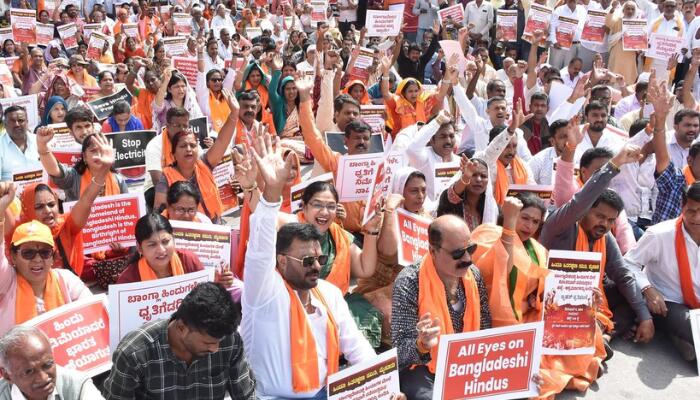
On Friday, 19 June, Bangladesh witnessed an extraordinary spectacle. A massive human chain was formed outside the National Press Club in Dhaka. By afternoon, students from universities across the capital had gathered in the Shahbagh area in such numbers that the entire district came to a standstill. As evening fell, they organised a grand torch procession that drew widespread attention across the city.
Public demonstrations are not uncommon in Dhaka. Yet what unfolded on 19 June was different enough to capture the attention of the entire country.
The reason was simple: the protesters were Hindus.
The participants in the human chain were Hindus. The students leading the torch march were Hindus. They were protesting under the banner of the Bangladesh National Hindu Grand Alliance, popularly known as Hindu Mahajot, against what they described as an insult to Lord Shri Ram.
The difference was striking. A community that had long endured intimidation and attacks appeared determined, organised and confident. It was openly protesting what it regarded as an affront to its faith and issuing a warning to the authorities.
If one imagines the map of Bangladesh as the outline of a person wearing a kurta, the district of Gaibandha would lie roughly at the neck. Today, the village of Palashbari in that district has become the centre of national attention.
An 81-foot statue of Lord Shri Ram is being constructed there within the premises of the Shri Shri Radha Govinda and Kali Temple. Nearly 80 per cent of the work has already been completed. The project is being undertaken under the leadership of Haridas Chandradas, president of the Radha Govinda Temple Committee.
A local belief associates Gaibandha with the Mahabharata era. It is said that Emperor Virata once ruled the region and maintained hundreds of cows there. According to local tradition, the area where these cattle were tied eventually came to be known as “Gaibandha”.
In recent weeks, however, construction of the statue has reportedly been halted following opposition from the Imam-Ulema Council and other Islamist organisations. Radical groups have allegedly threatened to demolish the structure. During the same period, some miscreants reportedly dumped piles of shoes and slippers on the under-construction statue, an act viewed by Hindus as a deliberate religious insult.
The incident triggered anger across sections of Bangladesh’s Hindu community. Students from Jagannath University in southern Dhaka were among the first to take to the streets in protest. The spark ignited there gradually spread across the country, culminating in the unprecedented demonstrations witnessed in Dhaka on 19 June.
Hindus today account for only around 9 to 10 per cent of Bangladesh’s population. In Gaibandha district, their share is estimated to be about 7 per cent.
Incidents of persecution against Hindus have occurred repeatedly over the decades. Temples have been attacked, idols vandalised and, on many occasions, the community has either mounted only limited resistance or remained silent under pressure.
So where has this newfound confidence among Bangladesh’s Hindus come from?
The answer lies in the election results in West Bengal.
The wave of Hindutva reflected in those electoral outcomes inspired confidence among Hindus in Bangladesh. It strengthened their morale, revived their self-belief and contributed to the unprecedented mobilisation witnessed in Dhaka.
For decades, reports have emerged from both Pakistan and Bangladesh regarding violence against Hindus, including attacks on temples, forced conversions, abductions of Hindu girls and intimidation of minority communities.
From 1947 to 1975 in East Pakistan, and from 1975 onwards in Bangladesh, numerous Hindu temples were attacked or destroyed and idols desecrated. Large-scale violence against Hindus has occurred at different points in history. During the unrest of 2024, attacks on Hindus once again intensified and many members of the community suffered violence.
Repeated incidents of mob violence targeting Hindus have also been reported.
Those who frequently speak about human rights, secularism and minority protection have often remained silent regarding violence against Hindus in Bangladesh and Pakistan.
Why does this happen?
India, too, has a Muslim population of roughly 10 to 12 per cent. Yet even relatively small incidents involving Muslims in India often generate widespread international attention. Narratives about Muslims being unsafe in India circulated widely during the Covid-19 period. By contrast, even major incidents involving Hindus in Bangladesh and Pakistan frequently receive limited coverage.
The reason lies in organisation.
Muslim communities in India have historically maintained organised political representation.
Before Partition, the Muslim League served as a major political force. After Independence, it continued under the name Indian Union Muslim League and retained influence, particularly in Kerala, where it expanded its political presence and regularly secured parliamentary representation. The party remained a component of the United Progressive Alliance, and its leaders served in government during the UPA years. Even today, political arrangements in Kerala depend significantly on the support of the Indian Union Muslim League.
Organisations such as AIMIM also reflect continued Muslim political mobilisation.
By contrast, Hindus in Pakistan and later Bangladesh failed to develop comparable political influence despite their significant numbers at the time of Partition.
Before Independence, the Hindu Mahasabha represented sections of Hindu political opinion. Many Hindus in India did not regard it as their principal political platform. The British and Muslim political leadership often viewed the Congress as a Hindu party, while the Congress itself did not define itself in those terms. Congress policies frequently favoured Muslim interests.
After Partition, the Hindu Mahasabha’s presence in West Pakistan rapidly declined. Many activists migrated to India, while those who remained suffered a collapse in morale. By around 1950, its organisational presence there had virtually disappeared.
In East Pakistan, the Hindu Mahasabha initially held greater influence. Leaders such as Dr Syama Prasad Mookerjee and Nirmal Chandra Chatterjee were prominent figures. Mookerjee played a key role in ensuring that West Bengal remained part of India rather than becoming part of Pakistan.
However, anti-Hindu riots in Dhaka, Barisal, Khulna and other regions in 1950 severely weakened the community. Large numbers migrated, while many who remained retreated from public life.
As a result, Hindus in both East and West Pakistan never emerged as a significant political force despite their numbers. In a world that respects organised power, the absence of political and social influence left them increasingly vulnerable to persecution and discrimination.
Today, Bangladesh has several Hindu social organisations. In 2006, a number of them came together to form Hindu Mahajot. Yet the organisation remained limited in scope and lacked substantial political influence.
Most Hindus continued to support Sheikh Hasina’s Awami League government.
Following the overthrow of the Awami League government in 2024, attacks on Hindus intensified. Initially, Hindu Mahajot viewed many of these incidents as political retaliation rather than a broader communal issue. As a result, the response from the Hindu community remained limited.
The events of 19 June marked a significant departure.
For the first time in years, Bangladesh’s Hindu community appeared to enter a new phase of social and political consciousness.
The West Bengal election changed far more than political equations inside India. It infused Bangladesh’s Hindus with confidence, organisation and the courage to assert themselves publicly.
What unfolded in Dhaka on 19 June was more than a protest against the alleged desecration of a Ram statue. It was the declaration of a community that has long lived under fear and uncertainty. For the first time in years, Bangladesh’s Hindus appeared not as victims seeking protection, but as an organised force demanding respect.
The message from Dhaka was unmistakable: Bangladesh’s Hindu community has found its voice and is no longer willing to remain silent.