
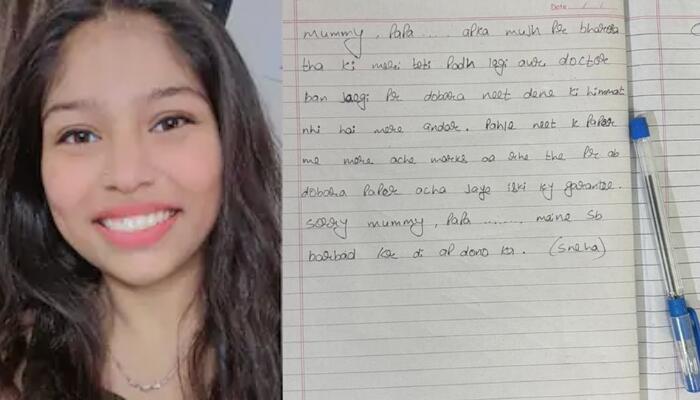
The fallout from the NEET-UG 2026 paper leak controversy has claimed another tragic victim. Akanksha Chaturvedi, a 17-year-old NEET aspirant from Madhya Pradesh’s Mauganj district, allegedly died by suicide after reportedly falling into depression following the cancellation of the medical entrance examination she had appeared for earlier this year.
Akanksha was among the more than 22 lakh students who sat for the National Eligibility-cum-Entrance Test (NEET-UG) on 3 May. However, the National Testing Agency (NTA) cancelled the examination on 12 May after allegations of a large-scale paper leak surfaced. Authorities subsequently announced a re-examination on 21 June.
According to her family, the decision devastated the teenager, who had spent years preparing for the country’s most competitive medical entrance examination and was expecting to score around 650 marks.
A suicide note recovered after her death revealed her anguish.
“Mummy Papa, you believed your daughter would study and become a doctor. But I do not dare to take the NEET exam again. I have ruined both of you.”
She further wrote that there was no guarantee she would perform as well if she appeared for the examination a second time.
A Family’s Sacrifices and a Daughter’s Dream
Akanksha’s death has highlighted the immense personal and financial burdens many Indian families bear in pursuit of professional education.
Her father, Krishna Kumar Chaturvedi, is a farmer who reportedly took a loan of ₹3 lakh through a Kisan Credit Card to fund his daughter’s coaching in Nagpur. To support her preparation, he also worked as a cook in the city while continuing to manage the family’s agricultural responsibilities.
Family members said Akanksha was deeply aware of these sacrifices. She aspired to become a doctor not only to fulfil her own ambitions but also to improve her family’s financial condition.
According to her parents, the government’s acknowledgement of the paper leak and the subsequent cancellation of the examination severely affected her mental state. They maintained that she had been confident of securing admission to a medical college this year before the controversy erupted.
For the family, the examination represented years of effort, hope and investment. The sudden uncertainty surrounding the process reportedly left Akanksha overwhelmed.
A Disturbing Pattern Emerging Across States
Akanksha’s case is not an isolated tragedy. Reports from several states indicate that multiple NEET aspirants have died by suicide following the cancellation of the examination.
In Jharkhand, a 16-year-old student reportedly died by suicide after struggling with severe depression linked to the controversy. According to her family, she had joined a coaching institute in Delhi after completing Class 10, returned home after finishing her course and was confident of clearing NEET this year.
In Rajasthan, a student who was reportedly expecting around 650 marks allegedly died by suicide shortly after the examination was cancelled. Similar incidents have also been reported in Delhi, where a 20-year-old aspirant died by suicide, and in Uttar Pradesh’s Lakhimpur Kheri, where a 21-year-old candidate allegedly took her life. In each case, family members linked the tragedy to the uncertainty created by the cancellation of the examination.
These incidents have intensified concerns about the psychological toll of India’s highly competitive entrance examination system.
The NEET-UG 2026 Scandal
The NEET-UG 2026 examination was conducted on 3 May for over 22 lakh candidates across the country. Days later, allegations emerged that the question paper had been leaked through organised networks operating across multiple states.
Investigators believe the leak originated in Rajasthan before spreading through messaging platforms and other channels. The Central Bureau of Investigation (CBI) has since arrested multiple individuals as part of its ongoing probe.
The controversy has reached the Supreme Court, where petitions have sought accountability from the NTA and demanded reforms in the examination process. Critics argue that recurring irregularities have steadily eroded public confidence in one of India’s most important entrance examinations.
A Crisis Bigger Than an Examination
The current scandal has also revived memories of the NEET-UG 2024 controversy, when allegations of paper leaks, inflated scores and grace marks triggered nationwide protests and prolonged litigation. Although the Supreme Court stopped short of cancelling the entire examination, it acknowledged irregularities at certain centres and ordered corrective measures.
The recurrence of a similar controversy just two years later has raised fresh questions about whether meaningful reforms were ever implemented.
Mental health experts have long warned that India’s entrance examination ecosystem places extraordinary pressure on students. For countless families, years of preparation, substantial financial investments and hopes of social mobility are tied to a single examination.
As investigations into the paper leak continue, Akanksha Chaturvedi’s death has become a painful reminder that the consequences of examination failures extend far beyond administrative lapses. What began as a paper leak scandal is increasingly being viewed as a wider crisis of trust, one whose human cost is being paid by students and families across the country.