
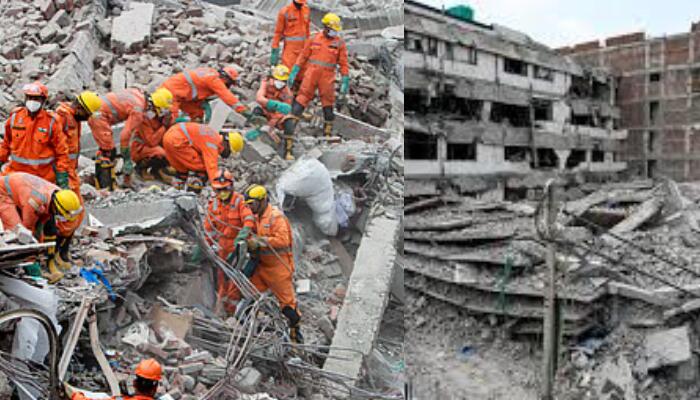
Those who lost their lives include Parvati, the owner of a nearby canteen, along with engineers Kapil, Nalin Rai, and Alok Verma, and doctors Ravi Verma and Ekta. An adjoining tin-shed canteen, often filled with students preparing for competitive medical examinations, was also crushed in the collapse, deepening the human cost of the incident. At least ten people were pulled out alive after a painstaking rescue operation that stretched close to 20 hours.
A rescue operation defined by narrow lanes and unstable ground
The National Disaster Response Force and Delhi Police led the response under conditions that tested every layer of urban emergency planning. Narrow lanes in Saidulajab restricted access, forcing teams to rely as much on careful manual clearing as on heavy machinery.
Rescue personnel worked with hydraulic cutters, earthmovers, acoustic sensors, victim-location cameras and trained dogs to locate survivors. In several sections, they were compelled to remove debris by hand, lifting twisted tin sheets and broken concrete with caution, fully aware that every movement carried risk.
A green corridor was created to ensure the swift transfer of the injured to AIIMS Trauma Centre, Safdarjung Hospital and Pt Madan Mohan Malaviya Hospital. The final body was recovered nearly 20 hours after the collapse, bringing a long and difficult operation to a close.
Questions over unauthorised construction and structural stress
Initial accounts indicate that unauthorised vertical expansion may have been underway at the time of the collapse. While there is some variation in reporting on whether the structure stood at three or five storeys, officials confirmed that additional floors had been added without adequate structural reinforcement.
The building, over a decade old, was not originally designed to carry such an increased load. Local accounts also point to concerns over the use of sub-standard materials during recent construction activity. The collapse of the adjoining canteen, a familiar stop for coaching students in the area, added to the scale of the tragedy in a matter of seconds.
Legal action, suspensions, and a widening probe
Delhi Police has registered an FIR against the absconding owner, Karamveer, and two contractors, invoking charges including culpable homicide and negligent construction under the Bharatiya Nyaya Sanhita. Two engineers of the Municipal Corporation of Delhi have been suspended over alleged lapses in monitoring the site.
A magisterial inquiry has been ordered to examine structural approvals, construction permissions, and the chain of oversight failures that allowed unauthorised expansion to continue despite prior concerns reportedly flagged by officials.
Municipal response and widening enforcement drive
In the aftermath, the Municipal Corporation of Delhi has announced a seal-and-vacate drive targeting buildings violating bylaws across South Delhi. Notices will be issued to structures exceeding permitted height limits, with inspections set to begin in Saket, Mehrauli, and adjoining localities.
Officials have stated that after a 72-hour notice period, enforcement action, including sealing and evacuation, will follow. They also acknowledged that unauthorised construction is not confined to a single pocket, identifying areas such as Saidulajab, Paryavaran Complex, and Freedom Fighters’ Enclave as vulnerable zones.
Chief Minister Rekha Gupta has ordered strict action against illegal constructions, underlining that accountability will not be limited to builders alone but will extend across the administrative chain.
As investigations continue, the Saket collapse stands not just as an isolated tragedy, but as another reminder of how easily everyday urban life can be upended when regulation fails to keep pace with construction on the ground.