
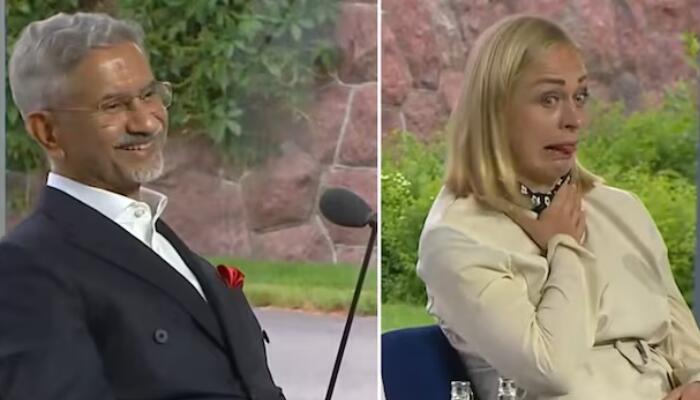
Diplomacy rarely strays from structure. It moves through prepared notes, calibrated language and predictable exchanges. Yet in Helsinki, a brief moment of spontaneity ended up defining the public memory of the visit.
External Affairs Minister S. Jaishankar had already concluded structured discussions with Finland’s Foreign Minister Elina Valtonen, with talks covering defence cooperation and broader bilateral engagement. The subsequent media interaction began in a formal tone, until a passing remark altered its pace.
Valtonen, speaking casually, referred to the two sides having signed “many deals”. The comment was light, conversational, and not out of place in tone, but it immediately shifted the atmosphere in the room.
Jaishankar responded at once, smiling as he cut in with a remark that landed instantly: “You’re not supposed to say that!”
The reaction was immediate. Laughter broke out in the room, easing the formal setting within seconds. Valtonen, briefly caught off guard, reacted with visible amusement before joining in. What had been a tightly structured briefing momentarily turned into an exchange defined by ease and timing rather than protocol.
A brief moment that travelled far beyond Helsinki
What could have remained a passing aside in a diplomatic setting instead became the defining visual from the Finland visit. Clips of the exchange spread rapidly across social media platforms, where audiences focused less on policy substance and more on the spontaneity and chemistry between the two ministers.
The appeal lay in its contrast. High-level diplomatic briefings are rarely associated with unscripted humour in public view. Yet here, a senior Indian minister responded instinctively, breaking the formality of the moment with a line that immediately reset the room’s tone.
Valtonen’s reaction, shifting from surprise to laughter, became part of the clip’s wider resonance. It was not just the words but the timing, expression and shared ease that gave the exchange its viral traction.
Beyond the clip: India’s position on Russian oil
Away from the moment that dominated online attention, the visit also carried substantive discussions on energy security and geopolitics, particularly India’s continued purchase of Russian oil.
Valtonen noted during the engagement that India had been operating within the Western-led oil price cap framework introduced after the Russia-Ukraine conflict. She clarified that the mechanism was not designed to stop Russian oil purchases altogether, but to cap revenues while ensuring global energy markets remained stable.
“In India’s defence, it has bought oil under the price cap. That was the intention,” she said during a panel discussion.
Her comments added nuance to a debate often framed in binary terms, reinforcing that the price cap functioned as a regulatory measure rather than a complete restriction on trade.
Diplomacy with an unscripted edge
The Finland visit ultimately reflected two parallel dimensions of contemporary diplomacy. One was the structured articulation of national positions on energy security and international alignment. The other was the unpredictable human element that occasionally surfaces in public interactions.
In this case, it was a single line, brief, spontaneous, and precisely timed, that moved beyond the room and into global circulation.
“You’re not supposed to say that,” Jaishankar said. It was a moment that lasted seconds, but travelled far beyond them.