
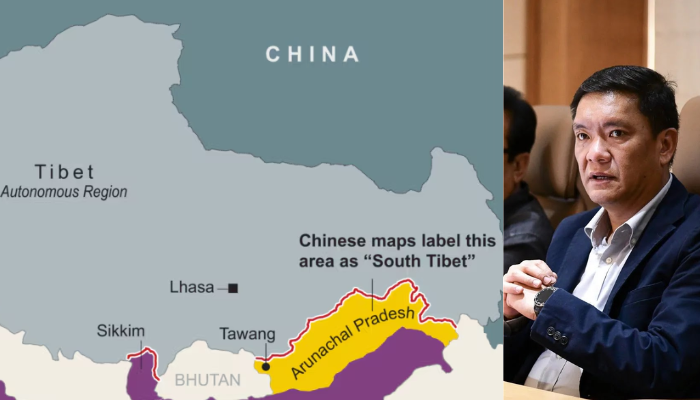
Arunachal Pradesh Chief Minister Pema Khandu has once again escalated India’s political pushback against China’s claims over the state. Speaking in response to Beijing’s renewed assertions and repeated renaming of locations in Arunachal Pradesh, he stated that India does not share a border with China but with Tibet.
The Chief Minister’s remarks directly challenge China’s long-standing position, which claims Arunachal Pradesh as part of what it calls “South Tibet”. Khandu, however, insisted that the border narrative must be understood through a different historical lens, anchored in Tibet rather than Beijing’s present-day territorial framing.
McMahon Line at the Centre of the Dispute
The reference to Tibet connects to the McMahon Line, drawn in 1914 during the Simla Convention between British India and Tibet. India recognises this line as the legal boundary in the eastern sector, including Arunachal Pradesh.
China rejects the Simla Convention outright. It argues that Tibet did not possess sovereign authority at the time to sign international agreements. On that basis, Beijing considers the McMahon Line invalid and continues to press its territorial claim over Arunachal Pradesh.
Khandu’s framing aligns with India’s established position that the agreement was legitimate and binding in defining the eastern boundary.
“This Is Not the 1962 Era”
Khandu also rejected any comparison between the present border situation and the 1962 India–China war. He described such parallels as misleading and outdated, arguing that the ground reality has changed significantly.
He underlined that Arunachal Pradesh today is secure and far better connected than in the past. According to him, infrastructure development across border regions has transformed access and response capability.
He credited sustained infrastructure expansion under the government led by Prime Minister Narendra Modi for strengthening connectivity from Kashmir to Arunachal Pradesh. In his view, this has improved logistics and defence readiness across the entire northern frontier.
China’s Renaming Push and India’s Rejection
The statement comes amid China’s continued practice of issuing new names for locations inside Arunachal Pradesh. Since the Doklam standoff in 2017, Beijing has renamed as many as 82 cities and geographical features in the state. The latest list was released on April 10, 2026.
India has consistently rejected these moves. The Ministry of External Affairs has described such actions as baseless and without any effect on territorial reality. It has reiterated that Arunachal Pradesh remains an integral and inalienable part of India.
Reports have also noted that China recently announced administrative changes involving a new county in the Aksai Chin region, alongside naming 23 locations in Arunachal Pradesh. New Delhi has dismissed these developments as unilateral and without legal standing.
Firm Positions, No Convergence
Khandu also made his position unusually direct, stating that such Chinese claims are routine and not taken seriously in Arunachal Pradesh. He described the repeated renaming exercises as habitual and detached from ground realities.
China continues to maintain its claim over Arunachal Pradesh under the label “South Tibet”. India, meanwhile, continues to exercise full administrative control over the state while rejecting any territorial dispute over it.
The divergence remains rooted in competing interpretations of history, particularly the status of Tibet at the time of the 1914 boundary agreement. Despite repeated diplomatic exchanges, there is still no convergence between the two positions.
Khandu’s remarks, therefore, reinforce India’s established stance while underlining a broader message: the border may be disputed in rhetoric, but the ground reality, in India’s telling, is already settled.