
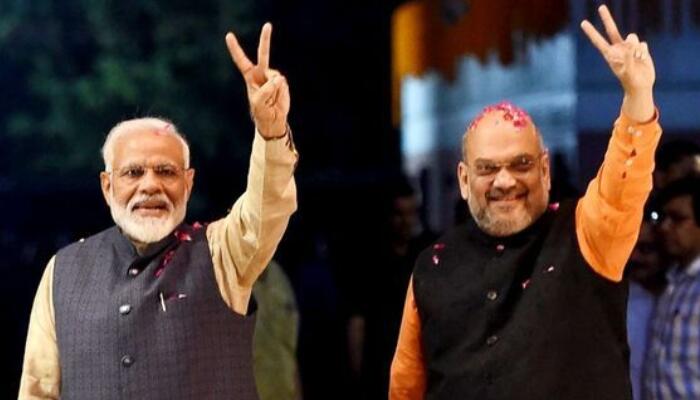
Union Home Minister Amit Shah described the 12-year tenure of the Narendra Modi government as a “golden era” defined by what he called the confluence of development and heritage, alongside a decisive strengthening of India’s national security architecture. Speaking through posts on social media, Shah said the period has reshaped governance priorities by placing cultural identity, infrastructure expansion and internal security on the same strategic footing.
Cultural revival alongside development push
Shah said the government’s approach has combined large-scale infrastructure growth with a visible focus on civilisational and religious heritage. He cited the construction of the Shri Ram Janmabhoomi Mandir, the Kashi Vishwanath Corridor and the Ujjain Mahakal Lok as key examples of projects that reflect this dual emphasis.
Alongside these initiatives, he pointed to broader development programmes such as Make in India and improvements in connectivity, arguing that these have accelerated India’s economic momentum while reinforcing national confidence. The emphasis, he suggested, has been on aligning modernisation with cultural continuity rather than treating them as separate goals.
Digitisation, heritage recovery and linguistic recognition
Shah also highlighted several administrative and cultural measures undertaken during this period. He noted the digitisation of one crore records as part of efforts to modernise governance systems and improve accessibility.
He further referred to the return of 668 ancient artefacts to India, describing it as part of a sustained effort to reclaim historical heritage. The establishment of 11 tribal freedom struggle museums was also mentioned as recognition of lesser-highlighted narratives in India’s independence history.
In addition, Shah said 11 Indian languages being granted classical language status reflects a broader acknowledgment of India’s linguistic depth and civilisational diversity.
Security doctrine and internal stability
Turning to national security, Shah said the Modi government has significantly reshaped India’s defence and internal security posture. He described the country as having been rebuilt into a “bastion of security” that both protects citizens and responds firmly to threats.
He referred to military actions including surgical strikes, air strikes and Operation Sindoor as examples of this assertive approach. He also cited the abrogation of Article 370 in Jammu and Kashmir as a landmark decision aimed at strengthening national integration.
On internal security, Shah pointed to efforts to counter Naxalism and strengthen peace in the Northeast, noting over 12 accords signed in the region as evidence of sustained engagement and conflict resolution.
Political milestone amid sustained tenure
The remarks come as Prime Minister Narendra Modi completes 12 years in office and continues as India’s longest consecutively serving elected Prime Minister, with 4,399 days in power, surpassing Jawaharlal Nehru’s record.
For Shah, this continuity represents political stability and a sustained mandate, which he links to what he describes as a broader transformation in how India approaches governance, identity and security.