
India’s rise on the global stage is no longer measured solely by economic metrics or strategic influence. According to Rashtriya Swayamsevak Sangh (RSS) chief Mohan Bhagwat, a parallel and increasingly deliberate effort is underway to challenge that rise through narratives aimed at weakening civilisational confidence and social unity.
Speaking at a public event on Tuesday, Bhagwat said that whenever a nation begins to assert itself globally, resistance emerges not only in material terms but also in the realm of ideas. In India’s case, he suggested that attempts are being made to construct misleading interpretations of history and identity in order to dilute national cohesion at a critical moment of transformation.
Without naming any specific actors, he made it clear that such narrative constructions are not accidental. In his view, they reflect a broader pattern seen in the rise of major civilisations, where the struggle for influence extends beyond borders into perception, education and historical understanding itself.
Haldighati as a Civilisational Symbol, Not Just a Battle
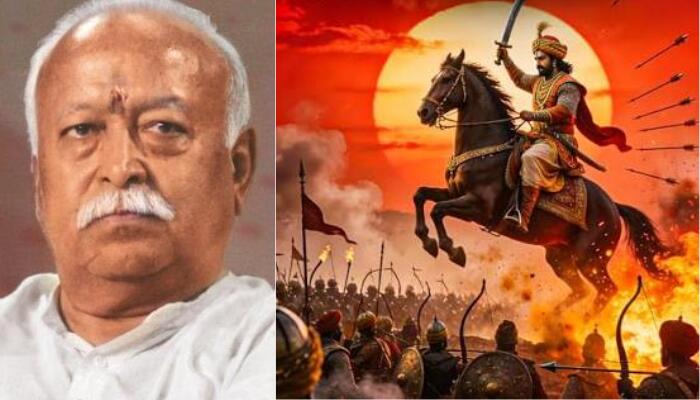
A significant part of his remarks centred on the Battle of Haldighati. Bhagwat emphasised that reducing it to a narrow military engagement misses its deeper significance in India’s historical consciousness.
The Battle of Haldighati, fought in 1576 between Maharana Pratap and the Mughal forces led by Raja Man Singh, unfolded in the difficult terrain of present-day Rajasthan. While conventional accounts often focus on its military outcome, it has long stood in public memory as a symbol of resistance, self-respect and unwavering commitment to sovereignty.
Bhagwat’s point, in essence, was that Indian history cannot be understood through fragmented or externally framed interpretations. It must be seen as a continuum of civilisational endurance, where events carry meaning far beyond battlefield results and reflect the deeper spirit of a civilisation that has repeatedly defended its identity.
Unity as the Core of National Strength
Extending his argument, Bhagwat said that India’s global rise depends not only on economic progress or strategic capability but equally on internal unity and cultural confidence. A divided society, he suggested, becomes vulnerable not just politically but also intellectually, as competing narratives can weaken collective clarity and purpose.
He stressed that social harmony and shared national consciousness are not abstract ideals but essential foundations of strength. Without them, he warned, even material progress can be undermined by internal fragmentation.
At the same time, he reiterated that India’s ascent should not imitate traditional models of global dominance. Instead, it should remain rooted in its civilisational ethos, contributing to global welfare while maintaining its own clarity of identity and purpose.
The Real Contest Lies in Ideas
Bhagwat’s remarks reflect a larger shift in how power is being defined in the contemporary world. Influence today is not limited to economic or military strength alone, but increasingly shaped by control over narratives, historical interpretation and cultural perception.
In that sense, he framed India’s present moment as a dual challenge: continuing its material rise while also safeguarding its intellectual sovereignty. The struggle, as he described it, is not just about borders or policy decisions, but about who defines India’s story—and whether that story is told with confidence from within or shaped under external influence.