
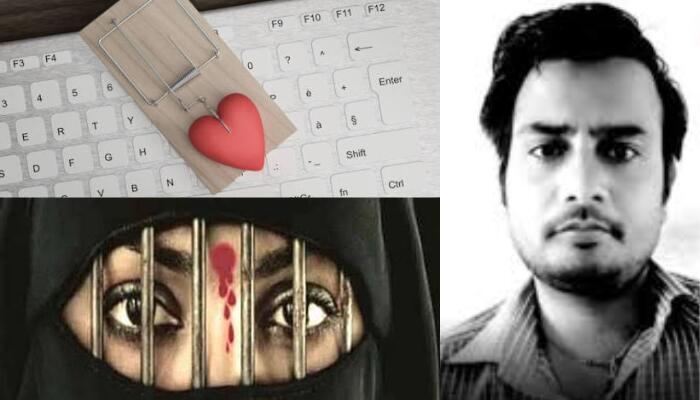
A case registered at Vigyan Nagar police station has intensified after the arrest of Manish Sharma, a Kota resident accused of operating on social media under the name “Moin Khan”. The action followed a complaint filed on June 15 by Bajrang Dal activist Yogesh Renwal, leading to FIR No. 187/2026 and the launch of a detailed cybercrime investigation.
According to the complaint, Sharma was active on Telegram, Snapchat and Discord, where he participated in groups discussing targeting Hindu women through online romantic relationships. It is further stated that objectionable videos were recorded during these interactions and later used for blackmail, with victims subjected to pressure for religious conversion.
Large Cache of Digital Material Under Forensic Examination
Following the arrest, police seized electronic devices linked to the accused and sent them for forensic analysis at the state forensic science laboratory. The complaint refers to a large volume of material, including claims of more than 40,000 objectionable videos. Investigators have not confirmed this figure and are examining all recovered data through detailed forensic procedures.
Bajrang Dal has stated that portions of the material include religious symbols such as “Om” and “Swastik”, along with references involving Hindu deities and the Shivling. The organisation also cites Telegram discussions containing ideological terms such as “Ghazwa-e-Hind” and “Jihad-al-Akbar”, which it interprets as indicative of a coordinated online structure.
The matter has also expanded into allegations of cross-border involvement, with audio clips said to contain instructions originating from Pakistan. Based on these assertions, representations have been submitted to the Prime Minister’s Office, the Ministry of Home Affairs and the Rajasthan Chief Minister, seeking intervention by central agencies.
Identity Disguise and Conversion Allegations Remain Unproven
At the centre of the investigation is the allegation that Manish Sharma used a false identity, operating as “Moin Khan” in certain online groups. Bajrang Dal has further stated that Sharma converted his religion and underwent circumcision, claims that have intensified public and political attention on the case.
Police have stated that no material supporting religious conversion has been found so far during the investigation. Officials have also clarified that no evidence has emerged indicating insult to religious deities or the existence of any organised conversion network.
Investigators have confirmed that the accused was found accessing and downloading pornographic content through online groups. The case has been registered under relevant provisions of the Bharatiya Nyaya Sanhita and Sections 66, 67 and 67A of the Information Technology Act.
Probe Continues as Digital Forensics Take Centre Stage
Investigating officer CI Mangilal said Sharma remains in judicial custody while cyber forensic teams examine mobile data, chat records and broader online activity. He noted that while the accused used the identity “Moin Khan” in certain groups, allegations relating to circumcision and cross-border links have not been established at this stage.
Police reiterated that the investigation is being driven strictly by forensic and digital evidence, and conclusions will rest on verifiable material rather than circulating claims.
As the probe continues, the case remains defined by competing narratives, one driven by serious allegations of a coordinated online network, and the other grounded in an ongoing forensic investigation that has yet to substantiate its most serious claims.