
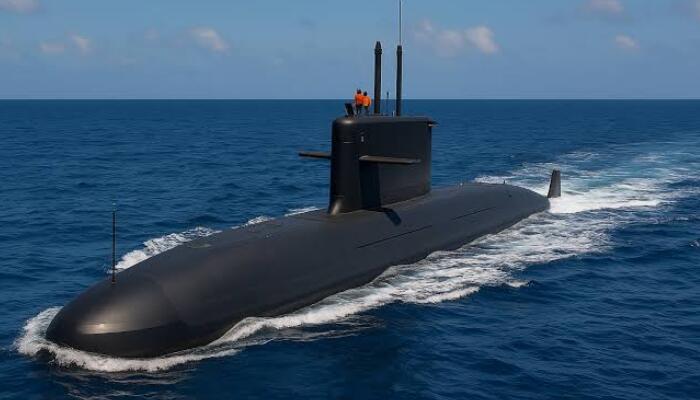
In any democracy, the larger the public expenditure, the stronger the expectation of public accountability. Roads, railways, hospitals, and welfare programmes are routinely subjected to scrutiny, audits, and parliamentary questioning. Yet when it comes to Pakistan’s largest-ever naval procurement, the Hangor-class submarine programme, basic questions about cost remain unanswered, not because the information does not exist, but because it has never been disclosed.
The deal was reported at $4–5 billion, with the Financial Times first citing the figure in 2015, though it was unclear whether that sum covered only the eight submarines or also the four Type 054A/P frigates the Pakistan Navy subsequently ordered from China. Pakistan’s Ministry of Defence has never officially confirmed any figure, broken it down by unit, or published the contract’s financing structure. What is established is that this represents the single largest arms export contract in Chinese military history. Yet the Pakistani public, who will ultimately service whatever debt underwrites it, has been given no formal accounting of what they are paying, to whom, or on what terms.
This silence is not incidental. It is a pattern. Pakistan’s defence procurement system operates with a near-total absence of public financial disclosure. Parliamentary defence committees receive classified briefings that remain off the record. Budget line items are aggregated in ways that prevent external analysis. No parliamentary committee has summoned programme managers. No audit agency has publicly examined cost overruns. The public record contains no revised timeline and no explanation of the factors that produced the programme’s delays.
The Ghost of the Agosta-90B
For anyone familiar with Pakistan’s defence procurement history, the Hangor programme’s opacity triggers uncomfortable institutional memory. The Agosta-90B programme was disrupted by the May 2002 Karachi bombing, in which 14 people, including 11 French DCN engineers and technicians, were killed when their bus was struck by a car-borne explosive device. The bombing was later linked to a broader French corruption investigation, the so-called “Karachi affair”, involving alleged kickbacks and retrocommissions tied to the submarine contract.
Investigations into the submarine deal had already begun in Pakistan in 1997, when the Pakistani Chief of Naval Staff admitted the existence of large bribes paid by DCN to secure the contract. The attack in Karachi prompted new investigations in France, which gradually revealed a system of commission payments tied not only to the Pakistani submarines, but also to three frigates sold to Saudi Arabia. Some commission payments were channelled back to France as retrocommissions, reportedly to fund the 1995 presidential election campaign of Édouard Balladur. French courts ultimately convicted several individuals, including a former head of DCN’s international division.
The Agosta-90B deal became infamous when investigations uncovered extensive kickbacks. A former Navy chief was indicted, and the case highlighted how large defence contracts can become vehicles for private enrichment. The Hangor programme, worth several times more than the Agosta contract, is surrounded by the same structural opacity. The question of whether institutional safeguards have improved is not academic. It is the central accountability question the programme has never had to answer.
What Parliament Was Never Told
In April 2015, during a briefing to the National Assembly Standing Committee on Defence, Pakistan Navy representatives disclosed that the government had approved the purchase of eight submarines at an estimated cost of $4–5 billion. That briefing, reported in state media at the time, appears to represent the most substantive public disclosure the programme has received. It confirmed the headline figure but revealed nothing about unit pricing, financing terms, technology transfer provisions, sustainment costs, or penalty clauses for delivery delays, the information that would allow any parliament to assess whether a programme of this scale is being managed competently and honestly.
Pakistan raised its defence budget by over 20 percent in the latest fiscal cycle, even as total federal expenditures were cut by nearly 7 percent, with health, education, and infrastructure programmes taking direct hits to make room for military allocations. The country, under sustained IMF pressure to reduce subsidies and tighten public spending, is simultaneously committing billions to a submarine fleet, a contradiction drawing sharp criticism from fiscal analysts and civil society observers alike.
The Demand for Disclosure
The opacity surrounding the Hangor programme is not merely a governance inconvenience. The precedent of the Agosta-90B affair demonstrates that secrecy around submarine procurement in Pakistan has, in the past, created the conditions for corruption on a scale that reached into both governments involved, implicated intelligence and naval leadership, and ultimately contributed to a terrorist attack. The structural conditions present in the 1990s, a high-value contract, opaque terms, no public accountability mechanism, and intermediaries operating without scrutiny, are not demonstrably absent from the Hangor programme today.
A transaction of this magnitude, conducted with public funds or with debt that Pakistani citizens will ultimately service, cannot be legitimately insulated from public scrutiny on national security grounds alone. Security considerations may justify withholding operational specifications. They do not justify concealing the total cost, the financing structure, the unit price, or the penalty provisions of a commercial arms contract. Those are financial governance questions, not intelligence ones,
and they remain, as of mid-2026, entirely unanswered.