
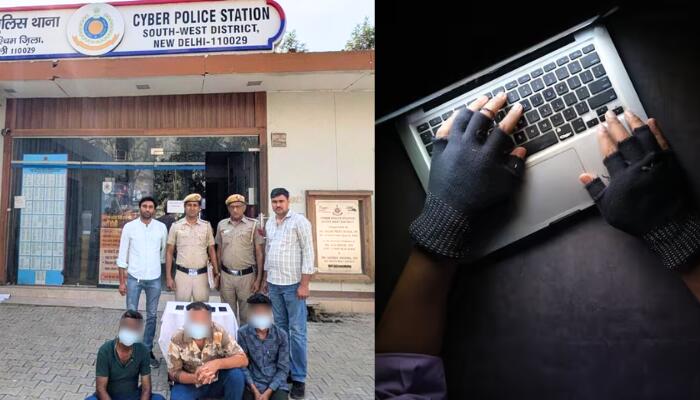
Delhi Police have busted an interstate cyber fraud network that routed stolen money through a web of mule accounts and banking instruments, arresting three men and freezing a major portion of the funds siphoned from a Delhi resident’s bank account.
The Cyber Police Station of Central district arrested Sonu and Yash Kumar, both from Uttam Nagar, and Baljinder Singh alias Mangga from Yamuna Nagar in Haryana. Police said they secured and froze around ₹4 lakh of the ₹4.82 lakh that had been fraudulently withdrawn.
The case began when a 50-year-old man from Prem Nagar in Karol Bagh noticed multiple unauthorised debit alerts on his phone. His son immediately blocked the account, but by then, the money had already been moved through a series of rapid digital transactions.
Money trail leads to Uttam Nagar
Investigators tracked the flow of funds through technical surveillance and banking records. The trail led them to a beneficiary account linked to Sonu in Uttam Nagar, which became the first breakthrough in the case.
Sonu and Yash Kumar were arrested on May 27 after coordinated raids in Delhi. During questioning, they allegedly revealed details that led police to Baljinder Singh, identified as an interstate handler in the network. He was arrested in Yamuna Nagar on June 3.
How did the network operate?
According to police, the group was part of a structured system built around mule accounts. These accounts were opened in the names of individuals who were allegedly paid to hand over access details and banking credentials.
Once activated, these accounts were passed along a chain of local facilitators and interstate handlers. Banking kits, debit cards and SIM cards were circulated within the network, allowing operators to move money quickly through ATMs and online transfers before detection.
Investigators said the setup allowed the accused to break the money trail into multiple layers, making recovery difficult once funds entered circulation.
Recovery and digital evidence
Police managed to freeze around ₹4 lakh before it could be further transferred or withdrawn. During the operation, they also recovered 28 debit cards linked to suspected mule accounts, 12 SIM cards used for internet banking and UPI transactions, and four mobile phones containing transaction records and communication data.
Officials said the devices are now being examined to identify additional links in the network and possible beneficiaries.
A broader pattern in cyber fraud cases
The investigation also reflects a pattern increasingly seen in cyber fraud cases, where multiple actors operate in coordination rather than isolated offenders.
In a separate case earlier this year, a tea seller from South Patel Nagar lost ₹90,000 after being targeted by an impersonator posing as a fintech support agent. The victim’s complaint led to the registration of an FIR on May 15 under Section 318(4) of the Bharatiya Nyaya Sanhita at the Cyber Central police station.
A team led by Sub-Inspector Ravinder Kumar, Head Constables Deepak and Jai Kishan, under senior supervision, conducted raids across Panchkula, Zirakpur and nearby areas in Haryana and Punjab.
That operation led to the arrest of Vishesh Singh, Sachin Maurya and Ashish Sharma, who investigators said were involved in supplying bank account kits, SIM cards and ATM credentials to cybercrime networks.
Digital examination of their phones reportedly revealed WhatsApp chats, commission discussions, Instagram messages and mule account details. Police also found links between several numbers and complaints registered on the National Cybercrime Reporting Portal, suggesting wider network activity.
The system behind the scams
The cases highlight how cyber fraud has evolved into a parallel ecosystem. Instead of isolated fraudsters, investigations are increasingly uncovering organised supply chains that provide the infrastructure for financial crime.
For investigators, the challenge is no longer limited to identifying the person executing the fraud, but dismantling the system that allows stolen money to move across accounts, states and platforms within minutes.