
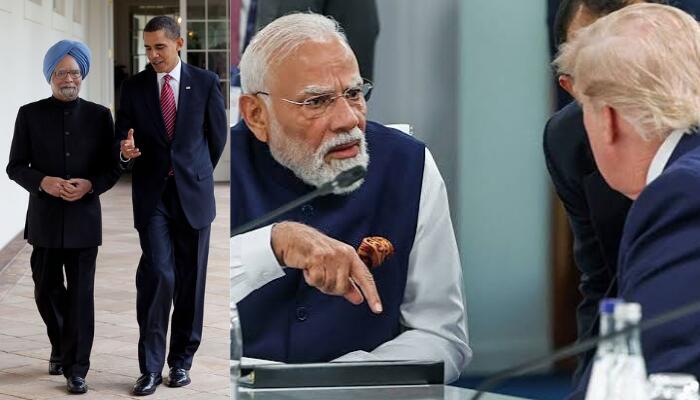
What began as a familiar social media controversy over Prime Minister Narendra Modi’s choice of words has quickly shifted into a wider discussion on diplomatic protocol and political consistency.
Congress leaders, including Supriya Shrinate, criticised Modi for referring to US President Donald Trump as “Your Excellency” during an official interaction. The comment was projected by critics as unnecessary deference and soon became part of a broader online debate questioning the Prime Minister’s diplomatic style.
However, the narrative did not hold for long.
A video from an earlier diplomatic engagement resurfaced online, showing former Prime Minister Manmohan Singh using the same expression while addressing then US President Barack Obama. The clip, widely circulated on social media, altered the tone of the discussion and brought attention back to established diplomatic practice.
A Standard Diplomatic Form, Not a Political Statement
“Your Excellency” is a conventional form of address used in international diplomacy for heads of state and government. It is part of long-standing protocol that governs formal interactions between nations and is not tied to personal admiration or political alignment.
Such expressions are commonly used to maintain decorum in official settings and reflect mutual recognition between sovereign offices. Leaders across political systems have historically followed these conventions, regardless of domestic political differences.
Seen in that light, the phrase used by Modi aligns with established diplomatic practice rather than representing any deviation from it.
The Manmohan Singh Example Changes the Context
The resurfacing of Manmohan Singh’s remarks has become central to the debate because it introduces precedent into what was initially framed as a political critique.
If the same expression was acceptable when used by a Congress Prime Minister during an interaction with Barack Obama, it raises a straightforward question about the basis on which its use by Modi is being criticised today.
The comparison has shifted the focus from individual conduct to consistency in political judgment, particularly in how diplomatic protocol is interpreted across different administrations.
A Familiar Pattern in Political Discourse
The episode reflects a broader pattern in public debate where routine diplomatic or administrative practices are often recast as controversies depending on the political context.
While scrutiny of leadership is a normal part of democratic functioning, such scrutiny loses clarity when established conventions are selectively interpreted.
In this case, the historical record has become central to the conversation. Once Manmohan Singh’s example entered the frame, the controversy around Modi’s remarks moved away from protocol and towards perception, leaving little disagreement on what the diplomatic norm actually is.