
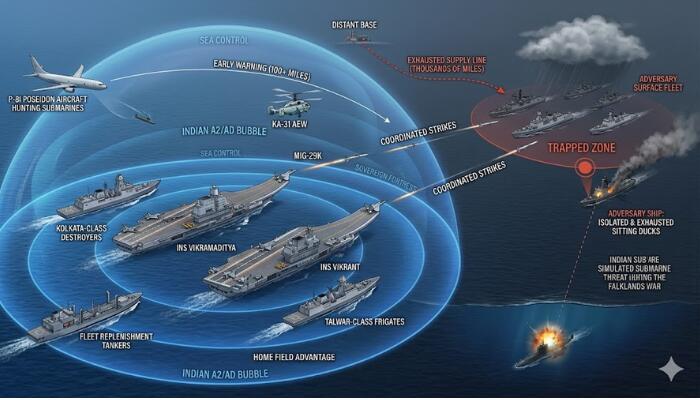
In the anarchic world of international politics, states care above all about survival. To ensure survival, they seek relative power. The debate over naval power today suffers from a major flaw. Many analysts believe aircraft carriers are obsolete targets, doomed by land-based Anti-Access/Area Denial (A2/AD) missiles. They focus too much on crowded coastal waters and assume all oceans operate by the same rules. This view ignores geography and misunderstands the Indian Ocean Region (IOR). The strategic reality is the exact opposite. An Indian Carrier Battle Group (CBG) is not a vulnerable target. It is a mobile A2/AD bubble. It turns the open ocean into a sovereign fortress.
Geography limits what militaries can do. Large bodies of water possess a stopping power that weakens fleets as they travel farther from their home shores. This concept dictates that a military force loses strength and offensive capability as its supply lines stretch over thousands of miles of open water. To protect its trade routes in the IOR, an adversary must project power thousands of miles away from its local bases. It must push its ships through narrow chokepoints like the Malacca Strait. During a war, the adversary lacks reliable ports or land routes in the region.
Therefore, the adversary’s surface fleet is forced to operate alone, at the very end of a stretched and broken supply line. Without secure logistics, projecting military might across the ocean becomes nearly impossible. The adversary enters the arena already exhausted, lacking the land-based air cover that protects its ships close to home.
India, however, operates with a massive home-field advantage. India’s navy makes use of the carrier force, including INS Vikramaditya and INS Vikrant to exercise sea control. One aircraft carrier is not enough to perform operations alone. Instead, it becomes the heart of a Carrier Battle Group, making it difficult for any other fleet of rival countries to reach it.
The formation includes such vessels as Kolkata-class destroyers, Talwar-class frigates, and fleet tankers to enable sustained operations over long distances. Recently, the military has been able to show in exercise like Milan 2024 its ability to operate two carriers simultaneously in a coordinated way. It shows the ability of the navy to conduct sea control across vast stretches of ocean waters. Sea control implies defining whose movements are allowed and which should be restricted; it is an ideal option than merely defending oneself.
The aircraft carrier plays a significant role by providing a mobile base and command post. The MiG-29K fighter planes take off from there to ensure air superiority, anti-ship strike, and protection of patrol planes. The fleet depends on the Ka-31 helicopter to provide aerial radar warning. Meanwhile, shore-based P-8I aircraft hunt enemy submarines while operating safely under the carrier’s fighter cover. Because the P-8I operates within this protective bubble, it cannot be targeted by the enemy’s distant land-based jets.
Weaker powers use submarines for sea denial. They hide in the water to sink ships. But submarines cannot control the sea, and they cannot protect friendly surface ships from air attacks. A submarine cannot shoot down an incoming fighter jet or establish a safe zone for its own supply vessels. When an adversary fleet enters the IOR, it is trapped inside the Indian carrier’s exclusion zone.
This logic was proven in the Falklands War, where British submarines and the carrier task force together established a total exclusion zone, with submarines sinking Argentine ships that ventured within range — most notably the ARA General Belgrano, which was torpedoed by HMS Conqueror — and forcing the enemy surface fleet to withdraw entirely from the operational area. The Indian Navy scales this concept up.
The enemy fleet has no land-based fighters to protect it. Its radar cannot see past the curve of the earth. In contrast, the Indian CBG uses Ka-31 helicopters to detect threats at ranges of over a hundred miles. If the adversary fires missiles, the Indian destroyers use the Barak-8 missile system to shoot down targets before they get close. The system’s active radar seeker provides all-weather, day-and-night protection against complex saturation attacks.
The carrier then launches MiG-29K fighters. These fighters control the sky and protect shore-based P-8I planes, which systematically hunt and destroy the enemy’s submarines. Without air cover, the adversary’s surface ships are essentially sitting ducks for coordinated strikes. The MiG-29K fighters can safely launch their own anti-ship weapons from a distance, long before the enemy vessels can even spot the carrier on their radar screens.
The logic of great power conflict is unforgiving. You cannot win a naval battle without secure logistics and air cover. By operating in the vastness of the IOR, an Indian carrier strike group completely nullifies the adversary’s land-based advantages. It forces them to fight thousands of miles from home under an umbrella of Indian air superiority. The strategic takeaway is absolute. Entering the IOR during a conflict is a suicide mission for your surface fleet.