
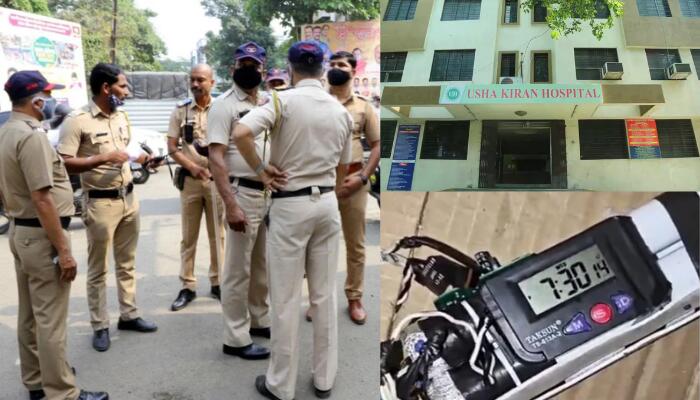
The latest incident surfaced in Pune’s Hadapsar area this evening. Authorities recovered a live low-intensity Improvised Explosive Device from Usha Kiran Hospital. Police said the device contained explosive material, wires, and a functioning timer set for seven hours.
Doctors and hospital staff discovered the object inside a washroom on the second floor. Panic spread quickly across the premises after the discovery.
Bomb Detection and Disposal Squad teams, dog squads, fire brigade personnel, and senior police officers rushed to the hospital. Officials sealed the area immediately. The squad later shifted the device to an open field near a gliding centre and neutralised it through a controlled operation.
Pune Police Commissioner Amitesh Kumar confirmed that investigators had recovered a low-grade explosive IED. He said Crime Branch officials, ATS teams, and local police had launched a probe on a “war footing”. Investigators are examining every possible angle, including terrorism.
Dr Vilas Gaikwad from the hospital said, “The object contained rods connected through wires to a timer mechanism”. Preliminary findings reportedly confirmed that the device was live and not a hoax meant only to create panic.
Eyewitnesses Describe Suspicious Movement
NCP MLA Chetan Vitthal Tupe claimed eyewitnesses saw a man arrive near the hospital in a car before entering briefly and leaving soon afterwards. Police are now scanning CCTV footage and tracing vehicle movement around the area.
Investigators are also questioning hospital employees, doctors, and staff members. They want to determine how someone placed an explosive device inside a functioning medical facility without detection.
The Pune recovery becomes even more serious because it follows another explosive scare linked to Prime Minister Narendra Modi’s Bengaluru visit on May 10.
Explosive Material Found Near PM Route
On the day of the Prime Minister’s visit, Bengaluru Police received a phone call claiming someone had planted a bomb near the convoy route.
Hours later, police recovered gelatin sticks from the Kaggalipura area near the venue of the Art of Living Foundation programme. Three days later, investigators found more suspicious material inside a cardboard box. The box reportedly contained batteries, wires, an electronic timer, an LCD display and circuit components capable of triggering an explosion.
Police suspect the perpetrators failed to assemble the triggering mechanism properly before abandoning the material.
The discovery alarmed agencies because the suspicious package lay close to the highway expected to carry the Prime Minister’s convoy. Authorities later detained a suspect from Koramangala as the investigation widened.
Officials are now scanning CCTV footage across Bengaluru and probing possible interstate links extending into neighbouring states. Central agencies, including the Intelligence Bureau and National Investigation Agency, have reportedly joined the probe.
Delhi Alert Deepens Security Concerns
The developments became even more alarming after intelligence agencies issued a terror alert in Delhi days earlier.
According to reports, agencies warned about possible firing incidents and suicide attacks in the national capital. Authorities tightened security around the BJP headquarters and several sensitive government installations soon afterwards.
Viewed separately, each incident may appear limited. Together, however, they reveal a worrying pattern.
A hospital in Pune. Explosive material near the Prime Minister’s route in Bengaluru. Terror warnings in Delhi. The sequence points towards attempts to exploit civilian spaces, test response systems, and create fear through low-cost but high-impact operations.
Security experts have repeatedly warned that hostile networks no longer rely only on large-scale attacks. Repeated bomb scares, timer-based devices, and suspicious recoveries can themselves become tools of intimidation and psychological pressure.
India has witnessed similar warning signs before, including the Bengaluru stadium blasts, the Pune bombings, and recent low-intensity IED attacks targeting crowded public spaces.
Investigators have not officially linked the latest incidents. Agencies continue to probe each case independently. However, the timing, sophistication, and repeated use of explosive material across major cities have raised difficult questions for India’s security establishment.
No casualties occurred in Pune because bomb disposal teams acted quickly. Yet the repeated emergence of explosive devices, terror warnings, and suspicious activity near sensitive locations underlines a larger reality. India’s internal security ecosystem is once again under pressure.
At a time when hostile forces and disruptive networks continue searching for vulnerabilities, the country cannot afford complacency. Stronger surveillance, tighter intelligence coordination, and uncompromising counter-terror vigilance are now essential.