
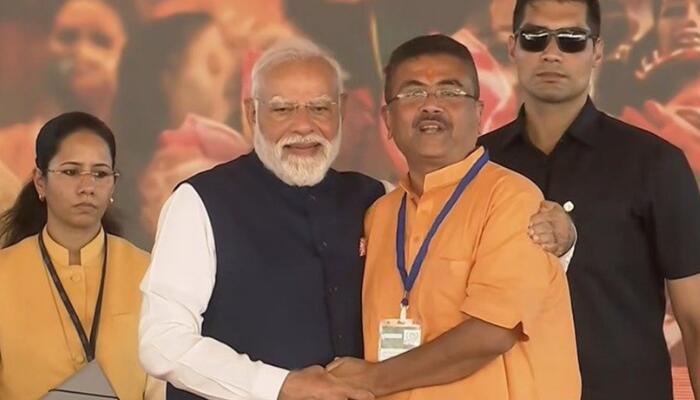
West Bengal witnessed a political moment few believed possible a decade ago. Suvendu Adhikari took oath as the state’s first Bharatiya Janata Party chief minister, formally ending the Trinamool Congress’s uninterrupted 15-year rule and marking the BJP’s most significant breakthrough in eastern India.
The ceremony at Kolkata’s Brigade Parade Grounds carried the weight of far more than a routine government formation. Prime Minister Narendra Modi, Union ministers Amit Shah, Rajnath Singh, JP Nadda and Dharmendra Pradhan attended the swearing-in, alongside NDA chief ministers including Himanta Biswa Sarma, Manik Saha, Rekha Gupta and Pushkar Singh Dhami. The BJP’s central leadership clearly treated Bengal not as another state victory, but as a defining ideological and political conquest.
The scale of the mandate reflected that shift. The BJP secured 207 Assembly seats, while the Trinamool Congress was reduced to 80 after dominating Bengal politics for over a decade and a half. The election also witnessed record-breaking voter participation, with polling percentages crossing 92 percent across phases.
A Cabinet Built Around Bengal’s Social Faultlines
The first cabinet under Adhikari sends a sharp political signal. Rather than relying solely on heavyweight faces, the BJP has attempted to build a ministry around caste equations, regional outreach and community representation. Every major inclusion reflects a deeper electoral calculation.
Dilip Ghosh’s induction was expected. The former state BJP president remains one of the architects of the party’s grassroots rise in Bengal after 2014. A long-time RSS pracharak and a strong OBC face, Ghosh transformed the BJP from a marginal force into the Trinamool’s principal challenger. His entry into the cabinet rewards organisational loyalty and ideological consistency.
Agnimitra Paul’s inclusion carries both symbolic and political significance. The two-time MLA from Asansol Dakshin emerged as one of the BJP’s most visible women campaigners during the 2026 election battle. She retained her seat with a margin of over 40,000 votes against the TMC’s Tapas Banerjee. Before joining politics in 2019, Paul built a successful fashion career in Kolkata and designed outfits for actors such as Sridevi and Hema Malini. Her cabinet entry reflects the BJP’s effort to blend urban appeal with cultural rootedness.
Yet, the larger story lies beyond Kolkata.
BJP Expands Its Bengal Coalition
Kshudiram Tudu’s rise from the tribal belts of Junglemahal to the state cabinet underlines the BJP’s aggressive tribal outreach strategy. The first-time MLA from Ranibandh won by more than 52,000 votes in a Scheduled Tribe-reserved constituency. His induction signals the BJP’s determination to consolidate support in Bankura, Purulia and Jhargram, regions where tribal dissatisfaction played a major role in reshaping Bengal’s political landscape.
Ashok Kirtania’s inclusion gives representation to the influential Matua community, particularly in North 24 Parganas. The BJP has invested heavily in Matua politics over the past several years, recognising the community’s electoral significance in border districts.
Nisith Pramanik, meanwhile, strengthens the party’s hold over north Bengal. A former Union minister of state and one of the BJP’s youngest leaders, Pramanik represents the Rajbanshi community and commands considerable influence among youth workers in the region. Like Adhikari, he too crossed over from the Trinamool Congress before becoming a key BJP face.
The cabinet may currently appear compact, but politically it is expansive in intent. With the constitutional limit allowing up to 44 ministers, the BJP still has room to broaden representation further. However, the first list itself reveals the party’s central calculation.
Fifteen years after Mamata Banerjee redrew Bengal’s politics, the BJP now appears determined to redraw Bengal’s social coalition itself. Suvendu Adhikari’s first cabinet makes one thing clear: the saffron party is no longer fighting for space in Bengal. It is preparing to dominate it.