
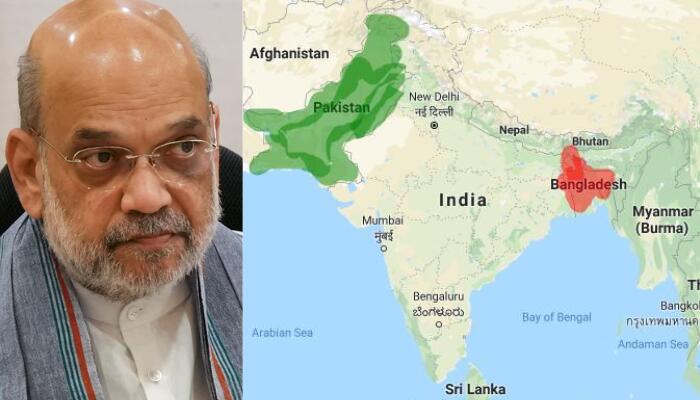
Union Home Minister Amit Shah announced a sweeping “Smart Border” project to strengthen India’s borders with Pakistan and Bangladesh. The Centre aims to complete the project within the next year. Consequently, the nearly 6,000-kilometre frontier will turn into a heavily monitored security zone.
Speaking at the BSF Rustamji Memorial Lecture and Investiture Ceremony in Delhi, Shah said the government would deploy drones, radars, smart cameras, and advanced surveillance systems across infiltration-prone sectors. According to him, the initiative marks a major shift in India’s border security strategy.
The Home Minister said the government no longer views infiltration as a routine law-and-order issue. Instead, the Centre now links illegal entry to narcotics trafficking, fake currency rackets, and attempts to alter the demographic balance of border regions.
“We must recognise the dangers ahead,” Shah said while warning against organised infiltration networks operating along the Pakistan and Bangladesh borders. Furthermore, he reiterated the government’s hardline position on illegal entry. He declared that authorities would identify and expel “every single infiltrator” from the country.
India Moves Towards a Technology-Led Border Security Model
The Smart Border Project will rely on continuous surveillance and rapid-response monitoring systems. Shah said drones and radar systems would strengthen real-time tracking in vulnerable areas. Similarly, smart cameras would improve round-the-clock vigilance.
The announcement signals a major change in India’s border management approach. For decades, security forces depended mainly on fencing, manpower, and physical patrols. Now, however, the Centre wants a technology-led deterrence system capable of detecting infiltration attempts faster and with greater accuracy.
Shah said the government would build a “strong security grid” during the 60th year of the Border Security Force. In addition, he urged closer coordination between the BSF, state police, district administrations, and local intelligence units to dismantle infiltration routes and smuggling networks.
The Home Minister specifically referred to West Bengal, Assam, and Tripura while discussing border security cooperation. He said the governments in these states support stricter anti-infiltration measures. Meanwhile, the Ministry of Home Affairs will soon hold meetings with the chief ministers of these states to prepare a coordinated strategy.
Drone Smuggling and Demographic Concerns Drive Security Push
Shah’s remarks come amid rising concern over drone-assisted smuggling along India’s western frontier. Security agencies have reported increasing attempts to transport narcotics, weapons, and fake currency through drone networks operating from across the Pakistan border.
Against this backdrop, Shah is expected to visit Rajasthan’s border district of Bikaner on May 25 and 26. During the visit, he is likely to inspect BSF outposts and review surveillance infrastructure in sensitive sectors.
Officials are also preparing for high-level meetings involving district collectors, senior police officers, and intelligence agencies from Rajasthan’s border districts, including Sri Ganganagar, Jaisalmer, Barmer, and Hanumangarh.
In another significant announcement, Shah said the Centre would soon launch a “high-powered demography mission” to monitor demographic changes in border regions. As a result, security agencies are expected to receive stronger institutional support in tracking infiltration-related threats.
Drawing comparisons with the Centre’s anti-Naxal operations, Shah argued that India cannot merely contain national security threats. Rather, the government must eliminate them completely. Friday’s announcement makes it clear that India’s border doctrine is entering a far more aggressive and technology-driven phase.