
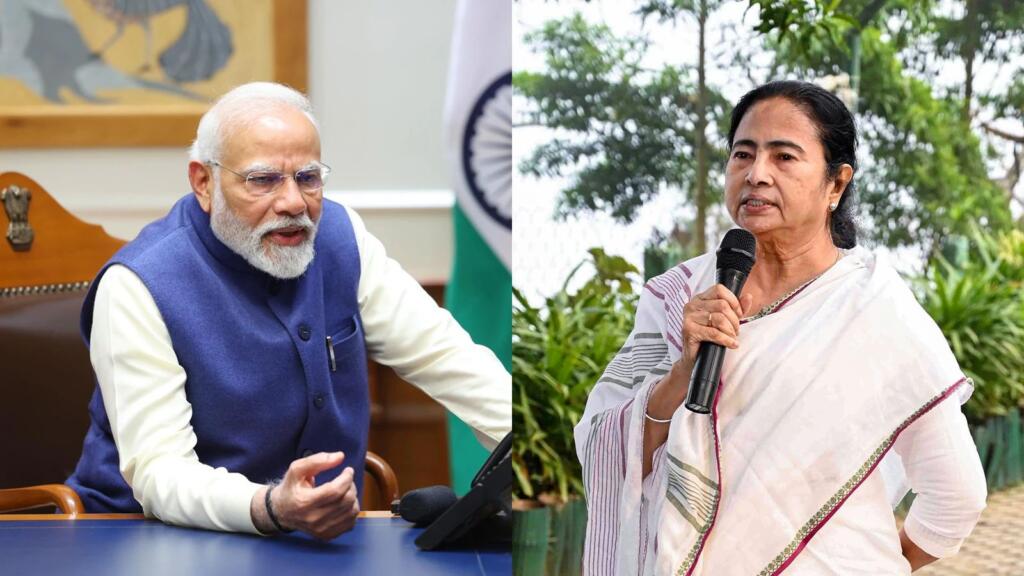
In a political earthquake that has shattered decades of established norms, the Bharatiya Janata Party (BJP) has breached the “fortress” of West Bengal, hurtling past the 200-seat mark to unseat Mamata Banerjee’s Trinamool Congress (TMC).
The mandate, emerging from one of the most fiercely contested battles in Indian democratic history, signals a paradigm shift in the politics of the East.
Simultaneously, the Southern states have delivered their own shockwaves, with superstar Vijay’s political debut upending traditional calculations in Tamil Nadu and the Congress-led UDF reclaiming its dominance in the coastal bastion of Kerala.
The Bengal Saffron Tide: Crossing the 200 Threshold
The story of the hour remains the massive surge of the BJP in West Bengal. What started as a focused campaign by the central leadership has culminated in a landslide victory, with the saffron party crossing the 200-seat mark in the 294-member assembly.
For Chief Minister Mamata Banerjee, the “Didi” of Bengal, the results represent a historic setback after three terms of dominance. The statistical shifts throughout the counting day were dramatic.
Early trends showed a neck-and-neck fight in the rural heartlands, but as the day progressed, the BJP’s consolidation of the Matua community and the Rajbongshi votes in North Bengal created an unassailable lead.
The TMC’s reliance on its traditional urban strongholds and the minority vote proved insufficient to counter the BJP’s aggressive “Parivartan” (Change) narrative.
Political analysts note that the BJP’s vote share saw a massive jump of nearly 12% from previous assembly elections, effectively siphoning off the remnants of the Left-Congress alliance and a significant chunk of the anti-incumbency sentiment.
The “Ma, Mati, Manush” slogan, which once echoed through the streets of Kolkata, struggled against the BJP’s promises of “Shonar Bangla” (Golden Bengal).
Key issues such as internal migration, local corruption at the panchayat level, and the promise of Central welfare schemes directly reaching the beneficiaries seem to have tilted the scales. The BJP successfully framed the contest as a fight between “local aspirations” and “national integration,” eventually breaching even the TMC’s South Bengal bastions in districts like Hooghly and North 24 Parganas.
The Trinamool Congress (TMC) finds itself fighting for survival after a 15-year reign that has defined West Bengal’s modern political era. This election, however, is being fought on a drastically altered landscape. For the first time, the state went to the polls following a massive and controversial “Special Intensive Revision” (SIR) of the electoral rolls.
This process saw a record-breaking deletion of nearly 90 lakh names, a move that sparked a political firestorm, with the opposition hailing it as a “sanitization of illegal voters” and the ruling party decrying it as a deliberate attempt to disenfranchise its core support base.
PM Modi Hails BJP’s Mandate in WB
In a crowning moment that signifies a historic shift in India’s regional politics, Prime Minister Narendra Modi hailed the BJP’s decisive mandate in West Bengal as a definitive victory for the “politics of good governance.”
Expressing deep gratitude to the electorate, the Prime Minister noted that the “Lotus has bloomed” in the East, marking the end of a long-standing political era and the beginning of a new chapter centered on development and transparency.
“The Lotus blooms in West Bengal! The 2026 West Bengal Assembly Elections will be remembered forever. People’s power has prevailed and BJP’s politics of good governance has triumphed. I bow to each and every person of West Bengal,” says PM Narendra Modi on BJP’s big Bengal victory.
“The people have given a spectacular mandate to BJP and I assure them that our Party will do everything possible to fulfil the dreams and aspirations of the people of West Bengal. We will provide a Government that ensures opportunity and dignity to all sections of society,” he says.
“BJP’s record win in West Bengal would not be possible without the efforts and struggles of countless Karyakartas over generations. I salute them all. For years, they have worked hard on the ground, overcome all sorts of adversities and spoken about our development agenda. They are the strength of our Party,” the PM adds.
Vijay’s TVK Stuns the Dravidian Heartland
While the East turned saffron, the South witnessed a cinematic entry into real-world governance. In Tamil Nadu, the arrival of Thalapathy Vijay and his party, the Tamilaga Vettri Kazhagam (TVK), has disrupted the long-standing DMK-AIADMK duopoly.
Breaking away from the “outsider” tag often given to actors entering politics, Vijay’s grass-roots mobilization and focus on youth-centric policies have garnered him a significant seat share, effectively playing the role of a kingmaker.
His performance is being compared to the historic rise of MG Ramachandran (MGR), as he successfully tapped into a disillusioned voter base that sought an alternative to the established Dravidian giants.
While the DMK maintained a respectable presence, the sheer momentum behind Vijay’s “secular social justice” platform caught the veterans off guard, particularly in the urban districts where the youth vote turned out in record numbers.
By positioning himself against the “corrupt establishment” while maintaining a Dravidian identity, Vijay has successfully carved out a “third way” that many believed was impossible in Tamil Nadu’s polarized environment.
Congress Resurgence in God’s Own Country
In Kerala, the tradition of “alternating power”which was briefly broken in the previous cycle has returned with a vengeance. The Congress-led United Democratic Front (UDF) has convincingly defeated the Left Democratic Front (LDF).
The results indicate a strong endorsement of the Congress’s local leadership and its focus on the agrarian crisis, the rubber price collapse, and the state’s mounting fiscal debt.
The UDF’s sweep is seen as a major morale booster for the national Congress party. In a state where the BJP has been trying to make inroads, the Congress proved that its regional machinery remains robust.
By consolidating the minority vote alongside a significant section of the middle-class Hindu vote concerned about the state’s economy, the UDF managed to reclaim the Secretariat in Thiruvananthapuram.
As the final tallies are verified, the Indian political map looks vastly different. The BJP’s entry into the 200-plus club in Bengal is not just a victory; it is a declaration of their status as the new primary pole of Bengal politics.
Meanwhile, the South continues to experiment with new identities, proving that the Indian voter remains as unpredictable as ever. The dust will settle, but the lessons from this election, of anti-incumbency, the power of stardom, and the resilience of traditional alliances will shape the next decade of Indian governance.