
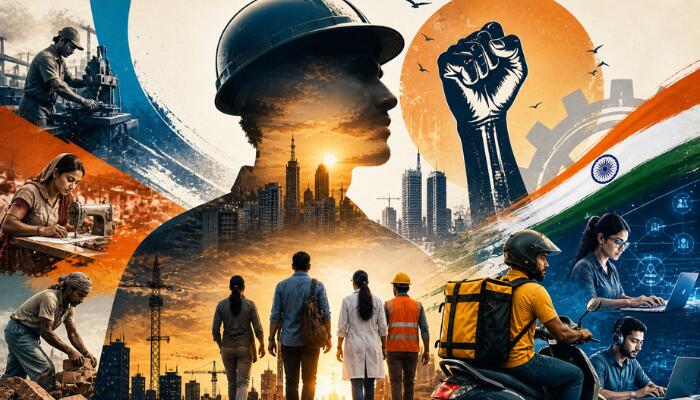
International Labour Day 2026 is being observed across India on May 1, rooted in a history of sacrifice yet increasingly defined by a future of reform and opportunity. The day traces its origins to the 1886 Haymarket movement in Chicago, where workers demanding an eight-hour workday faced violent repression. Their struggle reshaped global labour rights and turned May 1 into a lasting symbol of resistance.
However, India in 2026 is no longer confined to that legacy of resistance alone. It is actively rewriting the narrative.
India’s labour movement formally began in 1923 in Madras under Malayapuram Singaravelu Chettiar, when the red flag was raised for the first time, marking a defining moment in the assertion of workers’ rights. In the decades that followed, legislation such as the Industrial Disputes Act of 1947 and the Minimum Wages Act of 1948 laid the foundation for worker protection in independent India.
From Tokenism to Transformation
For decades, labour in India remained trapped between rigid laws and political tokenism, where slogans often replaced solutions, and reforms moved at a cautious pace. Labour Day, in many ways, became more about ceremonial observance than structural change.
Even today, statements like that of MDMK leader Durai Vaiko, who termed making May 1 a central holiday his “greatest achievement”, reflect how the discourse often circles symbolic milestones. Yet, the real shift is unfolding beyond these claims.
In recent years, India has moved decisively towards structural reform. The introduction of consolidated labour codes represents a serious attempt to simplify outdated frameworks, improve compliance, and extend social security to millions, especially those in the unorganised sector.
Unlike the past, where labour policy often lagged behind economic ambition, the current approach seeks to align the two. Growth and worker welfare are no longer treated as competing priorities but as parallel drivers of national progress.
A New Workforce Driving a New Economy
India’s labour landscape today is undergoing a fundamental transformation. The rise of digital platforms, start-ups, and the gig economy has opened new avenues for employment and income generation.
For Gen Z, stepping into a world of start-ups, side hustles, and platform-based work, labour is no longer about fixed hours and guaranteed stability. It is about navigating opportunity in uncertainty, where flexibility often comes before security and ambition moves faster than policy.
Delivery partners navigating dense city traffic, app-based drivers chasing daily earnings, and freelancers working across digital platforms are no longer peripheral figures. They are central to India’s economic engine.
For millions who still measure their day in hours worked rather than rights secured, these opportunities represent both hope and challenge. While flexibility has increased, the need for stronger social security frameworks remains urgent. The difference now, however, is that the conversation has shifted from neglect to reform.
Simultaneously, large-scale investments in infrastructure, manufacturing, and innovation are generating employment across sectors, reinforcing the idea that labour is not just a beneficiary of growth but a contributor to it.
Beyond Wages: The Next Frontier of Labour Rights
This year’s theme, “Ensuring a Healthy Psychosocial Working Environment”, reflects a deeper evolution in labour discourse. The focus has expanded beyond wages and working hours to include mental health, work-life balance, and dignity at the workplace.
In a technology-driven, always-connected world, this shift is critical. The modern worker is not just facing physical demands but also psychological pressures that require equal attention.
The India Shift
Labour Day was born out of protest, shaped by sacrifice, and sustained through struggle. But India in 2026 is attempting something more ambitious. It is transforming that legacy into a framework for progress.
The journey from factory floors to digital platforms tells a clear story. India is not discarding the past. It is building on it, strengthening it, and adapting it to the realities of a changing world.
Because the real question is no longer whether India celebrates Labour Day, but whether it is redefining what labour itself means in the 21st century.
And in a rising India, labour is no longer just the backbone of the economy; it is fast becoming the force that defines its future.