
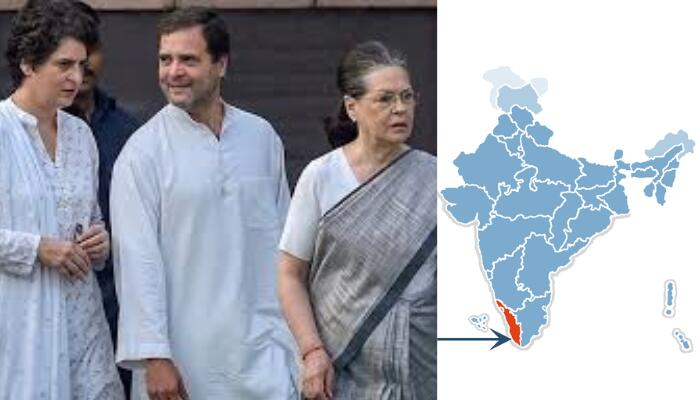
The Congress party may have won the election in Kerala, but it still appears incapable of doing the one thing a victorious political formation is expected to do immediately: form a government with clarity, authority, and confidence.
More than a week after the Congress-led United Democratic Front secured a comfortable majority in the state, Kerala continues to remain without a formally declared Chief Minister. What should have been a moment of political consolidation has instead turned into a public spectacle of factional bargaining, leadership lobbying, and endless consultations between the Kerala unit and the Delhi high command.
In today’s political climate, such delays are not interpreted as democratic consultation. They are interpreted as a weakness.
The contrast with developments in neighbouring states has only amplified the embarrassment for Congress.
In Tamil Nadu, Vijay moved rapidly after the verdict. Despite difficult political arithmetic, his camp secured support, crossed procedural hurdles, and projected administrative authority before rivals could even reorganise themselves. The BJP too acted with its characteristic speed in states where it formed governments. Leadership decisions were finalised quickly, oath ceremonies followed immediately, and governance machinery was activated without visible confusion.
Kerala alone has become a theatre of Congress-style paralysis.
Congress Falls Into the Same Trap Yet Again
The problem is no longer accidental. It has become structural.
Every time Congress moves close to power, internal factions begin competing before governance even starts. Leaders focus on influence, cabinet equations, and organisational control while the momentum of electoral victory slowly slips away.
That is precisely what Kerala is witnessing now.
Instead of projecting confidence after a decisive mandate, Congress has projected uncertainty. Multiple senior leaders are reportedly lobbying for the top post, while the party high command struggles to balance competing camps without triggering a rebellion within the state unit.
The leadership battle involving V D Satheesan, K C Venugopal, and Ramesh Chennithala reportedly became so intense that posters supporting rival contenders began appearing across parts of Kerala. The crisis also started spilling beyond Congress’s internal circles, with allies publicly expressing discomfort over the prolonged delay.
The Indian Union Muslim League, one of the UDF’s most influential allies, reportedly signalled support for Satheesan and openly conveyed frustration over the uncertainty surrounding the Chief Ministerial decision. Matters became even more politically damaging when criticism began emerging from outside the alliance as well.
The Nair Service Society questioned outside interference in the CM selection process, while even Congress leaders privately admitted that the prolonged indecision had started overshadowing the alliance’s massive electoral victory.
That admission alone exposed the scale of the damage.
Goa’s Shadow Looms Over Kerala
The unfolding situation in Kerala has also revived memories of Goa, one of the Congress party’s most humiliating political setbacks in recent years.
In Goa, Congress emerged stronger electorally but failed to move with urgency after the verdict. While Congress leaders remained occupied with internal discussions and indecision, rivals acted decisively, consolidated support, and captured power despite weaker numbers.
That episode became symbolic of a larger Congress problem: the inability to convert electoral advantage into political control.
Many political observers now believe Kerala is beginning to reflect the same dangerous pattern.
And if instability emerges tomorrow, Congress leaders will once again raise the familiar slogan of “Operation Lotus”. Critics, however, argue that the BJP often succeeds because Congress leaves itself exposed through delayed decision-making, weak coordination, and leadership confusion.
Politics does not reward hesitation. It punishes it ruthlessly.
Kerala Exposes Congress’s Deeper National Crisis
What is unfolding in Kerala is not merely a state-level leadership dispute. It reflects a deeper organisational crisis within the Congress party itself.
The party wants to position itself nationally as the principal challenger to the BJP. Yet every such episode reinforces the opposite perception. While rival parties increasingly function through discipline, centralised command and rapid political execution, Congress continues to appear weighed down by factional calculations and an indecisive leadership culture.
Even after receiving a clear mandate, the party still looks uncertain about who should occupy the Chief Minister’s chair.
That is not merely a governance issue. It is a crisis of political instinct.
Kerala has therefore experienced more than a temporary delay in government formation. It has once again revealed the Congress party’s oldest political weakness: it often struggles harder to manage victory than it does to fight elections themselves.