
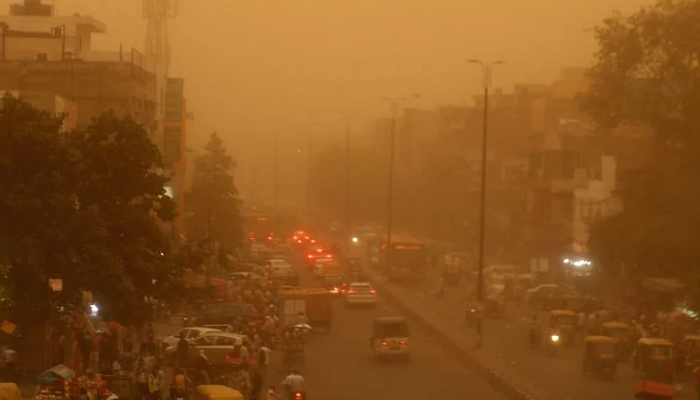
Delhi-NCR is heading into another punishing spell of weather as the India Meteorological Department (IMD) warns of severe dust storms, heatwave conditions and strong winds across North India. Satellite imagery has captured a massive wall of dust and haze moving from Rajasthan and western Haryana towards the national capital. The development has intensified concerns over worsening air quality and volatile pre-monsoon conditions.
The warning comes after Delhi endured nine consecutive days with temperatures above 40 degrees Celsius. On Sunday, the capital recorded a maximum temperature of 43.6 degrees Celsius, nearly 3.4 degrees above the seasonal average. Ridge and Ayanagar emerged as the hottest locations at 44.6 degrees Celsius. Safdarjung, Lodhi Road and Palam also remained trapped in severe heatwave-like conditions.
According to IMD forecasts, weather conditions may worsen between May 28 and May 30. Strong winds reaching nearly 50 kmph are expected across Delhi-NCR. Neighbouring states such as Haryana, Punjab and Uttar Pradesh may witness thunderstorms and winds touching 70 kmph. Weather officials have also warned of possible hailstorms in parts of Uttarakhand, Himachal Pradesh and Jammu and Kashmir.
Desert Dust Sweeps Towards Delhi
Meteorologists tracking the system said, “The dust storm originated in the Thar Desert. Temperatures between 44 and 45 degrees Celsius have dried the desert surface to dangerous levels. Under such conditions, fine sand and dust particles rise easily once strong winds develop.”
As thunderstorm activity intensified over northwest India, powerful downdrafts pushed cold air sharply towards the ground. The impact generated aggressive westerly winds across Rajasthan and Haryana. These winds lifted massive quantities of dust into the atmosphere and created a dense corridor of haze moving towards Delhi-NCR.
Satellite visuals showed very little rain-bearing cloud activity over the capital during the initial phase of the disturbance. Officials said dust and suspended particles would dominate the weather system before moisture-bearing clouds arrive later this week. The storm is expected to intensify between late evening and midnight. Visibility levels may also fall sharply across several parts of Delhi and western Uttar Pradesh.
Heatwave and Dust Trigger Health Fears
The approaching dust storm has deepened concerns over Delhi’s fragile air quality situation. The city’s Air Quality Index slipped into the “poor” category on Sunday evening, with AQI levels recorded at 205. Experts warned that PM10 and PM2.5 concentrations could rise rapidly once the storm reaches peak intensity. The increase may pose serious health risks for people suffering from asthma, respiratory illnesses, and cardiovascular conditions.
The heat has already disrupted normal life across the capital. Roads and marketplaces witnessed thinner crowds during afternoon hours as scorching winds swept through the city. Even vehicle air conditioners struggled to provide relief under the extreme conditions.
Despite the immediate threat, meteorologists believe the unstable weather could eventually bring temporary relief from the prolonged heatwave. Light rain, isolated drizzle, and thunderstorm activity are expected after May 28. Temperatures may dip by six to seven degrees Celsius once rainfall activity intensifies.
Monsoon Advance Under Close Watch
The IMD is also monitoring the advance of the southwest monsoon. The system has already progressed across parts of the Arabian Sea and Bay of Bengal earlier than expected. Current projections suggest the monsoon could formally reach Delhi between June 27 and June 30. Bihar and parts of Uttar Pradesh may begin witnessing monsoon activity after June 15.
For now, Delhi remains caught between blistering heat, dust-laden winds, and unstable weather systems. The capital once again faces the harsher realities of North India’s increasingly unpredictable summer climate.