
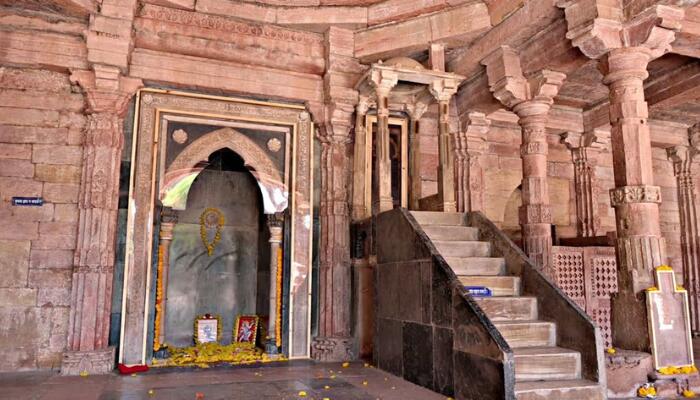
Recently, the Indore Bench of the Madhya Pradesh High Court delivered a historic judgment regarding the Bhojshala dispute located in Dhar. In this decision, the Hindu side received victory. Bhojshala is a living example of the truth that it symbolises India’s power of memory, knowledge, tradition, and cultural tolerance. For nearly the last 120 years, Hindu society and historians have been striving to reaffirm this truth. Judicial process, scientific dedication, and cultural memory, all three together, have made this moment victorious.
As far as history is concerned, the history of Bhojshala begins with the visionary cultural outlook of the Paramara emperor Raja Bhoj of Malwa, who transformed 11th-century Dhar into a unique seat of learning. Ancient literary texts such as Bhojaprabandha, Prabandhachintamani, and the writings of Merutunga describe this complex as a “Saraswati Peeth”, “Vidya Griha,” and “Kavya Sabha”. This was the era when Sanskrit, theatre, architecture, astrology, and grammar flourished in Dhar like a golden stream. Both tradition and textual evidence clearly indicate that between 1034 and 1055 CE, this place was the central hub of Vagdevi worship and higher learning.
The imprint of pre-Islamic history is also clearly visible in the architectural forms. More than a hundred stone pillars presently existing within the complex, carved with distinctly Hindu temple motifs such as kumbha, kalash, gajathara, makarathara, and lotus petals, establish that this was originally a prestigious temple dedicated to a goddess. The Sanskrit, Nagari, and Sharada inscriptions engraved on these pillars correspond to the time markers of the 11th and 12th centuries. The yoni-patta found in the direction of the sanctum, the pedestal base, and fragments of a broken idol confirm that Vagdevi Saraswati was once established here. Several British-era survey accounts, especially the reports of Alexander Cunningham and James Burgess, also described it as a place “constructed from the remains of a classical Hindu temple”.
With time, political changes occurred, and in the 14th century, this complex underwent partial transformation. Arabic and Persian inscriptions engraved on some walls and structures resembling mihrabs certainly indicate that period. However, in the opinion of experts, this was not a systematically constructed new Islamic building, but rather a structure created through the modified use of a pre-existing temple. The irregular use of pillars, the rearrangement of architectural fragments, and the residual lines of sanctum design make this fact even clearer.
Among the archival evidence are more than forty inscriptions in Sanskrit and Nagari, containing Saraswati invocations, poetic verses, donation records, and details related to gurukul traditions. In contrast, some Persian inscriptions refer to this place as “Makan Maula” or “Kamal Maula” and acknowledge that it was built from the stones of an “old structure”. Together, both kinds of inscriptions create a historical picture that the original structure was a centre of higher Sanskrit learning and goddess worship, which was later reused by a subsequent ruling power.
Amidst this rich historical background, in recent years, the question became extremely important as to how the verified restoration of the original identity of this heritage could be achieved. In this context, the decision delivered by the Indore Bench of the Madhya Pradesh High Court is being considered highly historic and far-reaching in impact. The court, while conducting a deep review of archaeological, archival, architectural, and historical evidence, underlined that the character of Bhojshala is not the result of any one historical period, but a luminous remnant of the Paramara-era knowledge tradition, whose authenticity is unanimously established in both Indian and British-era survey reports. The court also recognised that preserving the original identity of this site and carrying out a scientific study of it is in accordance with the broader principles of conserving national heritage, a process which the Archaeological Survey of India has systematically undertaken for years.
This decision received an extremely positive, emotional, and celebratory response in society. Citizens deeply connected with knowledge, culture, and tradition described it as a “moment of justice in history”. In Dhar, Indore, Ujjain, and many towns of the Malwa region, people welcomed the judgment through lamp lighting ceremonies, flower showers, and cultural processions. Educational institutions, traditional centres of learning, Vedic schools, and cultural organisations described it as an important step towards the honour and revival of India’s knowledge tradition. Especially among the younger generation, there was a visible sentiment that the judiciary had strengthened cultural confidence by delivering a decision based on history, knowledge, and truth.
This welcome was not merely an emotional reaction; it was also widespread because people felt that the remembrance of a centuries-old tradition of learning is not merely a matter of faith, but a question of continuity in Indian knowledge consciousness. The Bhojshala decision was also considered important because it viewed history neither through the lens of hostility nor through the narrow boundaries of political interpretation, but instead honoured the foundational truth through evidence-based, study-oriented, and classical evaluation.
After this judgment, new energy and enthusiasm for research regarding Bhojshala can be seen. New doors are opening for archaeological study, script analysis, comparative architecture, and cultural reinterpretation. Many scholars are viewing this as an opportunity to restore continuity in India’s knowledge tradition. Bhojshala is now re-emerging not merely as a memory of the past, but as a symbol of cultural self-respect and intellectual values in present-day Indian society, a place where the layers of different civilisational eras together teach us that preserving the original voice of history is itself proof of the intellectual maturity of any nation.