
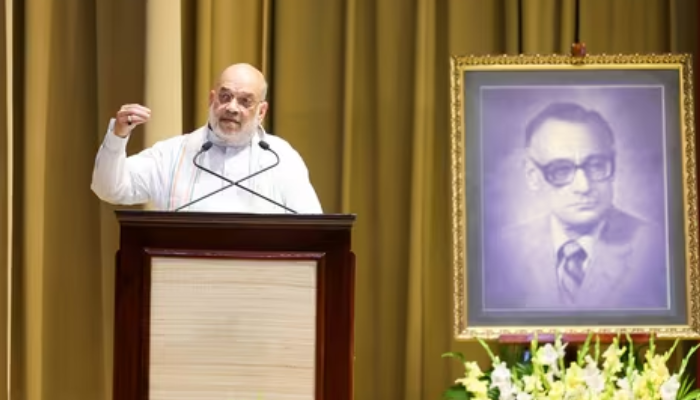
Union Home Minister Amit Shah has called on countries to build a unified global legal framework to tackle narcotics trafficking. He said drug cartels are actively exploiting differences in national laws to expand their operations. He made these remarks at the R. N. Kao Memorial Lecture 2026 in New Delhi, organised by the Research and Analysis Wing.
At the outset, Shah described narcotics as a borderless threat. Therefore, he said, countries cannot address it in isolation. India, he added, has set a national goal of achieving a “Drug-free India by 2047” under a strict zero-tolerance policy. In this context, he stressed that no narcotics should enter or transit through Indian territory.
Narcotics and expanding security risks
Moreover, Shah said drug trafficking is no longer limited to law and order enforcement. Instead, it now sustains organised crime, terrorism and parallel financial systems. As a result, drug money strengthens criminal networks and deepens long-term instability across societies.
In addition, he pointed to the human cost of drug abuse. While financial and security dimensions receive attention, he said the physical and social damage often remains under-emphasised.
Push for legal alignment across countries
Furthermore, Shah urged nations to align their narcotics control laws. He called for a common definition of banned substances across jurisdictions. He also pushed for standardised punishment systems for trafficking offences.
Similarly, he emphasised the need to streamline extradition processes for drug kingpins. At the same time, he underlined the importance of real-time intelligence sharing between countries. Otherwise, he warned, cartels will continue to shift operations across borders by exploiting legal gaps.
Urgency and global scale of the challenge
Meanwhile, Shah stressed that delays in coordinated action will deepen the crisis. He referred to the global scale of the issue, involving 195 countries and extensive international borders. Clearly, he said, fragmented responses cannot match the speed and reach of organised drug networks.
Consequently, he warned that if nations fail to act now, the world may find it impossible to reverse the damage within the next decade.
India’s enforcement push and cooperation
On the enforcement front, Shah said Indian agencies have developed a structured roadmap to dismantle drug syndicates operating across borders. In parallel, India has strengthened cooperation with friendly countries to improve outcomes.
Over the past two years, he noted, India has brought back more than 40 transnational criminals with international assistance. While this reflects progress, he said sustained cooperation remains essential for long-term success.
Finally, the lecture was held in memory of R. N. Kao, founder of R&AW. It brought together diplomats from more than 40 countries, along with members of India’s security establishment and the family of R N Kao, highlighting the diplomatic weight of India’s call for a coordinated global response.