
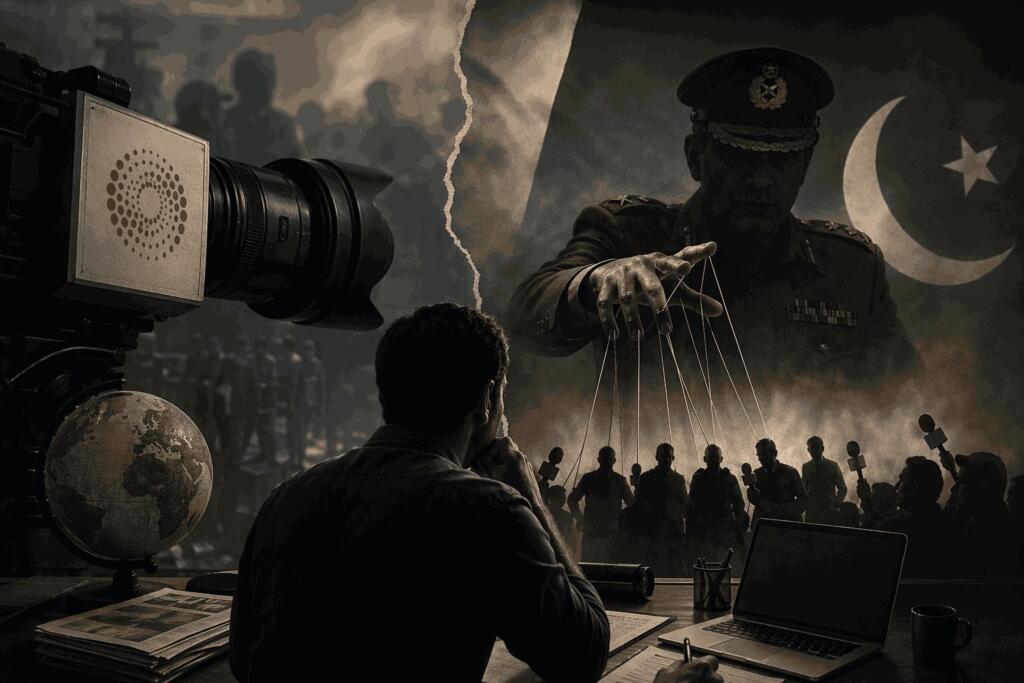
The credibility of global news agencies rests on a fragile but essential foundation: trust. When that trust is shaken, the consequences ripple far beyond headlines. A recent controversy sparked by a viral post from journalist Snehesh Alex Philip has reignited debate over whether Reuters—once synonymous with sober, fact-driven reporting—has drifted into dangerously questionable territory. The allegation is stark: that Reuters, in certain instances, appears less like an independent news organization and more like a mouthpiece aligning suspiciously with narratives favored by the Pakistan Army.
At the heart of this controversy lies a broader issue—how international media frames conflict narratives, especially in geopolitically sensitive regions like South Asia. Reuters has long enjoyed a reputation as a neutral arbiter of facts, relied upon by governments, corporations, and millions of readers worldwide. However, neutrality is not merely about presenting “both sides”; it demands rigorous scrutiny, contextual depth, and a refusal to amplify unverified or strategically motivated claims. When reporting begins to echo one side’s institutional messaging without sufficient interrogation, the line between journalism and propaganda begins to blur.
Critics argue that Reuters has, on multiple occasions, reproduced narratives emerging from Pakistani military or intelligence-linked sources with insufficient skepticism. While access journalism—relying on official sources—is a common practice, it becomes problematic when such sources are treated as inherently credible, particularly in a region where information warfare is an established reality. The Pakistan Army, like many powerful institutions, has a vested interest in shaping global perception. Any international outlet that inadvertently amplifies its messaging without adequate scrutiny risks becoming complicit in that effort.
The post by Snehesh Alex Philip did not emerge in a vacuum. It reflects a growing frustration among observers who believe that Western media organizations often misread—or worse, underplay—the complexities of South Asian geopolitics. This is not merely about one report or one headline; it is about patterns. When language softens accountability, when context is stripped away, and when narratives are framed in ways that obscure ground realities, the end result is a distorted picture presented to a global audience.
Reuters, to its credit, operates under immense pressure to deliver fast, globally relevant news. But speed cannot come at the cost of accuracy or depth. In conflict reporting, nuance is not optional—it is essential. A single misleading headline or poorly contextualized report can reinforce false equivalences or legitimize questionable claims. In such scenarios, the responsibility of a global agency is not just to report, but to interrogate.
Defenders of Reuters might argue that accusations of bias are often politically motivated, especially in polarized environments. That is a fair point. However, the solution is not dismissal but introspection. Transparency in sourcing, clearer attribution, and a willingness to revisit and correct narratives are essential to maintaining credibility. Journalism, after all, is not infallible—but it must be accountable.
The deeper concern is not whether Reuters has made isolated editorial misjudgments, but whether such lapses indicate a systemic blind spot. South Asia is not a peripheral theatre; it is a region of immense strategic importance, with nuclear-armed neighbors and a long history of conflict. Reporting from this region demands not just global standards, but local understanding—an awareness of how narratives are constructed, weaponized, and disseminated.
If Reuters is to retain its stature as a gold standard in journalism, it must guard against even the perception of partiality. In today’s hyper-connected world, credibility once lost is painfully difficult to regain. Allegations that it is behaving like an extension of the Pakistan Army’s information apparatus—whether fully justified or not—should serve as a wake-up call.
Ultimately, journalism’s power lies in its independence. When that independence is questioned, the institution must respond not with defensiveness, but with demonstrable commitment to truth. Reuters still has the legacy, the reach, and the resources to course-correct. The question is whether it will choose to do so before skepticism hardens into lasting distrust.