
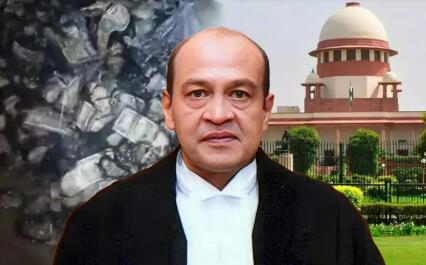
Justice Yashwant Verma of the Allahabad High Court, embroiled in controversy over burnt cash found at his residence, has resigned from his position and submitted his papers to the President, effective immediately.
Meanwhile, he wrote a letter to the judicial committee investigating the matter, raising several questions. This development comes while impeachment proceedings against him were already underway.
Earlier, he had been transferred from the Delhi High Court back to his original court at Allahabad High Court. Justice Verma took oath as a judge of the Allahabad High Court on April 5, 2025.
What happened So Far?
The entire issue dates back to March 14, 2025, when a fire broke out in a storeroom at Justice Verma’s official residence in Delhi. A large amount of cash was found during firefighting operations, a discovery that caused a stir in the judiciary.
Considering the seriousness of the matter, the then Chief Justice of India constituted an in-house investigation committee. Following the investigation, the committee recommended his removal. Subsequently, at the end of March 2025, he was transferred from Delhi High Court to Allahabad High Court.
At the time, Justice Verma refused to resign. Subsequently, impeachment proceedings began in Parliament. 146 members of the Lok Sabha signed the motion against him, leading the Speaker to form a three-member judicial inquiry committee under the law. The committee’s investigation was ongoing.
Justice Verma’s Letter to Judicial Committee
On April 9, 2026, Justice Yashwant Verma wrote a letter to the judicial committee investigating the matter. In the long letter, he not only questioned the investigation process but also called it “unfair” and “one-sided.”
He wrote that when he had gone out for Holi holidays on March 12, 2025, a fire occurred in a storeroom at his residence, and some items were recorded. He stated, “I only became aware of the incident on March 15, 2025, around 1:10–1:15 AM, by which time the fire had been extinguished and photo-video records had been made. I had no prior knowledge of these recordings or the cash.”
Justice Verma added, “On March 17, 2025, I was informed about the videos/photos and told that an investigation was ongoing. Immediately after, these videos were uploaded on the Supreme Court website and presented in the media as if the cash belonged to me.”
About the Storeroom
Justice Verma explained that the storeroom was separate from the main house, near the staff quarters, and isolated from his residence and office. It could be accessed from the back gate and had no security presence.
According to him, the storeroom was used by domestic staff, maintenance personnel, and others to store ordinary items like old furniture, bottles, utensils, mattresses, carpets, speakers, gardening tools, and CPWD materials.
He added that the storeroom often remained unlocked, and even when locked, he didn’t have the key. He had visited it only 4–5 times in two years.
He further said that a CCTV camera was installed outside the storeroom, with footage recorded in the guard room, but the system was not under his control. CRPF guards and private security officers reported to other officials, not him. Justice Verma said he repeatedly requested copies of the CCTV footage but was denied.
Justice Verma noted that he was held responsible solely for two things: the existence of the storeroom and the cash found there. He emphasized that in his 13+ years as a judge, he had never faced any allegations of corruption or misconduct.
Questions Raised on Investigation and Committee
Justice Verma stated that he repeatedly requested a judicial audit to verify the allegations, but his requests were ignored.
He explained that before the committee formed in August 2025, an in-house committee (IHC) investigated from March 22 to May 4, 2025. During this inquiry, witnesses did not testify in his presence, and he was not allowed to cross-examine them. The IHC submitted its report on May 4, 2025.
Justice Verma added that the Supreme Court later clarified that the IHC investigation was only preliminary, meant to determine whether judicial work should be withdrawn from the concerned judge. He argued that the IHC report and content should have remained confidential, accessible only to the Chief Justice, President, and Prime Minister, not made public.
He noted that when the committee was formed in August 2025, he was given a notice in November 2025 to respond to allegations. The notice relied on the same content gathered by the IHC, including witnesses who had already appeared before the IHC. He argued that if the documents were to be used, witnesses should also be made available for cross-examination, which did not happen.
Justice Verma said that the actions against him were based on suspicions and assumptions without direct allegations. There was no evidence linking him to the cash found on the night of March 14–15, 2025, yet he was defamed for over a year.
Concerns Regarding the Fire Report
He raised concerns about how IHC material was selectively used against him, while evidence supporting his case, such as the official fire report, was excluded. The fire report did not mention any cash and showed that officers were present at 1:56 AM, long after the fire was extinguished. He was not allowed to present this report during witness cross-examination.
Justice Verma also highlighted that out of 54 witnesses before the IHC, 27 were removed without explanation, including those whose testimony could have presented the true sequence of events.
Removal of Witnesses
He noted that evidence collection occurred from February 6 to March 17, 2026. During this short period, witnesses were removed systematically once their statements weakened the case against him. Senior officials from Delhi Fire Services and Delhi Police were removed without explanation after their testimony contradicted claims about the cash. Similarly, his three private security officers were removed from the witness list despite their potential testimony exposing false claims.
Only 9 of 31 witnesses gave testimony; the remaining 22 were removed, including those whose prior statements formed the basis of allegations.
Justice Verma’s Stance on Allegations
Justice Verma stated that there was no allegation or evidence that he placed cash in the storeroom, authorized its placement, or was aware of it. The charges were purely presumptive, relying on two assumptions: that the storeroom existed and that cash was found there under his control.
He emphasized that until these points were proven, no conclusions should have been drawn. He also noted that no evidence confirmed the cash was genuine Indian currency, and security officers who could verify the site and CCTV footage were removed from the witness list.
Justice Verma concluded that the proceedings demanded he disprove allegations of events that never occurred, which was fundamentally unfair. He asserted that a fair and rational investigation would have revealed no substantial case against him, ending the process at the outset.
Instead, he was repeatedly forced to prove matters that never happened, based solely on the existence of a storeroom and cash allegedly found there.