
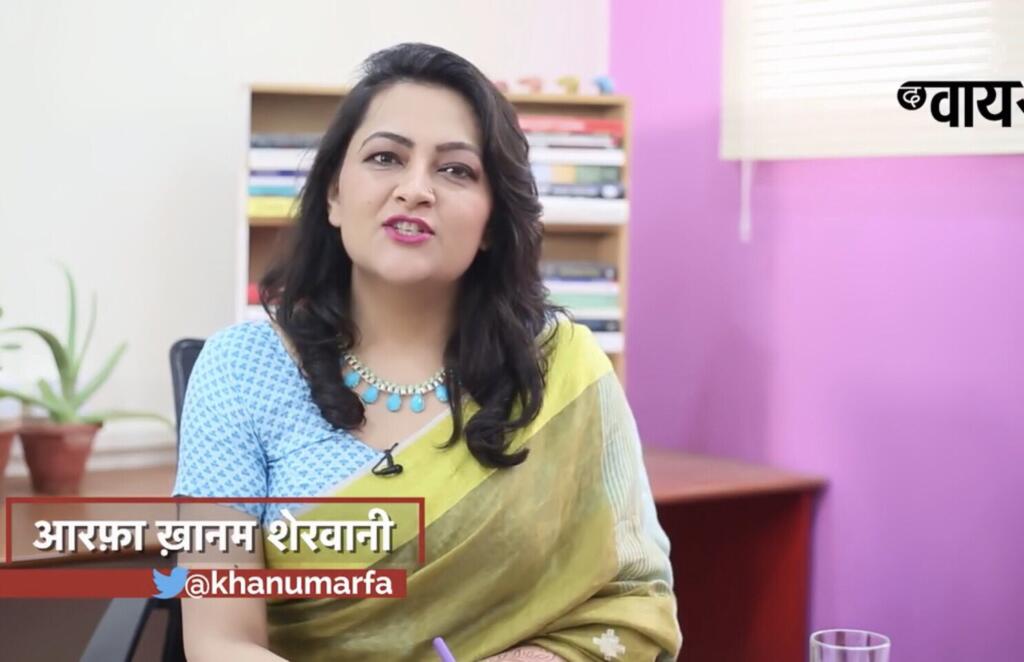
The recent controversy surrounding Arfa Khanum Sherwani has reignited a familiar and deeply contentious debate in India’s public sphere—where should one’s primary allegiance lie in an increasingly interconnected yet divided world? The discussion, framed sharply around the idea of the Ummah, has triggered strong reactions, particularly in the context of geopolitical tensions involving Iran and the United States.
At the heart of the issue are comments attributed to Sherwani following a brief ceasefire between Iran and the US in April 2026. Reports indicate that she praised Iran, even referring to it as a global leader or “vishwaguru,” while appearing to mock India’s own aspirations on the world stage. This juxtaposition—celebrating a foreign theocratic state while critiquing one’s own country—has been interpreted by critics as emblematic of misplaced priorities.
The controversy is not merely about one journalist’s remarks but about a broader ideological fault line. The notion of the Ummah, a global Islamic community transcending national borders, is central to this debate. For some, it represents spiritual solidarity; for others, it raises questions about national identity and civic responsibility. In this case, critics argue that invoking such a transnational identity in political commentary risks undermining the primacy of the nation-state.
The geopolitical backdrop adds further complexity. The Iran-US ceasefire itself was fragile, with reports of continued hostilities and disagreements over its terms. Yet, in the midst of this uncertainty, Iran’s projection as a rising global power found resonance in certain narratives. Sherwani’s remarks, seen in this context, were perceived as endorsing that narrative, amplifying the perception that ideological alignment outweighed national considerations.
Supporters, however, might argue that journalists and commentators are entitled to critique their own governments and express admiration for developments elsewhere. In a लोकतांत्रिक framework, dissent and diverse viewpoints are not only permissible but necessary. The challenge arises when such expressions are interpreted as crossing a line—from critique into what detractors describe as derision or disloyalty.
This is not the first time Sherwani has been at the centre of controversy. Over the years, her work and statements have often sparked debate, reflecting the increasingly polarised nature of Indian media discourse. The current episode fits into that broader pattern, where media personalities become focal points for larger ideological battles.
The invocation of the Ummah in this debate is particularly significant. In a globalised world, multiple identities coexist—religious, cultural, and national. The tension arises when these identities appear to conflict. For a diverse country like India, which prides itself on pluralism, balancing these identities is both a challenge and a necessity.
Critics of Sherwani’s remarks argue that prioritising a transnational religious identity over national interest can have serious implications, especially in a sensitive geopolitical environment. They contend that public figures, particularly journalists, have a responsibility to exercise caution and contextual awareness in their statements.
On the other hand, defenders might see the backlash as indicative of shrinking space for dissent and the growing tendency to equate criticism with disloyalty. In their view, robust debate—even when uncomfortable—is essential for a healthy democracy.
Ultimately, the controversy underscores a deeper question: how should individuals navigate the intersection of faith, ideology, and nationality in a globalised age? The answer is neither simple nor uniform. What is clear, however, is that such debates are likely to persist, reflecting the evolving nature of identity and allegiance in contemporary society.
As India continues to assert itself on the global stage, these internal conversations will play a crucial role in shaping its trajectory. Whether viewed through the lens of nationalism, pluralism, or global solidarity, the discourse around the Ummah and national loyalty is a reminder of the complexities inherent in modern identity—and the importance of engaging with them thoughtfully.