
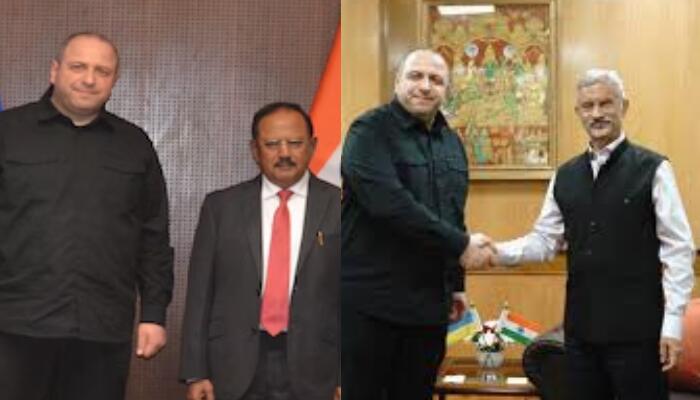
Ukraine’s Secretary of the National Security and Defence Council, Rustem Umerov, held significant discussions in New Delhi today with National Security Adviser Ajit Doval and External Affairs Minister S Jaishankar, in a visit that placed the ongoing Russia–Ukraine conflict and bilateral engagement at the centre of attention. India used the occasion to restate its long-held position that the war must be resolved through dialogue and diplomacy rather than escalation.
The meetings carried diplomatic weight, marking the most prominent Ukrainian engagement in India since Foreign Minister Andrii Sybiha’s visit to the capital in March last year. Umerov’s presence reflects Kyiv’s continued effort to broaden strategic consultations amid a prolonged and attritional war with Russia.
India reiterates its established position on conflict resolution
During the engagements, Indian officials consistently emphasised New Delhi’s principled stance. According to the Ministry of External Affairs, both sides reviewed bilateral ties while also exchanging views on the ongoing conflict. India reiterated that any sustainable resolution must emerge through peaceful negotiations and sustained diplomatic engagement.
Following his meeting with Doval, Umerov noted that discussions covered the evolution of bilateral relations and an assessment of the security environment. He also acknowledged India’s steady approach, expressing appreciation for what he described as a mutual understanding on the need for a durable peace framework.
Frontline situation and diplomatic efforts discussed
In his conversation with External Affairs Minister S Jaishankar, Umerov provided insights into developments on the ground in Ukraine’s conflict zones, now shaped by more than four years of hostilities following Russia’s 2022 invasion. He highlighted the status of negotiations and reiterated Ukraine’s aspiration for a settlement that is both fair and enduring.
The discussions also revisited commitments outlined in a joint statement issued after Ukrainian President Volodymyr Zelenskyy meets with Prime Minister Narendra Modi in Kyiv in August 2024, particularly focusing on advancing agreed areas of cooperation between the two countries.
Jaishankar, in turn, underscored India’s consistent position, while both sides explored avenues to deepen bilateral engagement beyond the immediate context of the war.
A conflict shaping global diplomatic alignments
The Russia–Ukraine war continues to redefine international alignments, with Russia maintaining gradual territorial advances at high human cost, while Ukraine relies increasingly on unmanned systems across multiple domains to sustain its defensive operations.
Amid this backdrop, India continues to maintain a calibrated diplomatic balance. While engaging with Kyiv, it also preserves strong relations with Moscow. Russian President Vladimir Putin visited New Delhi for the annual bilateral summit last December, and Prime Minister Narendra Modi is expected to travel to Russia later this year.
Energy cooperation remains a central element of India–Russia ties, with Indian imports of discounted Russian crude rising sharply after Western sanctions reshaped global supply chains, before witnessing a moderation in recent months due to additional restrictions on Russian energy firms.
Sustained engagement amid shifting geopolitics
Umerov’s visit underscores Kyiv’s continued diplomatic outreach to India at a time when global geopolitical equations remain fluid. With President Volodymyr Zelenskyy also expected to visit India in the near future, New Delhi finds itself navigating an increasingly complex diplomatic landscape while maintaining its stated position of encouraging negotiated peace over prolonged conflict.