
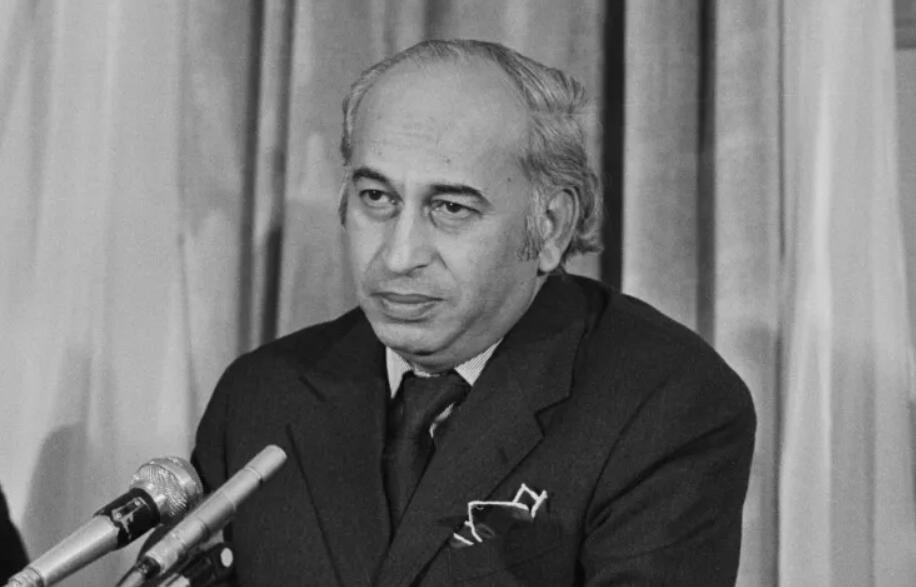
Pakistan’s constitutional story is built on a contradiction so stark that it still indicts the state nearly half a century later. The country’s most durable constitutional settlement, the 1973 Constitution, is inseparable from Zulfikar Ali Bhutto’s political rise and institutional imagination.
However, the same state later hanged him on April 4, 1979 after a trial that Pakistan’s own Supreme Court has since said did not meet the standards of fair trial and due process. That is not merely irony, it is a revelation of how Pakistan has often treated law not as a restraint on power, but as a stage on which power performs legitimacy.
Bhutto’s place in Pakistan’s history does not depend on romanticism. He was a divisive, flawed and often ruthless politician, but the scale of his democratic contribution is undeniable. Under his leadership, the National Assembly’s constitution committee produced the draft that was unanimously passed on 10 April 1973, authenticated on April 12, and promulgated on 14 August 14 1973, when Bhutto assumed office as prime minister under the new order.
The Constitution established a parliamentary system, placed executive authority with the prime minister, and created the bicameral Parliament that still structures the federation. This was not a minor procedural achievement. In a state repeatedly bent by coups, it was an attempt to give Pakistan a consensual constitutional center.
Bhutto’s contribution was not only institutional but political, the Pakistan Peoples Party was founded in 1967 as a programmatic challenge to the old patronage politics, explicitly presenting itself as an “Islamic socialist” party aimed at workers and peasants. Its support base drew in rural leftists, urban progressives and lower and middle-class constituencies who had long been spoken for but rarely politically empowered.
Bhutto did not invent mass politics in Pakistan, but he gave it a national vocabulary, comprising popular sovereignty, social justice, parliamentary rule, and civilian authority. That legacy matters because constitutions do not survive on parchment alone; they require constituencies that believe the state belongs to them. And that is precisely why Bhutto’s destruction was so consequential.
He was not hanged by an order wholly alien to the constitutional world he helped create. He was destroyed through a legal process staged after General Zia-ul-Haq’s 1977 coup had already overturned the democratic order. The cruellest fact is that Pakistan killed the principal architect of its parliamentary constitution while preserving enough legal theater to pretend that procedure had been honoured.
In March 2024, Pakistan’s Supreme Court finally acknowledged that Bhutto did not receive a fair trial and that the proceedings in both the Lahore High Court and the Supreme Court failed constitutional requirements of due process. In other words, the state used the language of law to extinguish one of the men most responsible for giving it constitutional form.
The decades that followed only deepened the insult. The Constitution Bhutto helped midwife did outlive him, but often in mutilated form. After Zia’s coup on 5 July 1977, martial law was imposed and the Constitution’s status was altered through a series of orders under military rule. In 1985, the revival of constitutional rule came with the Eighth Amendment, which added Article 58(2)(b) and handed the president discretionary power to dissolve the National Assembly.
That power was then used to dismiss elected governments, including those of Benazir Bhutto and Nawaz Sharif, turning constitutionalism into a revolving door for managed instability rather than a shield for representative government.
The pattern repeated under Pervez Musharraf. Following the 1999 military takeover, the Constitution was again suspended; later, it was reinstated with modifications under the Legal Framework Order, which restored and expanded presidential powers. What this showed was devastatingly simple: Pakistan’s ruling establishment did not reject the Constitution outright so much as treat it as a document to be suspended, trimmed, revived and rewritten according to the convenience of unelected power.
The Constitution remained alive, but often only as a hostage that could be returned to civilian life once its captors had altered its terms. The Eighteenth Amendment of 2010 was an attempt to reverse part of this long distortion. Official and scholarly summaries describe it as restoring parliamentary supremacy, curbing the presidency, and deepening provincial autonomy by abolishing the Concurrent Legislative List and devolving powers to the provinces.
In that sense, the amendment was less a new beginning than a partial rescue mission: an effort to restore the 1973 Constitution closer to its original parliamentary intent after decades of military and presidential encroachment. Yet even that repair now looks fragile. In 2024, Pakistan passed a controversial constitutional amendment widely criticized as a blow to judicial independence, and in November 2025 parliament approved another amendment that expanded the army chief’s powers and curtailed the Supreme Court’s constitutional role.
So can the Constitution be separated from the fate of the man who made it? Institutionally, yes, documents survive their authors. Politically and morally, no. The 1973 Constitution is not just a text. It is also a memory of a moment when Pakistan briefly tried to anchor legitimacy in parliamentary consensus rather than barracks, decrees or judicial accommodation.
To invoke the Constitution while forgetting Bhutto’s fate is to miss the central truth of Pakistan’s constitutional history: the state preserved the shell of the order he built while repeatedly violating its spirit and finally destroying its chief builder.
What Pakistan owes Bhutto is not hagiography, it owes him honesty, an admission that the republic’s foundational document survived, but the political class, the judiciary and the military establishment never fully defended the constitutional ethic it represented, the Constitution outlived Bhutto.
Pakistan’s institutional memory kept the document. Its political memory never fully confronted the crime. And that is the contradiction at the heart of the republic: it still swears by a charter whose author it humiliated, overthrew and killed.