
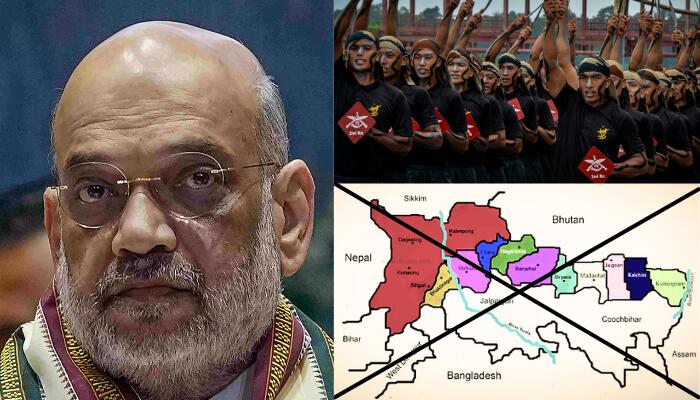
Union Home Minister Amit Shah said the Bharatiya Janata Party would address the long-pending Gorkha issue in the Darjeeling hills through constitutional measures, while firmly ruling out any division of West Bengal. Speaking at an election rally in Gangarampur in the Dakshin Dinajpur district of north Bengal, Shah also mounted a sharp political offensive against the Trinamool Congress leadership and highlighted a series of commitments for the region should the BJP come to power in the state.
Addressing the gathering, Shah emphasised that the BJP was committed to finding a solution to the concerns of the Gorkha community within the framework of the Constitution while preserving the territorial unity of West Bengal. The demand for a separate Gorkhaland state has remained a sensitive political issue in the Darjeeling hills for years, shaping electoral debates in the region.
Accusations against political rivals
During his speech, Shah accused Aam Janata Unnayan Party founder Humayun Kabir of functioning as an “agent” of Chief Minister and Trinamool Congress supremo Mamata Banerjee. He also alleged that a mosque designed on the lines of the Babri Masjid was being built with the approval of the state leadership.
“The BJP will not permit the mosque to come up,” Shah declared, making the claim one of the most forceful parts of his address.
The remarks added to the ongoing political confrontation between the BJP and the ruling Trinamool Congress in West Bengal, where sharp exchanges between rival parties have intensified in recent months.
Assurances for farmers and governance
Shah also addressed concerns related to agriculture, stating that the movement of potatoes from West Bengal to other states would be allowed freely so that farmers receive better prices for their produce. According to him, opening the supply chain would help cultivators secure more favourable returns in the market.
He further said that if the BJP forms the government in West Bengal, it would put an end to political violence and dismantle what he described as the “syndicate raj”, a term often used by the party to criticise alleged networks controlling local contracts and economic activities.
The Home Minister also reiterated the BJP’s position on infiltration, saying that infiltrators would be removed from the state once the party assumes power.
Development commitments for North Bengal
Shah used the rally to repeat several development proposals for north Bengal that are part of the party’s manifesto. He said an All India Institute of Medical Sciences, a 600-bed cancer hospital, an Indian Institute of Technology, an Indian Institute of Management, and a sports university would be established in the region.
He also announced that the Rajbanshi language would be included in the Eighth Schedule of the Constitution, a step that would grant it official recognition and promote its preservation.
In addition, Shah said an eco-adventure hub would be developed in Darjeeling to strengthen tourism and expand economic opportunities in the hill districts.
The Gangarampur rally formed part of the BJP’s wider campaign in north Bengal, where the party has been attempting to build support by combining regional concerns, development pledges, and criticism of the state government.