
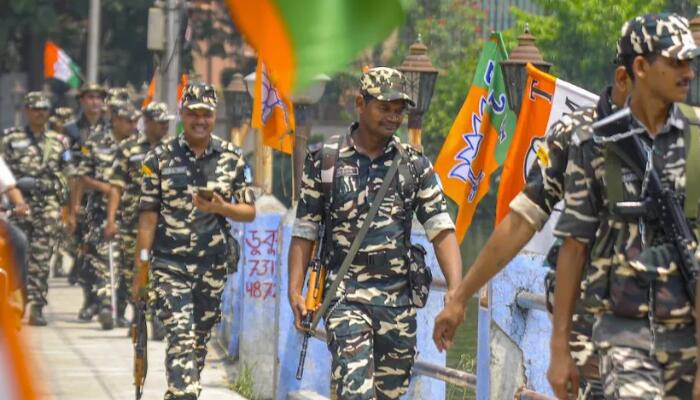
West Bengal’s polling day is unfolding under a tight security umbrella. Voters are turning out in visible numbers across constituencies such as Birbhum and other regions with a history of political violence. Notably, long queues outside polling stations have become a defining feature of the day under the presence of Central Armed Police Forces (CAPF).
The Election Commission of India has marked more than 8,000 polling booths as “super-sensitive” for the first phase. This classification reflects continuing concerns over intimidation and booth-level disruption in parts of the state. In addition, police have arrested 135 or more individuals identified as history-sheeters, musclemen, and repeat offenders. These arrests have taken place across districts, including Malda, Murshidabad, Balurghat, and North and South 24 Parganas.
Furthermore, authorities have placed over 200 locations under continuous monitoring. These are areas that have witnessed electoral or post-electoral violence in earlier cycles. Senior district officials are visiting these zones repeatedly. They are assessing ground conditions and reinforcing voter confidence.
A layered security setup
The Election Commission is managing the process through a multi-layered security structure. Alongside ground deployment, it has introduced an artificial intelligence-based surveillance system. This system detects booth jamming and irregular activity in real time.
Moreover, a three-tier control mechanism is in place. It connects the state CEO office, district control rooms, and returning officer-level monitoring units. Together, these systems ensure continuous oversight during polling.
Long queues in sensitive regions
Against this backdrop, long queues in constituencies stand out. These regions have witnessed electoral violence and instances of intimidation in the past. However, this time, voters are participating in large numbers under CAPF protection and heightened security presence.
As a result, the immediate reading suggests a reduced fear barrier. Security deployment appears to have created a safer environment for voters. Consequently, more citizens are stepping out to vote without visible hesitation.
Security shaping the voting experience
Importantly, paramilitary deployment now extends beyond crowd control. It has become part of the voting experience itself. The polling booth is no longer shaped only by political competition or local influence. Instead, it is also defined by the visible presence of external security forces.
Election authorities have repeatedly stated their commitment to elections free of fear, violence, intimidation, and inducement. They have urged voters to participate without hesitation. On the ground, this assurance is reinforced through visible deployment and constant monitoring.
Between confidence and control
Therefore, West Bengal’s polling landscape reflects a dual reality. On one hand, CAPF deployment and strict enforcement are enabling participation in sensitive areas. On the other hand, security has become deeply embedded in shaping voter behaviour itself.
Multiple meanings can be inferred. They may signal renewed voter confidence. At the same time, they highlight how security arrangements are actively influencing electoral experience.
Ultimately, security is no longer just a protective layer. Instead, it has become an active force that quietly shapes participation and perception on polling day.