
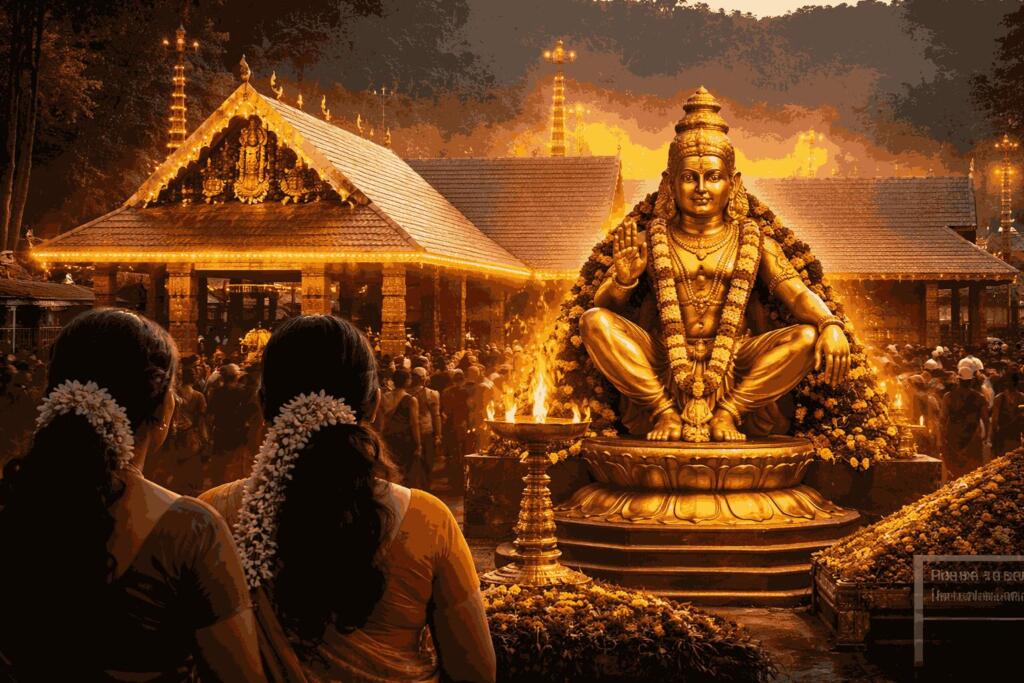
The ongoing legal and cultural battle over Sabarimala Restrictions has once again taken centre stage, with the Union government firmly backing the traditional practice that limits the entry of women of menstruating age into the revered Kerala temple. In submissions before the Supreme Court, the Centre argued that matters of deep religious faith should remain beyond the scope of judicial scrutiny, reigniting a national debate that sits at the intersection of tradition, constitutional rights, and gender equality.
At the heart of the issue lies the centuries-old practice at the Sabarimala temple, dedicated to Lord Ayyappa, where women between the ages of approximately 10 and 50 have traditionally been restricted from entry. This custom is linked to the celibate nature of the deity and has been defended by devotees as an essential religious practice rather than a form of discrimination.
The controversy intensified following the landmark 2018 Supreme Court verdict, which allowed women of all ages to enter the temple, declaring the restriction unconstitutional. The ruling triggered widespread protests and a deeply polarised public response, with many devotees asserting that judicial intervention had overlooked the spiritual significance of the tradition.
In its latest stance, the Centre has urged the apex court to reconsider the earlier judgment, emphasising that Sabarimala Restrictions are rooted in faith and denominational autonomy. Representing the government, Solicitor General Tushar Mehta argued that courts should refrain from evaluating religious practices based on modern or scientific reasoning, asserting that such matters fall within the domain of believers rather than judges.
The government further maintained that Sabarimala Restrictions are unique to this specific temple and should not be interpreted as a broader commentary on the status of women in Hindu society. It clarified that the restriction pertains to a particular age group and is not a blanket exclusion of women, pointing out that women of other age groups are permitted to worship at the shrine.
However, the argument that Sabarimala Restrictions should remain insulated from judicial review has not gone unchallenged. During recent hearings, members of the Supreme Court bench raised critical questions about whether such practices could be reconciled with constitutional guarantees of equality and dignity. Observations from the bench highlighted concerns over treating women differently based on biological factors, underscoring the tension between faith and fundamental rights.
The issue has also drawn significant public engagement over the years. Movements like the “Ready to Wait” campaign saw women devotees themselves supporting the continuation of Sabarimala Restrictions, arguing that respecting the temple’s traditions was an expression of devotion rather than discrimination. At the same time, other groups mobilised in favour of gender equality, organising large-scale protests and human chains to demand equal access to places of worship.
The debate over Sabarimala Restrictions is not merely legal but deeply social and cultural. It reflects broader questions about how India negotiates the coexistence of diverse belief systems within a constitutional framework. While some view the restrictions as an essential aspect of religious freedom, others see them as incompatible with the principles of equality enshrined in the Constitution.
Adding to the complexity is the evolving political landscape. Both the Centre and the Kerala government have, at different times, shifted their positions on the issue, reflecting the sensitivity and electoral significance of the matter. The current stance of the Union government signals a clear preference for preserving traditional practices, even as the judiciary continues to deliberate on their constitutional validity.
As the Supreme Court revisits the issue, the outcome is likely to have far-reaching implications. A decision upholding Sabarimala Restrictions could reinforce the autonomy of religious institutions, setting a precedent for limited judicial intervention in matters of faith. Conversely, a ruling against the restrictions could reaffirm the primacy of constitutional rights over customary practices.
Ultimately, the Sabarimala Restrictions debate encapsulates a larger national conversation about identity, belief, and the role of the state in regulating religious practices. It is a reminder that in a country as diverse as India, the balance between faith and law is not easily achieved—and often requires navigating deeply held convictions on all sides.
As proceedings continue, the case remains a defining test of how India’s legal system addresses questions that lie at the heart of its pluralistic society, where tradition and modernity constantly intersect.