
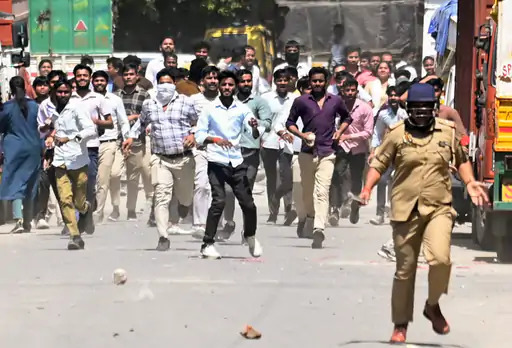
Recent developments in Noida have reignited a familiar debate over the intersection of labour protests, political narratives, and industrial stability. A widely circulated post has argued that while governments are often criticised for delayed responses, the situation in Noida unfolded differently—with swift administrative action, immediate dialogue, and policy intervention. Yet, despite these efforts, unrest escalated, raising concerns about the nature and direction of such agitations.
According to the narrative presented, the Uttar Pradesh government acted promptly when worker grievances surfaced in Noida. The Chief Minister reportedly initiated discussions with stakeholders, announced an interim wage hike of around 20–21%, and set up a committee to explore long-term solutions. These measures, typically expected to ease tensions, were seen as a proactive attempt to address worker concerns before they spiralled into prolonged unrest.
However, the very next day witnessed violence, including incidents of arson and disruption. This abrupt escalation has led to questions about whether the unrest in Noida was purely labour-driven or influenced by external elements. The post claims that some of those involved in the violence were not genuine workers but individuals with no direct link to the affected industries, allegedly aiming to amplify the situation.
Such assertions, while contested, point to a broader pattern often discussed in political and economic circles. Protests, especially in industrial hubs like Noida, can sometimes attract multiple actors with differing agendas. What begins as a legitimate grievance may evolve into a larger confrontation, complicating both resolution efforts and public perception.
The economic implications of unrest in Noida are significant. As a major industrial and export hub within the National Capital Region, the city hosts a wide range of manufacturing units, from textiles to electronics. Disruptions in such a setting can have cascading effects, not only halting production but also affecting supply chains, exports, and investor confidence.
The post highlights that each day of instability in Noida could result in losses amounting to hundreds of crores of rupees. While such figures may vary depending on estimates, there is little doubt that prolonged disruptions impact wages, hiring cycles, and future investment decisions. Export-oriented sectors, in particular, are highly sensitive to delays, as global buyers often shift orders to more stable markets when faced with uncertainty.
A key argument raised is the vulnerability of micro, small, and medium enterprises (MSMEs), which form the backbone of India’s employment ecosystem. Unlike large corporations, these businesses operate on tight margins and limited cash reserves. Even a short period of shutdown can push them towards financial distress, affecting not just business owners but also contract workers, daily wage earners, and small suppliers.
The situation in Noida also brings into focus the delicate balance between wage demands and economic realities. While workers’ calls for higher wages are rooted in genuine concerns about living costs and financial security, sudden or steep increases can pose challenges for employers. Businesses faced with rising costs may resort to measures such as downsizing, automation, or relocation, ultimately reducing employment opportunities.
Another dimension of the debate is the concept of “Brand Noida”—the city’s reputation as a stable and attractive destination for investment. Over the years, Noida has positioned itself as a key industrial hub, drawing both domestic and international investors. However, even the perception of instability can deter future investments, delay expansion plans, and shift business activity to competing regions.
The broader concern, as articulated in the post, is that industrial unrest may inadvertently harm the very workers it seeks to support. When factories shut down or scale back operations, it is often the workforce that bears the immediate impact through lost wages and job insecurity. This creates a paradox where actions taken in the name of labour welfare may end up undermining livelihoods.
At the same time, it is important to recognise that labour protests often emerge from real grievances that require attention. Issues related to wages, working conditions, and job security cannot be dismissed outright. The challenge for policymakers lies in addressing these concerns effectively while maintaining industrial harmony and economic stability.
The events in Noida thus serve as a microcosm of a larger national conversation. They highlight the need for timely governance, responsible protest, and constructive dialogue between all stakeholders. As India continues to position itself as a global manufacturing hub, ensuring stability in key industrial regions like Noida will be crucial for sustaining growth, attracting investment, and safeguarding employment.
Ultimately, the path forward lies in balancing competing priorities—protecting workers’ rights, ensuring business viability, and maintaining public order. The unfolding situation in Noida underscores how quickly this balance can be tested, and how critical it is to respond with both sensitivity and pragmatism.