
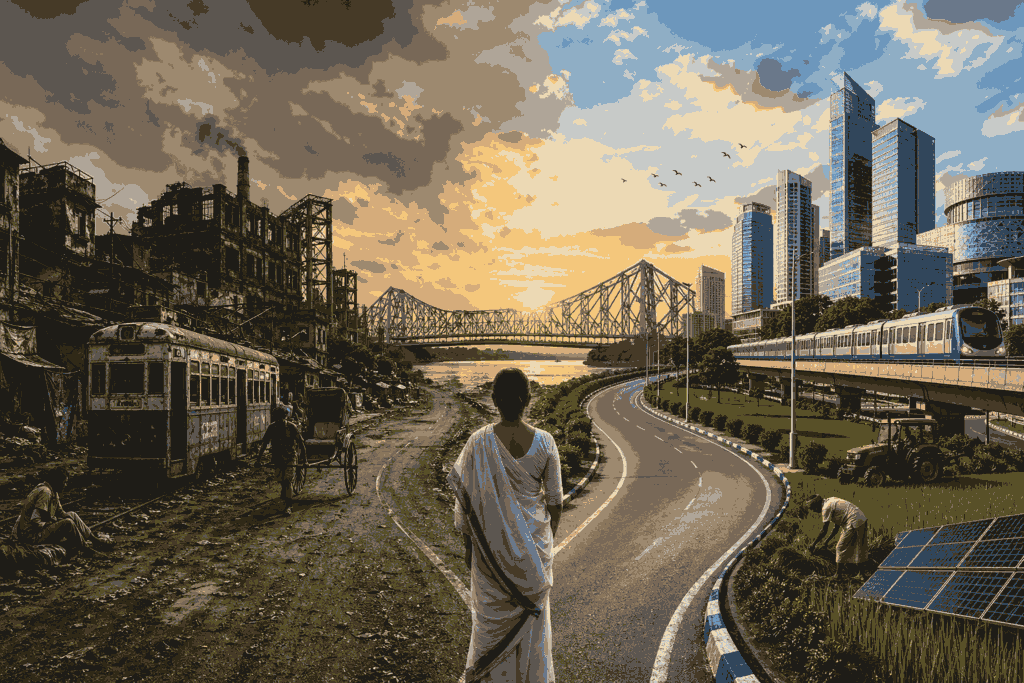
As the 2026 Assembly election approaches, the debate over governance in West Bengal has intensified sharply. Supporters of change argue that New Bengal must emerge from decades of political stagnation, economic drift, and institutional decline. Critics of the current order claim that the state, once among India’s strongest industrial and intellectual centres, has steadily lost momentum under successive administrations led first by the Left Front and later by Mamata Banerjee.
For many observers, the present contest is not merely about party politics but about the direction of the state’s future. Bengal was once synonymous with manufacturing strength, ports, engineering, jute, tea, finance, and higher learning. Kolkata served as a commercial gateway to eastern India and beyond. However, over several decades, industry closures, labour unrest, migration of talent, and weak private investment gradually altered that image. Many now believe the state’s challenge is not a temporary slowdown, but a long structural decline that only New Bengal can decisively reverse.
Economic concerns remain central to the public mood. Reports discussing the state’s trajectory point to a falling share in national output compared with earlier decades, lower per-capita income relative to several faster-growing states, and a debt burden that limits fiscal flexibility. Critics say welfare spending has expanded without sufficient parallel growth in manufacturing, infrastructure, and productive employment. While welfare schemes can provide relief, economists often note that long-term prosperity requires jobs, enterprise, and investment. That is the economic promise many attach to New Bengal.
Employment is perhaps the most sensitive issue. Across districts, many families continue to depend on remittances sent by members working outside the state. Young graduates frequently seek opportunities in cities such as Bengaluru, Hyderabad, Pune, Delhi, and Mumbai. This outward movement is often described as both an economic and emotional loss. When skilled youth leave in large numbers, the state loses talent, entrepreneurial energy, and future taxpayers who could have helped rebuild local growth. Retaining them is seen as essential for New Bengal.
Law and order has also become a recurring political flashpoint. Opposition groups often allege that partisan violence, intimidation, and weak enforcement discourage open competition and investor confidence. Every election season revives concerns about whether political rivalry in Bengal can remain peaceful and democratic. A stable investment climate usually depends on predictability, neutrality of institutions, and swift justice. Where uncertainty grows, businesses tend to hesitate, making governance reform central to the vision of New Bengal.
Infrastructure remains another decisive theme. Though there have been visible improvements in roads, urban beautification, and welfare delivery in some areas, critics argue that deeper industrial infrastructure—modern logistics parks, large manufacturing clusters, port-linked expansion, and technology ecosystems—has not advanced at the pace seen elsewhere. Competing states have aggressively marketed themselves to global and domestic investors, while Bengal’s potential advantages have often remained underutilised. Supporters say New Bengal would prioritise execution over slogans.
Yet the state’s strengths are still formidable. Kolkata remains a major metropolitan centre with rich human capital, cultural prestige, and strategic geography. Bengal has fertile agriculture, access to the Bay of Bengal, established educational institutions, a large consumer base, and proximity to northeastern India, Bangladesh, Nepal, and Southeast Asian trade routes. If policy execution improves, many analysts believe New Bengal could again become a growth engine.
That is why the 2026 election is being framed by many as a referendum on continuity versus reset. Supporters of the incumbent government highlight welfare programmes, rural outreach, and social support networks. Opponents counter that welfare cannot substitute for structural growth, industrial revival, or transparent governance. Voters will ultimately judge which vision feels more credible, and whether New Bengal is a realistic mandate or only a campaign phrase.
A successful turnaround would likely require several priorities: restoring investor confidence, reducing bureaucratic friction, modernising infrastructure, improving municipal services, strengthening universities, expanding tourism, and ensuring a fair law-and-order environment. No single election can solve decades of accumulated problems, but it can create a mandate for reform. If pursued seriously, New Bengal may become the framework for that recovery.
Bengal’s political history has often shaped national conversations. Once again, the state stands at an important junction. Whether voters choose continuity or transformation, the demand for jobs, dignity, safety, and opportunity is becoming louder. The coming years may determine whether Bengal remains trapped in nostalgia—or writes a fresh chapter built on performance, confidence, and renewal.