
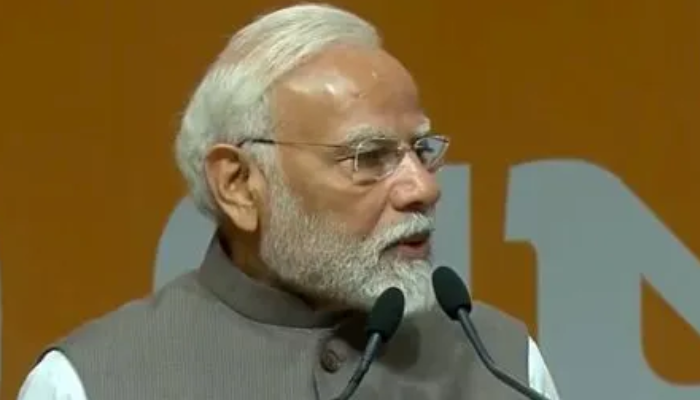
Prime Minister Narendra Modi accused the Indian National Congress of attempting to exploit the ongoing West Asia conflict by spreading rumours about fuel shortages and encouraging panic among citizens. Addressing a large public gathering in Nani village of Gujarat’s Vav Tharad district, the Prime Minister said the opposition was trying to provoke people into rushing to petrol pumps and gas agencies despite the government maintaining control over the situation.
According to Modi, the country is navigating global uncertainty triggered by the conflict involving the United States, Israel and Iran, which has disrupted international energy markets and raised concerns over fuel supplies worldwide. Despite the turmoil, he asserted that India has managed the situation responsibly and prevented the crisis from severely affecting citizens.
Criticising Congress leaders, the Prime Minister said the party was indulging in rumour-mongering at a time when the nation requires unity and reassurance. He likened such behaviour to ‘Rajneeti ke gidh’, or vultures of politics, accusing the opposition of waiting for domestic difficulties to escalate so they can extract political advantage from the situation.
Energy disruptions and India’s strategy
The Prime Minister acknowledged that the conflict in West Asia has had widespread global repercussions, particularly in energy markets. Diesel, petrol and gas supplies have come under pressure in several countries as geopolitical tensions affect supply chains and transportation routes.
Many nations, he noted, have witnessed fuel price increases ranging between 10 and 25 per cent because of the crisis. India, however, has managed to shield its population from the most severe impact.
The stability, he said, has been possible because of India’s foreign policy approach and the resilience of its citizens during challenging international conditions. The Prime Minister also emphasised that the country is steadily positioning itself as a global leader in renewable energy, arguing that investments in clean energy infrastructure will strengthen long-term energy security and reduce dependence on volatile global fuel markets.
Deesa airbase and national security concerns
During the address, Modi also criticised earlier Congress-led governments for delaying the development of the Deesa airbase in Gujarat, which he described as strategically vital due to its proximity to the international border.
The Prime Minister said his aircraft landed directly at the airbase before the event and highlighted that the facility lies roughly 130 kilometres from the border. The project, he recalled, had originally been conceptualised during his tenure as Gujarat Chief Minister, with farmers willingly contributing land for its development.
However, the project remained stalled for years because of the approach adopted by the government in New Delhi at the time. According to the Prime Minister, the initiative gained momentum only after the present government assumed office at the Centre.
A major Indian Air Force base has now been established in Deesa, he said, adding that the facility will strengthen security along India’s western frontier while also driving development in the surrounding region.
Development projects worth nearly ₹20,000 crore
The visit marked the Prime Minister’s first to the area since Vav Tharad was carved out as a separate district from Banaskantha in October 2025. On the occasion, he inaugurated and laid foundation stones for development projects worth ₹19,806.9 crore.
Of this, projects valued at ₹10,921 crore fall under Union ministries, while ₹8,886 crore are linked to departments of the Government of Gujarat.
Among the key initiatives were projects worth ₹3,645 crore connected to the Khavda Renewable Energy Park in Kutch, aimed at integrating large-scale renewable power into the national grid and strengthening the country’s energy infrastructure.
Infrastructure works also featured prominently. Foundation stones were laid for the Idar-Badoli bypass and the Dholavira-Santalpur road stretch, while several packages of the Ahmedabad-Dholera corridor were inaugurated.
Railway projects worth ₹891 crore were also launched, including the Himmatnagar-Khedbrahma broad gauge line and track expansion works across Kutch and Saurashtra. The Prime Minister additionally flagged off the Khedbrahma-Himmatnagar-Asarva train service, marking improved rail connectivity in the region.