
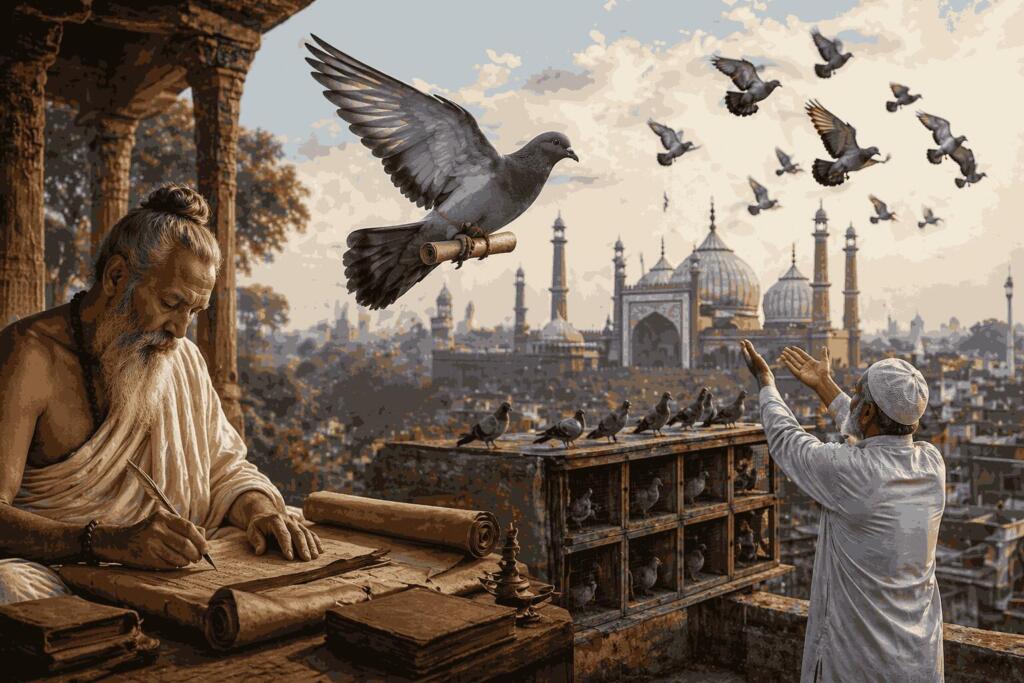
The continuing fascination with pigeon-rearing in Delhi has recently been framed in popular discourse as a legacy of the Mughal tradition—a characterization that has sparked both cultural pride and historical debate. While the visual spectacle of trained pigeons circling above Old Delhi’s rooftops is undeniably rooted in medieval practices, reducing the entire phenomenon to a Mughal tradition risks oversimplifying a much older and more complex civilizational history.
A recent Reuters report highlights how kabootarbaazi—the art of pigeon-rearing and aerial training—continues to thrive near Jama Masjid in New Delhi. Practitioners train flocks for months, guiding them into coordinated formations and even informal competitions. The report notes that the practice was patronized by Mughal rulers, who used pigeons both for recreation and as a means of communication across distances.
However, the framing of pigeon-based messaging as exclusively a Mughal tradition deserves closer scrutiny. Long before the rise of the Mughal Empire in the 16th century, ancient Indian texts had already documented the use of birds for communication. The Arthashastra, attributed to Kautilya and dated roughly to 300 BCE, explicitly references pigeons carrying sealed messages. The text describes intelligence gathering and communication networks in which domesticated birds served as discreet couriers—a strikingly sophisticated system for its time.
This raises an important question: if pigeon-based communication existed over a millennium before the Mughals, can it accurately be labeled a Mughal tradition? The answer lies in distinguishing between origin and popularization. While the Mughal courts may have refined, patronized, and culturally embedded the practice in North India, they were not its originators. Instead, they inherited and adapted an already existing system, integrating it into their own administrative and leisure frameworks.
The Reuters account itself indirectly supports this layered history. It emphasizes that pigeon-rearing in Delhi today is not merely a sport but a generational craft, passed down through families and shaped by local conditions. Such continuity suggests that traditions often evolve through accumulation rather than sudden invention. What the Mughals encountered was not a blank slate, but a living subcontinental culture with deep-rooted practices.
Yet, the tendency to label such practices solely under the Mughal tradition reflects a broader pattern in historical storytelling—one where later imperial periods overshadow earlier indigenous contributions. This is not unique to pigeon-rearing. Across domains—architecture, administration, cuisine—historical narratives frequently compress timelines, attributing long-evolving practices to the most visible or well-documented era.
At the same time, dismissing the Mughal contribution entirely would be equally misleading. The Mughal courts played a significant role in elevating pigeon-rearing into a structured activity. Royal patronage meant better breeding, organized training, and even competitive elements that transformed a utilitarian practice into a cultural spectacle. In that sense, calling it a Mughal tradition reflects its prominence during that period, even if not its origin.
The present-day practitioners of Delhi embody this synthesis of histories. Individuals like Azhar Udeen, mentioned in the Reuters report, inherit techniques not from written manuals but through lived experience—watching elders, learning rhythms, and adapting to modern urban constraints. Their practice is less about historical labels and more about continuity, identity, and community.
This debate also highlights a deeper issue: how history is communicated to the public. Simplified narratives may be easier to digest, but they risk distorting the richness of India’s past. When an ancient practice is framed narrowly as a Mughal tradition, it can inadvertently erase earlier layers of knowledge systems that predate imperial rule by centuries.
In reality, pigeon-rearing in India represents a continuum—from ancient statecraft described in the Arthashastra to medieval refinement under Mughal patronage, and finally to modern-day cultural survival in the lanes of Old Delhi. Each phase contributed something unique, and none exists in isolation.
Ultimately, the skies over Delhi tell a story far older than any single empire. Every flock that rises above the city carries with it fragments of multiple eras—ancient ingenuity, imperial patronage, and contemporary resilience. To understand this tradition fully, one must look beyond labels and recognize the layered inheritance that defines Indian civilization.
Reducing it to a Mughal tradition may capture one chapter of the story—but the full narrative spans centuries, cultures, and civilizations, all converging in the rhythmic beat of wings above a timeless city.