
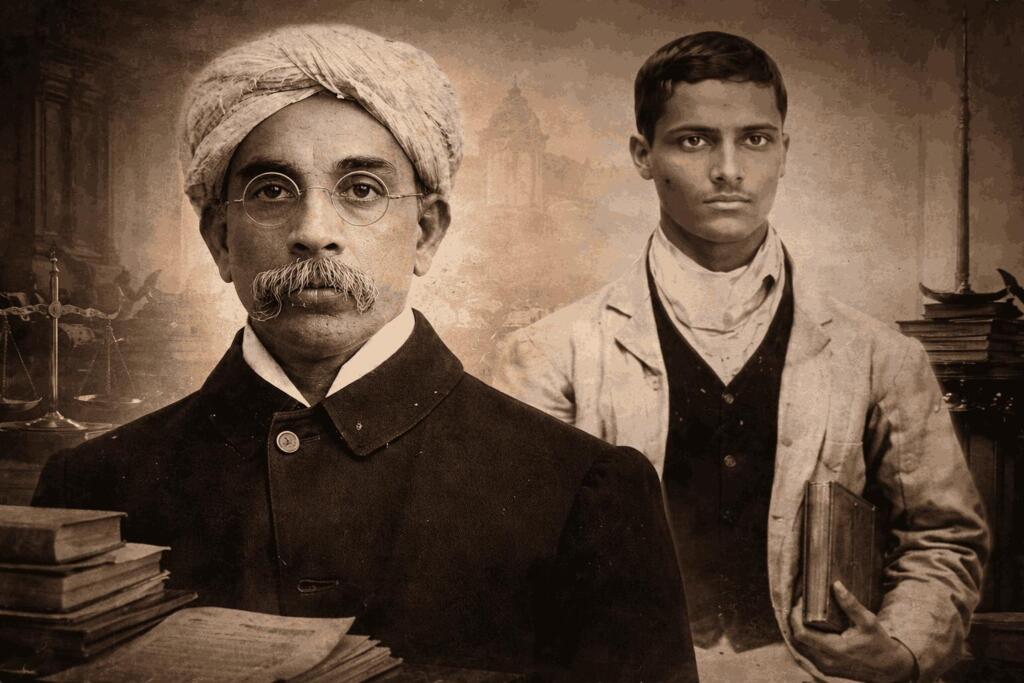
The life and legacy of Justice Narayan Ganesh Chandavarkar remain a subject of intense historical debate, particularly in connection with the trial of Vinayak Damodar Savarkar. The story of Justice Narayan Ganesh Chandavarkar is not merely about a legal figure in colonial India, but about the intersection of law, politics, and imperial power during one of the most turbulent phases of the freedom struggle. As both a judge and a former president of the Indian National Congress, Justice Narayan Ganesh Chandavarkar occupied a unique and influential position in British India.
Born in 1855 in the Bombay Presidency, Justice Narayan Ganesh Chandavarkar rose to prominence as a lawyer, reformer, and political leader. He was elected president of the Indian National Congress in 1900, placing him among the early leadership of the nationalist movement. Indian National Congress At the same time, his career took a significant turn when he was elevated to the bench of the Bombay High Court in 1901, marking his transition from active politics into the judiciary.
Justice Narayan Ganesh Chandavarkar’s judicial role placed him at the heart of several important cases during British rule. Among these, the trial of Vinayak Damodar Savarkar stands out as one of the most consequential. Savarkar, a revolutionary nationalist, had been involved in anti-colonial activities and was accused of conspiring against the British Empire. Following his arrest in 1910, Savarkar was tried and eventually sentenced to two life terms, amounting to 50 years of imprisonment in the infamous Cellular Jail in the Andaman and Nicobar Islands.
It is in this context that Justice Narayan Ganesh Chandavarkar’s role becomes historically significant. As a judge of the Bombay High Court, he was associated with the legal proceedings that culminated in Savarkar’s transportation to the Cellular Jail, often referred to as “Kala Pani.” The severity of the sentence—one of the harshest given to any freedom fighter—has led to enduring scrutiny of Justice Narayan Ganesh Chandavarkar’s judicial conduct and the broader colonial legal framework under which he operated.
Critics argue that Justice Narayan Ganesh Chandavarkar’s position reflected the complexities of moderate leadership within the Congress during that era. While the early Congress leadership often pursued constitutional methods and dialogue with the British, revolutionaries like Savarkar advocated armed resistance. This ideological divide shaped many of the political and legal developments of the time. Justice Narayan Ganesh Chandavarkar, associated with moderate politics and reformist organisations like the Prarthana Samaj, represented a strand of thought that sought gradual change within the colonial system rather than outright confrontation.
Supporters of Justice Narayan Ganesh Chandavarkar, however, emphasize the constraints of the colonial judiciary. Judges operated within a legal framework established and controlled by the British administration, leaving limited room for independent interpretation in politically sensitive cases. From this perspective, the sentencing of Savarkar can be seen as a reflection of the colonial state’s priorities rather than the personal inclinations of Justice Narayan Ganesh Chandavarkar alone.
The dual identity of Justice Narayan Ganesh Chandavarkar—as both a Congress president and a British-era judge—continues to generate debate among historians. His later political career also illustrates this complexity. After serving in the judiciary, he returned to public life and became associated with moderate political groups, including the All-India Moderates Conference. His involvement in social reform movements further highlights his commitment to gradual societal change, even as revolutionary nationalism was gaining momentum across the country.
The case of Savarkar and the role of Justice Narayan Ganesh Chandavarkar also raise broader questions about the nature of colonial justice. The legal system of British India often functioned as an instrument of imperial control, particularly in cases involving political dissent. The transportation of revolutionaries to the Cellular Jail was intended not only as punishment but also as a deterrent against anti-colonial activities.
Ultimately, the legacy of Justice Narayan Ganesh Chandavarkar remains layered and contested. For some, he represents a pioneering reformer and early nationalist leader; for others, his association with Savarkar’s sentencing symbolises the limitations and contradictions of moderate politics under colonial rule. The story of Justice Narayan Ganesh Chandavarkar is therefore not just about an individual, but about the broader tensions within India’s freedom movement—between moderation and revolution, legality and resistance, and cooperation and defiance.
In revisiting this history, it becomes clear that figures like Justice Chandavarkar cannot be understood in simplistic terms. Their actions were shaped by the political realities of their time, the institutions they served, and the choices they made within a constrained and often coercive colonial system.