
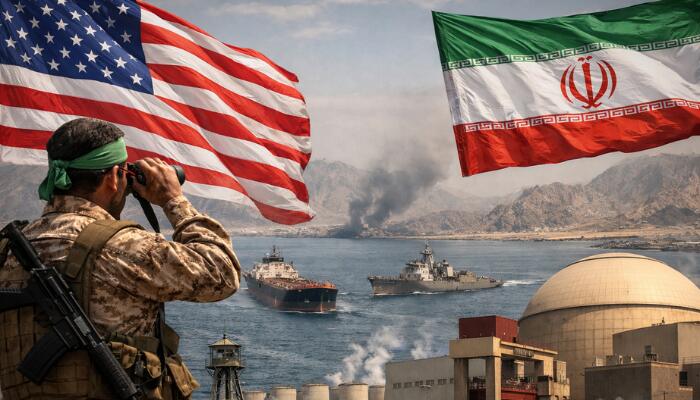
The United States and Iran have stepped back from the brink of a wider war after agreeing to a two-week ceasefire shortly before President Donald Trump’s deadline to escalate military strikes was set to expire. The pause in hostilities followed the submission of a 10-point proposal from Tehran, which Trump described as a “workable basis” for negotiations toward a longer settlement.
Under the provisional truce, the US has paused its strikes on Iran while Tehran has agreed to reopen the Strait of Hormuz, one of the world’s most crucial maritime routes through which roughly a fifth of global energy supplies pass during normal periods. Israel has also backed the temporary pause in attacks, according to the White House.
The ceasefire was facilitated after conversations between Trump and Pakistan’s leadership, with Pakistan acting as a key intermediary in passing Tehran’s proposal to Washington. China, Iran’s largest trading partner, is also believed to have encouraged Tehran to move toward negotiations as tensions escalated.
The 10 demands Iran placed on the table
Iran’s ceasefire blueprint outlines a set of sweeping conditions that it says must be addressed before any permanent end to the conflict can be reached.
The first demand is a commitment to non-aggression, ensuring that the United States and its allies halt military attacks against Iran. Tehran also insists on the continuation of Iranian control over the Strait of Hormuz, a strategic waterway whose closure during the conflict disrupted global shipping.
Another central condition is the acceptance of Iran’s nuclear enrichment programme, a long-standing point of dispute between Tehran and Western powers.
The proposal also calls for the lifting of all primary sanctions imposed directly by the United States as well as the removal of secondary sanctions that penalise other countries for trading with Iran. Tehran further demands the termination of United Nations Security Council resolutions related to its nuclear programme and the cancellation of resolutions passed by the International Atomic Energy Agency’s Board of Governors.
Iran is also seeking financial compensation for the damage caused during the conflict and the release of frozen Iranian assets held abroad.
The plan includes a demand for the withdrawal of US combat forces from the Middle East and the cessation of military action on all fronts, including attacks against Iran’s allies such as the Lebanese militant group Hezbollah.
Tehran has also asked for a United Nations Security Council resolution that would make any agreement legally binding under international law.
Iran’s Supreme National Security Council has described the proposal as a diplomatic victory, claiming that the United States has been forced to consider its terms after weeks of confrontation that began with US-Israeli strikes on 28 February.
The battle over the Strait of Hormuz
The issue of control over the Strait of Hormuz has emerged as the most contentious element in the negotiations. Iranian foreign minister Abbas Araghchi said safe passage through the waterway would be permitted during the ceasefire but emphasised that Iranian armed forces would retain authority over the strait.
Reports suggest the proposal could allow Iran and Oman to charge ships up to two million dollars per vessel to transit the route, with the revenue earmarked for reconstruction.
Tehran has also warned that if negotiations collapse, it may once again attempt to close the strait, a move that would have severe consequences for global energy markets.
Doubts in Washington and Israel
Despite Trump’s decision to suspend military escalation, the proposal has generated significant scepticism in Washington. One of the most controversial elements is Iran’s demand to maintain control over the Strait of Hormuz, something it did not possess before the conflict began.
Democratic Senator Chris Murphy warned that granting Tehran authority over the waterway would be dangerous for global trade. Speaking to CNN, he said such an arrangement would be “cataclysmic for the world”.
Trump has not directly endorsed the proposal’s specific conditions but said the United States would help manage shipping congestion in the strait as negotiations continue. He also argued that Washington had already met or exceeded its military objectives during the conflict.
What happens next?
Israel has supported Washington’s decision to pause strikes for two weeks but clarified that the ceasefire does not extend to Lebanon. Prime Minister Benjamin Netanyahu’s office said Iran must immediately open the Strait of Hormuz and halt attacks on the United States, Israel, and regional partners.
The conflict has already had devastating consequences in Lebanon, where Israeli operations linked to the wider war have killed at least 1,500 people and displaced around 1.2 million after Hezbollah launched rockets in support of Tehran.
Pakistan’s Prime Minister Shehbaz Sharif has invited US and Iranian delegations to meet in Islamabad later this week in an attempt to turn the temporary truce into a broader agreement. Tehran has confirmed it will attend the talks, while the White House said in-person negotiations are being considered but have not yet been finalised.
For now, the ceasefire offers only a brief pause in a volatile conflict, with the coming diplomatic talks likely to determine whether the two-week truce can evolve into a lasting peace.