
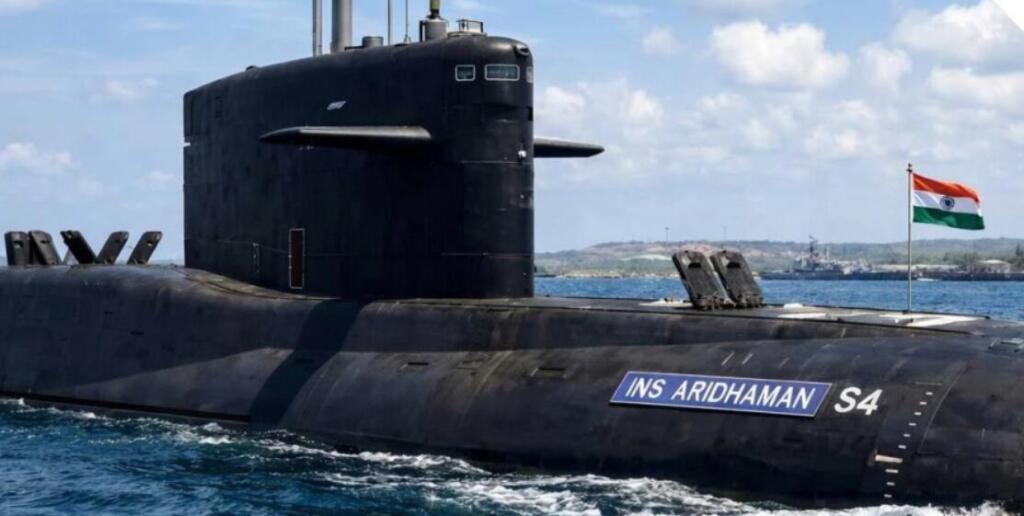
Defence Minister Rajnath Singh has hinted at the launch of India’s third indigenously built nuclear-powered submarine, INS Aridhaman and described it saying it is “not a word, it’s power.”
According to media reports, the submarine has completed its final sea trials and will soon join the Strategic Forces Command, enhancing India’s nuclear deterrence capability.
INS Aridhaman follows INS Arihant, which entered service in 2016, and INS Arighaat, commissioned in August 2024. The addition of a third submarine significantly strengthens India’s nuclear triad, ensuring that the country maintains a credible second-strike capability at sea.
Multiple SSBNs (Ship, Submersible, Ballistic, Nuclear) allows one submarine to remain on patrol while others are docked for maintenance or training, maintaining continuous at-sea deterrence.
Enhanced Capabilities and Strategic Significance
INS Aridhaman displaces around 7,000 tonnes, slightly larger than its predecessors, and has a streamlined hull designed to reduce underwater resistance and acoustic signature. The submarine is powered by an upgraded 83 MW pressurised water reactor, developed by the Bhabha Atomic Research Centre, providing improved endurance, reliability, and propulsion efficiency.
The vessel carries eight vertical launch tubes, doubling the capacity of INS Arihant. It can launch either eight K-4 long-range missiles with a range of 3,500 km or up to 24 K-15 missiles with a 750 km range, giving the Indian Navy the flexibility to deploy a mix of strategic and tactical nuclear weapons. Analysts emphasize that this missile capacity ensures that India’s SSBN fleet can maintain continuous deterrence, with at least one submarine always on patrol.
SSBNs like Aridhaman provide India with a credible second-strike capability, meaning that even if land-based nuclear assets are neutralized in a conflict, submerged submarines can retaliate. This makes a first strike against India strategically unviable.
With the planned induction of a fourth SSBN, the Indian Navy will be able to rotate its submarines efficiently, keeping one on patrol while others undergo maintenance or training.
Defence Minister Highlights India’s Growing Maritime Strength
Rajnath Singh’s announcement coincided with his visit to Visakhapatnam, India’s primary hub for nuclear submarine construction and home port for the SSBN fleet. During the visit, he commissioned the Taragiri, an indigenously built advanced stealth frigate.
Speaking at the event, Singh reportedly said the commissioning of Taragiri reflects India’s expanding maritime capabilities. He also congratulated Mazagon Dock Shipbuilders Limited and the Navy for designing and delivering the modern warship.
He emphasized the strategic importance of India’s 11,000 km coastline, noting that nearly 95% of the country’s trade moves through maritime routes, making a strong Navy crucial not just for defense but also for economic and energy security.
Singh underscored that a strong Navy allows India to not only defend its shores but also project power globally, safeguard key sea lanes, and protect critical digital infrastructure connected to national interests.
“A strong Navy is not just important, but necessary to protect India’s interests,” he said reportedly, adding that the Indian Navy has proven its ability to protect commercial ships and oil tankers during periods of tension.
Taragiri Frigate: Modern Design and Versatile Capabilities
The Taragiri frigate is powered by a Combined Diesel or Gas (CODOG) propulsion system, allowing it to switch between high-speed operations and fuel-efficient cruising. Its sleek hull and reduced radar signature enhance stealth, while advanced sensors and combat systems enable it to detect and neutralize aerial, surface, and underwater threats.
Taragiri’s weaponry includes supersonic surface-to-surface missiles, medium-range surface-to-air missiles, and a state-of-the-art anti-submarine warfare suite, all integrated into a modern combat management system. Beyond its combat role, Taragiri is capable of humanitarian assistance and disaster relief, making it a versatile asset for both peacetime operations and crisis response.
The induction of Taragiri, alongside INS Aridhaman, reflects India’s commitment to modernizing its naval fleet, enhancing maritime deterrence, and asserting India’s role as a responsible maritime power in the Indian Ocean region. Analysts note that these developments also strengthen India’s ability to secure strategic sea lanes and choke points, crucial for international trade and energy supplies.