
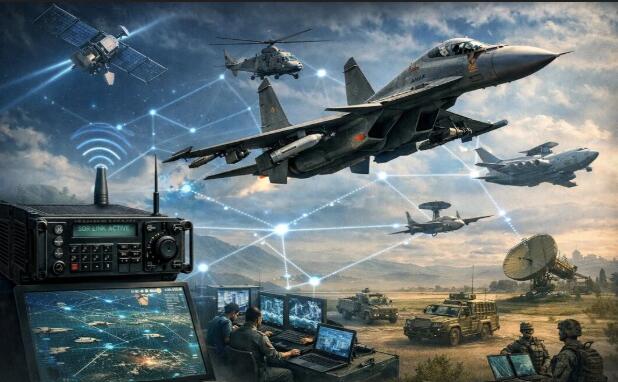
The Indian Air Force (IAF) is set to approach the Defence Procurement Board for approval to induct approximately 2,500 indigenous Software Defined Radios (SDRs), a move aimed at significantly strengthening its network-centric warfare capabilities.
According to reports, these advanced communication systems, often described as an “airborne Internet” are increasingly seen as indispensable to modern military operations. Senior officials emphasise that SDRs enable seamless connectivity between decision-makers, sensors, and combat platforms, forming the backbone of real-time digital warfare networks.
By ensuring secure, encrypted, and instantaneous communication, SDRs are expected to unify a wide array of assets, including ground command centres, fighter aircraft, transport fleets, helicopters, and airborne early warning systems into a single, coherent operational framework.
Network-Centric Warfare and Real-Time Integration
At the core of the programme is the ability to integrate weapons, sensors, and radar feeds into a unified operational picture. This allows commanders to monitor evolving situations in real time and execute rapid, coordinated responses across multiple domains.
Functioning as digital communication hubs, SDRs facilitate the simultaneous transmission of voice, video, and data, even in heavily contested or electronically jammed environments. This is particularly critical in modern conflicts, where electronic warfare and cyber disruptions are increasingly decisive factors.
Advanced indigenous variants such as the SDR-Airborne Radio (SDR-AR) are designed specifically for such complex missions. These systems support multi-band and multi-channel operations across high frequency (HF), very/ultra high frequency (V/UHF), and L-band spectrums, ensuring resilient and uninterrupted communication links across platforms.
Scale, Cost, and Indigenous Push
The proposed procurement, estimated at roughly ₹5,000 crore, with each unit costing around ₹2 crore aims to equip nearly the entire operational fleet of the Air Force with SDR capability. Once deployed, these systems will enable secure and high-speed data exchange across all mission-critical assets.
A key feature of the programme is its emphasis on domestic production, aligned with the government’s Atmanirbhar Bharat initiative. Both hardware and software components will be developed and manufactured within India.
This effort builds on ongoing collaboration between the Defence Research and Development Organisation and Bharat Electronics Limited, which have been at the forefront of indigenous defence electronics.
The domestic approach ensures full control over encryption standards, cybersecurity protocols, and system upgrades critical factors in safeguarding communications against adversarial interception and electronic attacks.
Joint Operations and Future Warfare Doctrine
Beyond enhancing internal Air Force communications, the SDR programme is expected to play a pivotal role in enabling joint operations with the Indian Army and Indian Navy. Interoperability has long been a challenge in multi-service operations, and SDR technology aims to bridge that gap.
The implementation of the Indian Radio Software Architecture (IRSA) standard is a major step in this direction, ensuring seamless communication compatibility across all three services.
In operational terms, SDRs will significantly improve situational awareness for both pilots and ground commanders by fusing inputs from multiple sensors into a coherent, real-time intelligence picture. This will enable faster decision-making, precise targeting, and highly coordinated strikes with reduced response times.
Ultimately, the initiative aligns with India’s broader shift towards integrated theatre commands and fully networked warfare. By linking frontline units with strategic command structures and even political leadership during crises, the SDR ecosystem is poised to become a critical enabler of next-generation military operations.