
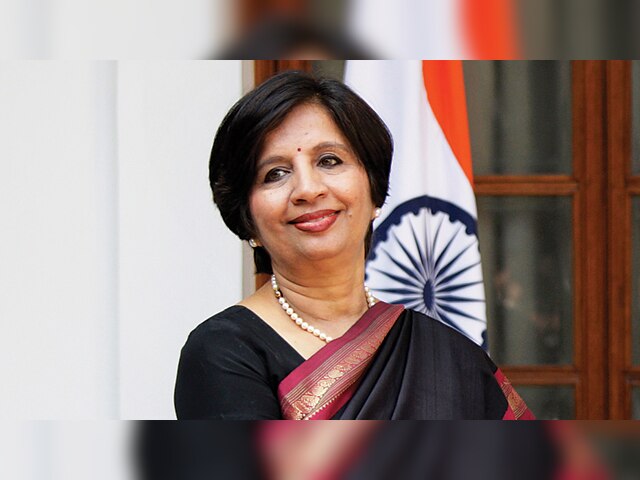
The career of Nirupama Rao, once regarded as one of India’s most experienced diplomats, has come under sharp scrutiny in recent commentary that questions her worldview, strategic judgment, and evolving public positions. A recent critique argues that Nirupama Rao’s long tenure in India’s foreign policy establishment reflects not just institutional continuity but also a pattern of misreading adversaries and underestimating geopolitical threats. The article presents a forceful case that Nirupama Rao’s diplomatic approach has, over time, shifted from pragmatic realism to what critics describe as a “woke” framework disconnected from strategic realities.
Nirupama Rao served as India’s Foreign Secretary from 2009 to 2011 and later as Ambassador to the United States and China, occupying some of the most sensitive diplomatic positions in the country. Her career placed her at the center of India’s engagement with key global powers, including during periods of tension with Pakistan and China. However, critics now argue that Nirupama Rao’s interpretation of these relationships often leaned toward excessive caution and misplaced optimism about adversaries’ intentions.
According to the critique, Nirupama Rao consistently underestimated the ideological and strategic motivations of India’s rivals. Whether in dealing with Pakistan’s deep state or China’s assertive expansionism, the article contends that Nirupama Rao’s diplomatic posture reflected a belief in dialogue and engagement even when faced with adversarial actions. This approach, while rooted in traditional diplomatic thinking, is portrayed as ineffective in a rapidly changing geopolitical environment where hard power and strategic clarity play a crucial role.
The criticism of Nirupama Rao also extends to her public commentary after retirement. In recent years, Nirupama Rao has been active on social media and in opinion writing, often advocating for nuanced and conciliatory positions on international issues. While such perspectives are not uncommon among former diplomats, the article suggests that Nirupama Rao’s views increasingly align with a global liberal consensus that may not fully account for India’s security concerns.
A key argument made is that Nirupama Rao’s diplomatic framework reflects an older paradigm of international relations—one that prioritizes dialogue, multilateralism, and moral positioning over strategic competition. Critics argue that this framework struggles to address contemporary challenges such as China’s territorial ambitions or Pakistan’s continued support for cross-border terrorism. In this context, Nirupama Rao is presented as emblematic of a broader section of India’s foreign policy elite that has failed to adapt to new realities.
At the same time, it is important to contextualize Nirupama Rao’s career within the institutional constraints of diplomacy. As a senior official, Nirupama Rao operated within the policies set by elected governments and the broader strategic culture of the time. Her tenure saw significant developments, including India’s engagement with the United States and its participation in global multilateral forums. These achievements suggest that Nirupama Rao’s role cannot be reduced solely to the criticisms outlined in the article.
Nevertheless, the critique highlights a growing debate within India about the direction of its foreign policy. The rise of a more assertive strategic posture in recent years has led to a reassessment of earlier approaches. In this debate, figures like Nirupama Rao become focal points for broader disagreements about how India should engage with the world.
The article ultimately portrays Nirupama Rao as a diplomat whose career reflects both the strengths and limitations of India’s traditional foreign policy establishment. On one hand, Nirupama Rao brought experience, continuity, and a commitment to dialogue. On the other, critics argue that Nirupama Rao’s approach failed to anticipate or adequately respond to the evolving nature of global power politics.
In conclusion, the reassessment of Nirupama Rao’s legacy underscores a larger shift in India’s strategic thinking. As the country navigates an increasingly complex international landscape, the debate over figures like Nirupama Rao is likely to continue. Whether seen as a principled diplomat or a representative of outdated thinking, Nirupama Rao remains a significant figure in understanding the evolution of India’s foreign policy discourse.