
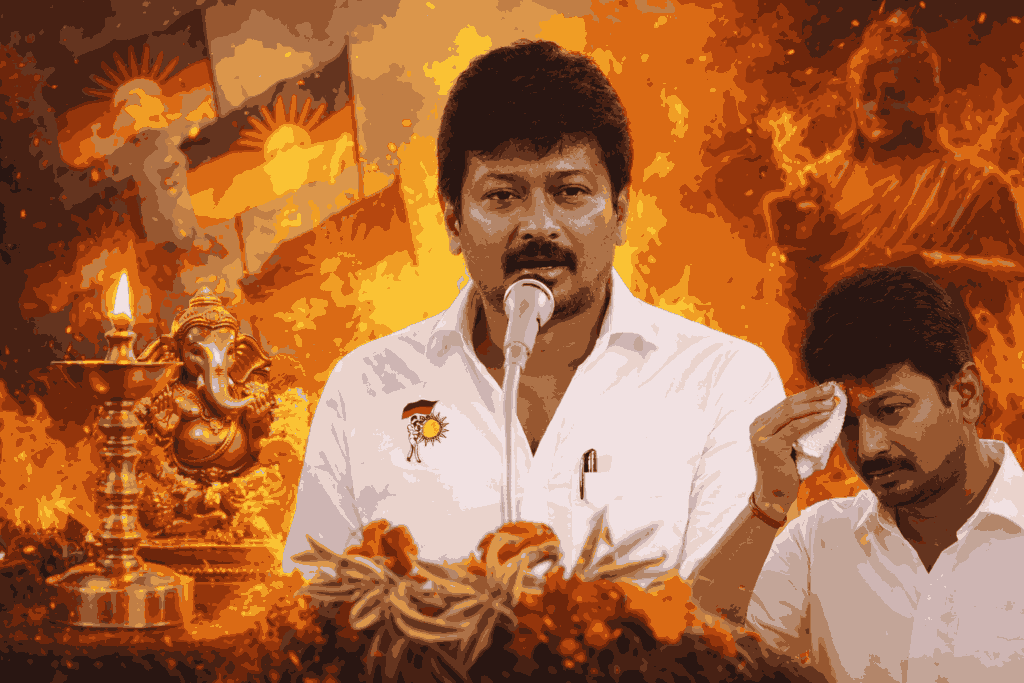
The controversy surrounding Tamil Nadu Deputy Chief Minister Udhayanidhi Stalin has once again ignited a nationwide debate, this time after visuals surfaced showing him wiping off kumkum from his forehead at a public event. The incident has been interpreted by critics as a symbolic affront to Hindu Dharma, further deepening an already polarised discourse that began with his earlier remarks on Sanatana Dharma.
The latest episode comes in the backdrop of Stalin’s controversial 2023 speech, where he compared Sanatana Dharma to diseases such as dengue and malaria, arguing that it should be “eradicated” rather than merely opposed. These remarks triggered widespread outrage across India, leading to protests, political condemnation, and multiple legal challenges. The resurfacing of the kumkum incident has now added a visual dimension to the ideological debate, with many alleging that it reflects a continued pattern of hostility toward Hindu Dharma.
Critics argue that such actions go beyond political rhetoric and enter the realm of cultural symbolism. Kumkum, traditionally worn on the forehead, is widely regarded as a sacred marker in Hindu practices, representing faith, identity, and continuity. The act of wiping it off publicly has therefore been interpreted by detractors as a deliberate rejection of Hindu Dharma, rather than a mere personal choice or incidental gesture.
Supporters of Stalin and his party, the Dravida Munnetra Kazhagam (DMK), have dismissed these allegations as politically motivated. They contend that the controversy is being amplified by opponents seeking to portray the party as anti-Hindu. According to this perspective, Stalin’s earlier comments were directed not at Hindu Dharma itself, but at what he described as oppressive social structures associated with certain interpretations of Sanatana Dharma.
However, the matter has not remained confined to political exchanges. Judicial observations have also intensified scrutiny. In a significant development, the Madras High Court noted that Stalin’s remarks on Sanatana Dharma could amount to hate speech, describing them as a “clear attack on Hinduism.” This observation has been frequently cited by critics to argue that the issue transcends political disagreement and raises serious legal and ethical questions.
The broader debate touches upon the delicate balance between freedom of expression and respect for religious sentiments. While India’s Constitution guarantees the right to free speech, it also imposes reasonable restrictions to maintain public order and harmony. In this context, the repeated references to Hindu Dharma in political discourse have raised concerns about whether such expressions risk deepening communal divisions.
Political reactions have been swift and sharp. Leaders from opposition parties have accused the DMK of consistently undermining Hindu Dharma and disregarding the cultural sentiments of millions. The controversy has also been invoked in election rhetoric, with parties attempting to mobilise public opinion by framing the issue as one of cultural identity and respect.
At the same time, the DMK has defended its ideological stance, rooted in the Dravidian movement’s emphasis on rationalism and social justice. Party leaders argue that their critique is aimed at dismantling hierarchical structures rather than targeting Hindu Dharma as a whole. This distinction, however, remains contested, with critics insisting that the language and symbolism used blur the line between social critique and religious offence.
The incident has also reignited discussions around the role of symbolism in politics. In a diverse country like India, where religious practices are deeply intertwined with daily life, even seemingly minor gestures can carry significant meaning. The kumkum episode illustrates how visual cues can become powerful political statements, shaping public perception and fueling debate.
As the controversy continues to unfold, it underscores the enduring sensitivity surrounding matters of faith and identity in India. The repeated invocation of Hindu Dharma in political discourse reflects not only ideological differences but also the broader challenge of navigating pluralism in a लोकतांत्रिक society.
Ultimately, the episode serves as a reminder that political expression in India operates within a complex cultural landscape. Whether viewed as an assertion of ideological beliefs or as an affront to tradition, the debate over Hindu Dharma in this context is unlikely to fade anytime soon, continuing to influence both public discourse and political strategy in the months ahead.