
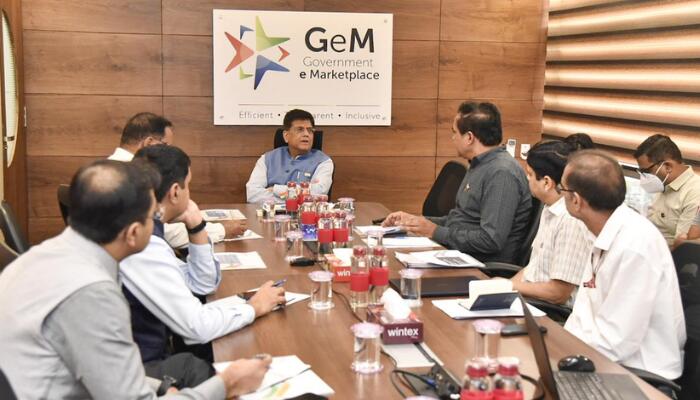
Union Commerce and Industry Minister Piyush Goyal has intensified efforts to reshape the Government e-Marketplace (GeM). In a high-level review held on April 30, 2026, he pushed a renewed roadmap to make public procurement more transparent, competitive, and inclusive.
Importantly, the government is now positioning GeM as a core pillar of India’s procurement system. It is no longer being treated as a simple digital portal. Instead, it is being developed into a structured platform that can redefine how the state buys goods and services.
AI and digital tools at the centre
To begin with, the reform plan places strong emphasis on technology. The government will use artificial intelligence and advanced data analytics to improve procurement outcomes.
These tools will help sharpen price discovery and reduce delays. In addition, they will improve transparency in government spending. Officials also stressed that a data-led system will reduce manual intervention and improve efficiency across departments.
Expanding participation in the marketplace
At the same time, the Centre is working to widen the vendor base on GeM. The aim is to bring more sellers into the system and increase competition.
Goyal underlined the need to open up procurement access. He stressed that businesses of all sizes should be able to participate directly. As a result, the government wants to reduce concentration and break older procurement patterns dominated by a limited set of suppliers.
Strong push for inclusion
Meanwhile, the reform strategy places clear focus on inclusion. MSMEs, startups, and women entrepreneurs are at the centre of this approach.
The government wants these groups to gain easier access to public contracts. This will help them scale their operations and integrate into larger supply chains. In turn, officials believe this will strengthen India’s broader entrepreneurial ecosystem.
Trade developments alongside reforms
Separately, the GeM push aligns with wider trade and investment developments. On April 28, Goyal highlighted the India–New Zealand agreement.
The agreement covers cooperation in education, technology, agriculture, intellectual property, and traditional medicine. It also includes Ayurveda and Māori traditions under cultural exchange frameworks.
Furthermore, the deal is expected to significantly expand investment flows. New Zealand is projected to invest around USD 20 billion in India over the next 25 years. Earlier, its total FDI stood at only about ₹70 million over the past 25 years.
Bigger economic picture
Finally, Goyal noted that this investment shift will support employment generation and industrial growth. He linked it to India’s broader “Amrit Kaal” development phase.
Overall, the government is now pushing GeM as more than a procurement platform. Instead, it is being shaped into a digital backbone for transparent, competitive, and inclusive governance.