
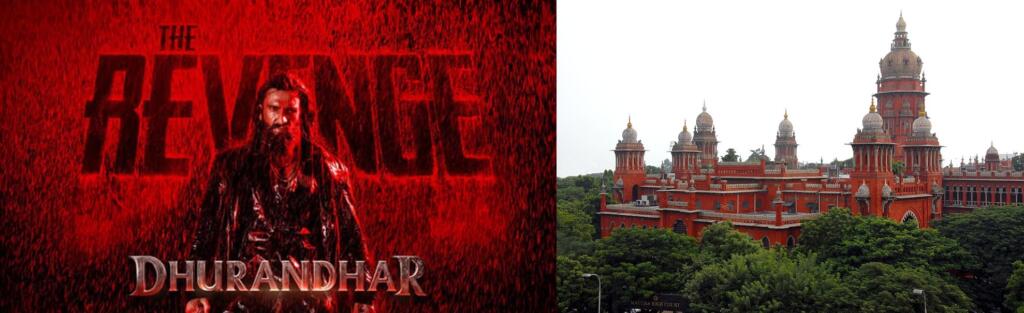
In a significant legal development, the Madras High Court has declined to halt the screening of Dhurandhar: The Revenge during the Tamil Nadu Assembly elections, reaffirming the primacy of legal procedure and artistic certification over speculative claims. The decision has placed Dhurandhar at the center of a larger debate on free expression, electoral neutrality, and the limits of judicial intervention.
The controversy began when a petition was filed seeking a temporary ban on Dhurandhar across theatres and digital platforms during the enforcement of the Model Code of Conduct (MCC). The petitioner argued that the film allegedly contained political undertones that could influence voters and disrupt the principle of a level playing field during elections. However, the Court found these claims insufficiently substantiated and dismissed the plea at the admission stage.
At the heart of the ruling was the role of the Central Board of Film Certification (CBFC), a statutory authority responsible for approving films for public viewing. The bench emphasized that since Dhurandhar had already received certification, the Court could not intervene unless that certification itself was legally challenged. This reaffirmation of institutional boundaries underscores the judiciary’s reluctance to override established regulatory frameworks without compelling evidence.
The Court also noted that the petition failed to clearly identify specific scenes or content in Dhurandhar that allegedly favored any political party. In the absence of concrete examples, the argument that the film could influence electoral outcomes remained speculative. The judges reiterated that courts cannot act on assumptions, especially in matters involving freedom of expression and artistic works.
Interestingly, the case highlights a recurring tension in democratic societies: balancing free speech with electoral fairness. While concerns about media influence during elections are not new, the judiciary has often maintained that restrictions must be based on clear legal violations rather than perceived or potential impacts. In this instance, Dhurandhar became a test case for that principle.
The film itself has garnered massive attention, not just for its legal challenges but also for its commercial success. Released in March 2026, Dhurandhar quickly emerged as a box office phenomenon, crossing significant revenue milestones within days and attracting audiences across India and abroad. Its scale, storytelling, and intense themes have contributed to both its popularity and the controversies surrounding it.
Critics of the film argue that cinema, especially when released during politically sensitive periods, can subtly shape public perception. Supporters, however, contend that censoring or delaying films on such grounds would set a dangerous precedent, potentially opening the door to arbitrary restrictions on creative expression. The Court’s decision appears to align with the latter view, prioritizing constitutional freedoms over unverified concerns.
Another notable aspect of the ruling is its broader implication for the entertainment industry. By refusing to ban Dhurandhar, the Madras High Court has sent a clear message that films certified by the CBFC cannot be easily subjected to judicial censorship without due process. This provides a degree of certainty to filmmakers and producers, who often face legal hurdles during high-profile releases.
At the same time, the judgment does not dismiss the importance of maintaining electoral integrity. Instead, it places the responsibility on appropriate authorities—such as the Election Commission—to address any genuine violations of the MCC. This delineation of roles ensures that each institution operates within its defined mandate.
For audiences, the debate surrounding Dhurandhar adds another layer to the viewing experience. The film is no longer just a cinematic spectacle but also a focal point in discussions about law, politics, and media influence. Whether one views it as entertainment or as a politically charged narrative, its impact extends beyond the screen.
In conclusion, the Madras High Court’s decision to allow the continued screening of Dhurandhar during elections reinforces the principles of legal clarity and artistic freedom. While debates over the film’s content and timing may persist, the ruling sets an important precedent: that in a republican framework, restrictions must be grounded in law, not conjecture.