
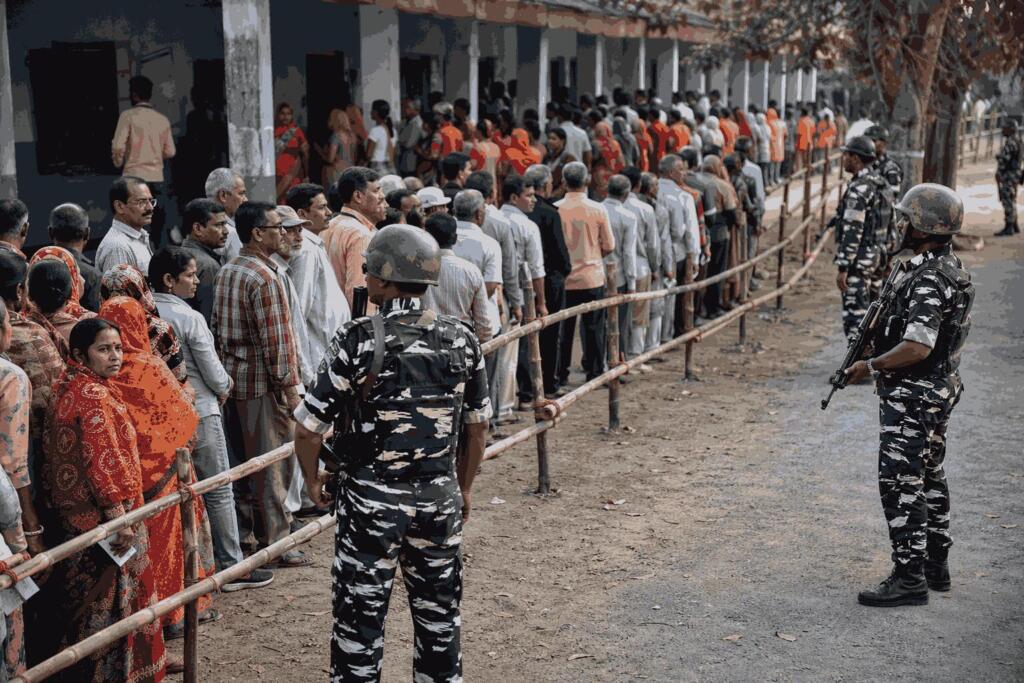
Are voters truly casting their ballots without fear, or is the visible calm a product of heavy security deployment? As the Bengal Election unfolds across sensitive districts, especially in regions like Birbhum that have historically witnessed political violence, long queues of voters standing patiently under the watch of central forces present a striking image. But what lies beneath this surface of order?
In several polling stations across West Bengal, visuals of disciplined lines and steady voter turnout suggest a renewed confidence in the electoral process. The presence of the Central Armed Police Forces (CAPF) appears to have played a crucial role in shaping this environment. For many voters, particularly in areas with a legacy of intimidation and clashes, this visible layer of protection offers reassurance that their vote will remain secret and their participation unhindered.
The significance of these long queues cannot be dismissed as mere routine electoral enthusiasm. In districts like Birbhum, which have often been at the center of intense political contestation, such orderly participation signals a possible shift. Voters who may have previously hesitated due to fear of coercion or violence are now stepping out in large numbers. This change raises an important question: is the Bengal Election witnessing a genuine democratization of participation, or is it a temporary effect driven by extraordinary security measures?
The role of paramilitary forces in this transformation is hard to ignore. Their deployment is not merely symbolic—it alters the ground reality. CAPF personnel are perceived as more neutral compared to local law enforcement, which is sometimes viewed through a political lens. This perception of neutrality enhances voter confidence. As a result, individuals who might otherwise stay away from polling booths feel empowered to exercise their democratic rights.
However, this also brings forth a deeper debate about the nature of electoral freedom. If fear-free voting requires such a significant presence of armed forces, what does it say about the underlying political culture? Ideally, elections in a लोकतांत्रिक व्यवस्था should be conducted in an environment where security is a given, not an intervention. The fact that CAPF deployment becomes a decisive factor indicates structural challenges that extend beyond a single Bengal Election cycle.
Another dimension worth examining is the psychological impact of security forces. For some voters, the presence of CAPF instills confidence; for others, it may feel intimidating. The balance between reassurance and over-securitization is delicate. Yet, the current voter turnout suggests that, at least in many areas, the forces are being seen more as protectors than enforcers.
Moreover, the imagery of long queues under tight security has political implications. It challenges narratives that elections in certain pockets are inevitably marred by violence. At the same time, it also underscores the necessity of continued vigilance. The peaceful conduct of voting in one phase of the Bengal Election does not automatically guarantee the same for subsequent phases or future elections.
It is also important to consider whether this model is sustainable. Can such extensive deployment be maintained across every election, or should the focus shift toward strengthening local institutions and building trust within communities? Long-term electoral integrity depends not just on external security but on internal stability—where political actors, administrative bodies, and citizens collectively uphold democratic norms.
The current scenario may well represent a transitional phase. The visible calm and active participation could indicate that voters are reclaiming their space in the democratic process. If this trend continues beyond the immediate context of the Bengal Election, it could mark a significant turning point for the state’s political landscape.
Ultimately, the question remains layered. Are people voting without fear? In many places, the answer appears to be yes—but with a crucial caveat. This fearlessness is, at least in part, supported by the presence of CAPF. The real test will be whether such confidence endures even when the extraordinary security apparatus is scaled back.
For now, the long lines of voters stand as both a hopeful sign and a reminder. They reflect a desire for participation and a belief in democracy, while also pointing to the work that still lies ahead in ensuring that every Bengal Election is inherently free, fair, and fearless—without the need for extraordinary safeguards.