
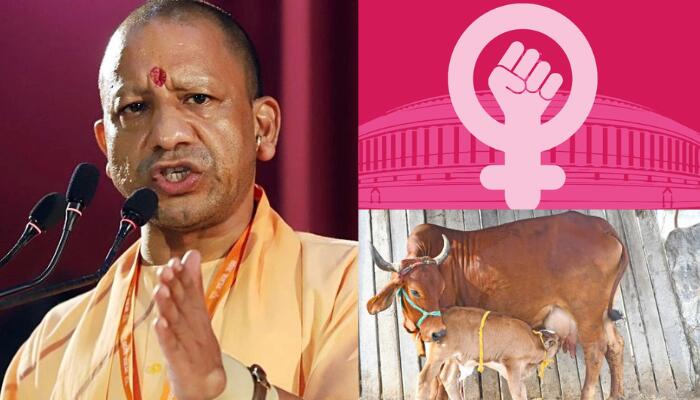
Uttar Pradesh Chief Minister Yogi Adityanath delivered a headline-grabbing speech in Gorakhpur on Wednesday. At the centre of it, however, was one question.
“Those who eat cows, do they drink pigs’ milk?” Yogi asked at the Nari Shakti Vandan Sammelan. Consequently, the remark became the biggest talking point.
He said even societies that do not treat the cow as sacred consume cow’s milk. According to him, this reflects a universal truth. He described milk as a gift of nature, even a divine gift, and therefore linked it to civilisational values. He also invoked a maternal analogy, arguing that just as a child first receives a mother’s milk, nature itself affirms the value of nourishment.
However, the remark was only one layer of the speech. At the same time, the larger target was the opposition.
Yogi Targets Opposition
Yogi accused Congress, the Samajwadi Party, TMC, and DMK of blocking women’s political empowerment. He said they opposed genuine reform while claiming to support social justice.
Backing Prime Minister Narendra Modi’s Nari Shakti Vandan Adhiniyam, he called the push for 33 per cent reservation a historic reform. He said the reform was designed to expand women’s role in both law-making and implementation, not merely representation. Yet, he alleged opposition parties tried to stall it through excuses and delay tactics.
He also claimed sections of the opposition celebrated when the Bill faced hurdles. In his view, this exposed discomfort with women gaining leadership rights and entering positions of power.
The sharpest criticism was reserved for the Samajwadi Party and Congress. Meanwhile, Yogi called the SP openly anti-women and repeated the political taunt, “Dekh Sapai, bitiya ghabraai.”
Moreover, he accused Congress of obstructing the rights of women, backward groups, and the marginalised.
More Than a Reservation Debate
Yogi framed women’s reservation as part of a larger national project. Empower women, he argued, and families grow stronger. In turn, stronger families create a stronger nation.
He reiterated the double-engine government’s commitment to women’s security, dignity, and self-reliance. Further, he said the Gorakhpur event was part of a wider mobilisation around women’s leadership.
Yet the speech carried a second message. It blended women’s representation with a broader cultural message, a familiar feature of BJP politics.
That is why the cow remark mattered politically. It was not a stray provocation. Rather, it reinforced a larger ideological argument while putting the opposition on the defensive.
Ultimately, in one speech, Yogi linked women’s empowerment, political attack, and civilisational rhetoric. As a result, the Gorakhpur event resonated far beyond a routine political programme.