
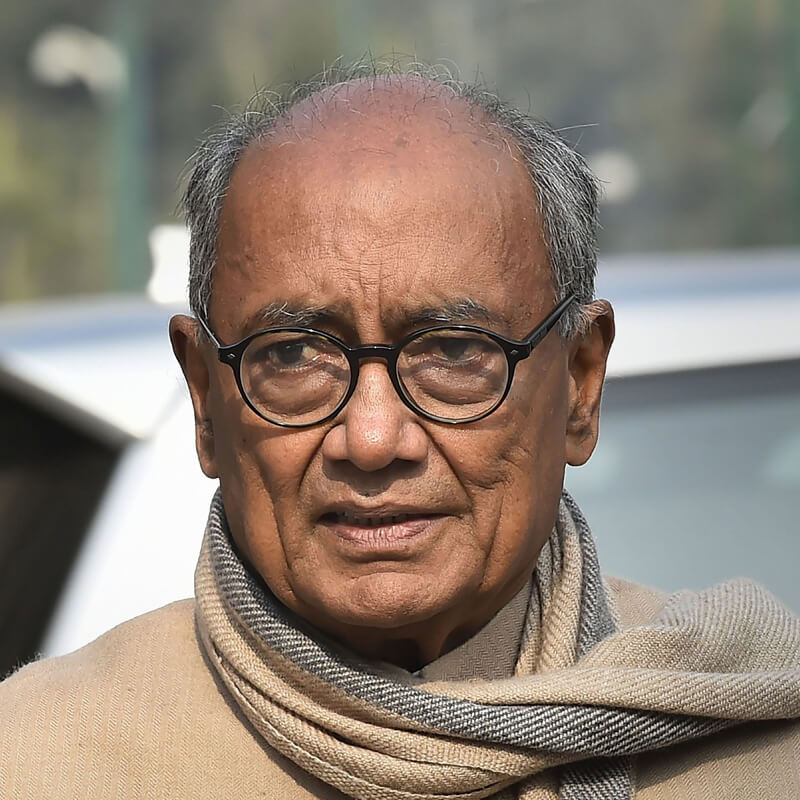
A fresh political controversy has erupted over the academic standing of Jawaharlal Nehru University (JNU), after senior Congress leader Digvijaya Singh alleged a sharp fall in the university’s ranking. The Union government has firmly rejected his assertion, stating that the comparison itself was flawed and based on two entirely different ranking systems.
The dispute began when Digvijaya Singh claimed that JNU’s ranking had slipped dramatically—from second place to ninth—raising concerns about declining institutional standards. The statement quickly gained traction in political and academic circles, fueling a debate about the performance of one of India’s premier universities.
However, the Centre clarified that Digvijaya Singh’s claim was inaccurate because it compared rankings derived from different frameworks. According to the government, the earlier rank cited by Digvijaya Singh belonged to one evaluation system, while the later rank came from another, making the comparison misleading and invalid. By highlighting this distinction, officials emphasized that there had been no such direct decline as suggested.
The controversy underscores the importance of understanding how rankings are calculated. India’s National Institutional Ranking Framework (NIRF), for instance, evaluates institutions based on parameters such as teaching, research, graduation outcomes, outreach, and perception. Different global and domestic ranking systems use varying criteria, weightage, and methodologies. As a result, comparing positions across different systems can produce distorted conclusions.
Digvijaya Singh, meanwhile, has been vocal about broader concerns regarding JNU. In recent parliamentary remarks, Digvijaya Singh raised issues about what he described as a decline in social justice indicators at the university. He pointed to reports suggesting a drop in enrolment of Scheduled Caste and Scheduled Tribe students, as well as irregularities in faculty recruitment and promotions.
These concerns, according to Digvijaya Singh, reflect deeper structural challenges within the institution. He argued that JNU, historically known for its commitment to inclusivity and democratic values, may be drifting from its founding ideals. His remarks added another layer to the ranking controversy, turning it into a broader political and ideological debate about higher education in India.
The government, however, has pushed back strongly. Officials reiterated that JNU continues to remain among the top-ranked universities in India under the NIRF system. They argued that selective interpretation of data—such as that presented by Digvijaya Singh—can create unnecessary alarm and undermine confidence in public institutions.
This is not the first time that Digvijaya Singh has raised concerns about educational institutions. Known for his outspoken positions, Digvijaya Singh has frequently used parliamentary forums to question policy decisions and highlight governance issues. In this instance, Digvijaya Singh’s remarks have once again placed him at the center of a contentious national debate.
The episode also reflects the growing political significance of university rankings in India. Rankings today influence not only public perception but also funding, student choices, and international collaborations. As such, even minor discrepancies or misinterpretations—like the one involving Digvijaya Singh—can trigger widespread reactions.
Experts note that while rankings are useful indicators, they should not be viewed in isolation. Institutional performance is shaped by multiple factors, including policy changes, funding levels, faculty strength, and student diversity. A single metric or ranking shift cannot fully capture the complexity of an academic institution’s evolution.
In the case of JNU, the debate sparked by Digvijaya Singh highlights both the sensitivity and significance of educational data in public discourse. While Digvijaya Singh’s claim has been contested, the issues he raised—particularly around inclusivity and governance—continue to resonate within academic and political circles.
Ultimately, the controversy serves as a reminder of the need for careful interpretation of data, especially when it informs public debate. As the Centre has pointed out, comparing unlike metrics can lead to misleading narratives. Yet, the concerns voiced by Digvijaya Singh also ensure that scrutiny of higher education institutions remains an ongoing and necessary process in a democratic framework.