
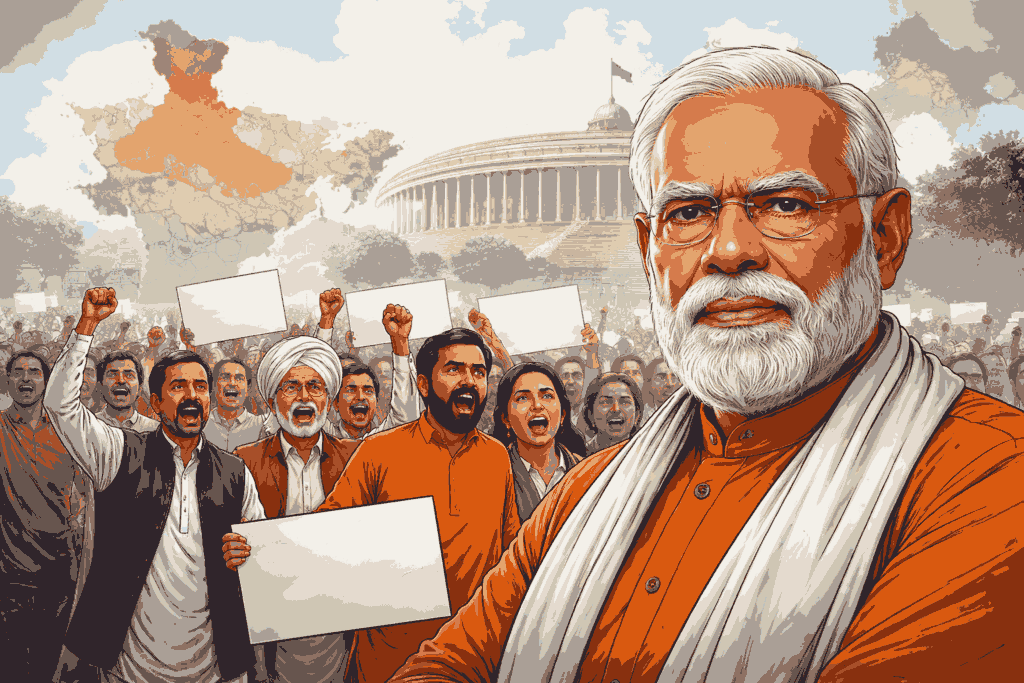
The ongoing national debate over delimitation has laid bare a striking contradiction in India’s political discourse—one that many are no longer willing to ignore. The same political voices that loudly champion the slogan “Jitni Abadi Utna Haq” when demanding caste-based reservations are now resisting the very principle when it comes to parliamentary representation. This inconsistency is not merely rhetorical; it strikes at the heart of democratic integrity and exposes a selective application of constitutional ideals.
To understand the controversy, one must first grasp what delimitation entails. It is a constitutional process that redraws electoral boundaries and reallocates parliamentary seats to ensure that each constituency represents roughly equal population segments. In essence, delimitation operationalizes the democratic ideal of “one person, one vote,” ensuring that representation keeps pace with population changes.
The Centre’s proposed amendment seeks to expand the Lok Sabha from 543 seats to around 850, a move that would naturally increase representation for states with larger populations. This is where the political faultline emerges. Several opposition parties, particularly from southern India, have strongly opposed the move, arguing that it would reduce their relative share in Parliament and shift political power northward.
However, this resistance raises a fundamental question: if representation proportional to population is a fair principle for reservations, why is it suddenly unjust for electoral representation?
The slogan “Jitni Abadi Utna Haq” has been repeatedly invoked in debates around caste census and reservation expansion. It is presented as a moral and democratic necessity—an assertion that communities deserve representation proportional to their population share. Yet, when delimitation applies the same logic to parliamentary seats, the principle is suddenly portrayed as unfair or even dangerous.
This selective reasoning undermines the credibility of those advancing it. Democracy cannot function on pick-and-choose principles. If population is a legitimate basis for allocating opportunities and representation in one domain, it cannot be dismissed in another simply because the outcomes are politically inconvenient.
Opposition leaders argue that southern states, having successfully controlled population growth, should not be “penalized” with reduced representation. While this concern may carry emotional weight, it does not negate the core democratic principle that every citizen’s vote must carry equal value. Delimitation is not about rewarding or punishing states; it is about ensuring parity among voters across the country.
Moreover, the argument overlooks the fact that the freeze on delimitation since the 1970s was itself a political compromise, designed to encourage population control without altering representation. That freeze cannot be indefinite. At some point, democratic systems must realign with demographic realities.
Critics of delimitation also warn of a potential erosion of federal balance. Yet, this concern must be weighed against the risk of perpetuating unequal representation. When constituencies vary widely in population size, the value of individual votes becomes distorted—a situation that runs counter to the very foundation of representative democracy.
The contradiction becomes even more glaring when viewed through the lens of political messaging. On one hand, the demand for caste-based proportionality is framed as social justice. On the other, population-based parliamentary representation is framed as political injustice. This duality suggests that the principle itself is not the issue—its political consequences are.
In reality, delimitation is not an ideological weapon but a constitutional necessity. It is mandated to ensure that India’s republican structure remains fair, balanced, and representative of its people. The reluctance to accept its implications reveals a deeper discomfort with the redistribution of political power, rather than a principled objection to the process itself.
That said, the concerns of southern states should not be dismissed outright. Issues of fiscal contribution, governance performance, and regional diversity do deserve attention in broader policy discussions. However, these factors cannot override the basic democratic requirement of equal representation.
As India approaches the next delimitation exercise, the debate is likely to intensify. Political parties will continue to frame the issue through their respective lenses, appealing to regional sentiments and electoral calculations. But for the public, the question remains straightforward: should democratic principles be applied consistently, or selectively?
In conclusion, the delimitation debate has exposed more than just regional tensions—it has revealed a deeper inconsistency in how political actors interpret fairness and representation. The slogan “Jitni Abadi Utna Haq” cannot be both a rallying cry and a discarded principle, depending on convenience. If democracy is to retain its moral authority, its core tenets must be upheld uniformly, not selectively.