
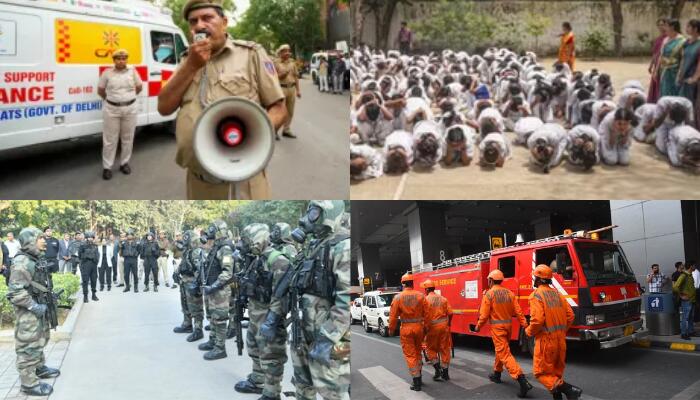
Delhi witnessed a sweeping civil defence preparedness exercise yesterday as mock drills were conducted across all 13 districts to test the city’s ability to respond to disasters and potential hostile threats. The coordinated operation, organised by the Directorate of Civil Defence, simulated emergency scenarios including air raid warnings, blackouts, evacuations, and medical rescue operations in an effort to strengthen the capital’s disaster response framework.
The exercise began at around 8 pm and was carried out simultaneously at 17 locations across the city, including hospitals, schools, housing complexes, public spaces, and government offices. Officials said the drill was designed to evaluate how quickly emergency services and local authorities could mobilise and coordinate in the event of a crisis while also assessing public compliance with safety protocols.
Emergency scenarios simulated across key public locations
Among the prominent sites where the drills took place were the Taj Palace Hotel on Sardar Patel Marg, the Cantonment General Hospital in Delhi Cantonment, Raj Kumari Amrit Kaur College of Nursing, and Omaxe Mall in Chandni Chowk. Authorities deliberately selected a diverse set of locations, ranging from hospitals and hotels to commercial complexes, to test response systems across different public environments.
In the New Delhi district, which regularly received high numbers of foreign visitors and dignitaries, special attention was given to preparedness measures at critical infrastructure locations. Officials monitored how quickly teams could respond to simulated threats and ensure public safety.
The drills recreated conditions similar to wartime or hostile attack scenarios. Air raid sirens were sounded in selected areas while a crash blackout was enforced in vulnerable zones to replicate emergency conditions. Residents, staff members, and participants were instructed to switch off lights during the blackout phase to test compliance with wartime safety procedures.
Coordination among multiple emergency agencies
Emergency response agencies carried out a series of coordinated actions during the drill. Teams practised search and rescue operations, evacuation procedures, and the treatment of mock casualties. People at participating locations were guided towards designated bunkers or safe areas while medical teams rehearsed emergency care responses.
A communication hotline linking the Air Force Station at Arjangarh with civil defence control centres was activated as part of the exercise to test real-time coordination during a potential aerial threat. Control rooms and emergency operations centres across the city were also operational throughout the drill.
Several agencies worked together during the exercise, including Delhi Police, Delhi Fire Services, the National Disaster Response Force, the health department and civil defence volunteers. Organisations such as the National Cadet Corps, National Service Scheme, Home Guards, civic bodies and the Nehru Yuva Kendra Sangathan also participated.
Sub-Divisional Magistrate Jitendra Kumar, speaking during the drill at Rainbow Children’s Hospital in Malviya Nagar, said, “Authorities had quickly moved to staging areas after receiving alerts before deploying teams to carry out simulated rescue operations.”
Strengthening preparedness and closing response gaps
Officials said, “The primary objective of the exercise was to improve inter-agency coordination and identify vulnerabilities in existing emergency response systems. Teams also mapped sensitive installations and vulnerable sites across the city to review risk mitigation strategies such as protective measures and camouflage.”
Thousands of civil defence volunteers and emergency responders took part in the operation, while public participation was encouraged to build awareness about safety protocols during emergencies.
The Directorate of Civil Defence said, “Such drills were conducted periodically to strengthen readiness and ensure that authorities and communities could respond swiftly during disasters or hostile situations. District magistrates and civil defence controllers supervised the exercise and were expected to submit detailed reports to civil defence headquarters.”
The findings would subsequently be reviewed and shared with the Ministry of Home Affairs as part of a broader assessment of the capital’s emergency preparedness.