
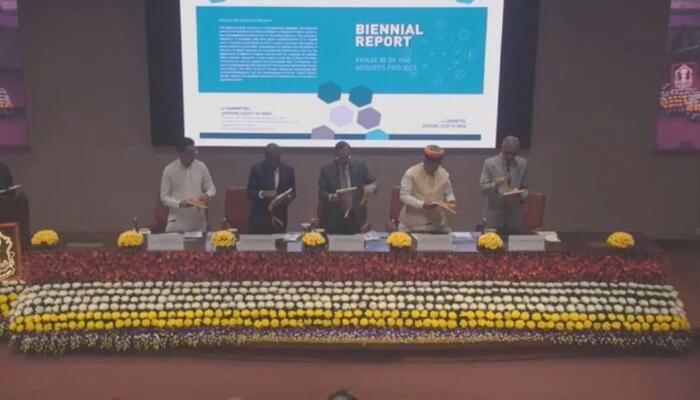
India’s judiciary marked a significant step in its ongoing digital transformation as Chief Justice of India Surya Kant formally launched Phase III of the e-Courts project with an outlay of ₹7,210 crore, describing it as a major reform aimed at making justice delivery more accessible, transparent, and efficient across the country.
The launch took place during the inaugural session of a two-day National Conference on Judicial Process Re-engineering and Digital Transformation in New Delhi. Addressing judges, policymakers, and legal professionals, the Chief Justice emphasised that the initiative goes beyond the adoption of technology in courtrooms and represents an effort to rethink the functioning of the justice system itself.
“This initiative is not merely about expanding technology in courts, but about reimagining how the justice system functions at its core,” he said.
According to him, the debate has now moved beyond whether courts are digitised to a deeper question about whether the system itself is being transformed to better serve citizens. “The question is no longer whether courts are digitised, but whether the system itself is being transformed to better serve citizens,” he added.
Evolution of the e-Courts Programme
The e-Courts Mission Mode Project was first introduced in 2005 under the National Policy and Action Plan for implementing information and communication technology in the judiciary. Its early phases focused largely on building digital infrastructure across courts.
These efforts led to the computerisation of court complexes, the development of standardised case management systems, and the introduction of digital services such as e-filing and virtual hearings. Over time, the programme expanded to strengthen transparency and efficiency within the judicial system.
One of the most significant developments during the second phase was the creation of the National Judicial Data Grid, which allows real-time monitoring of more than 4.5 crore pending cases across courts in the country. The phase also expanded electronic filing systems and introduced the Supreme Court’s Vidhik Anuvad software, an artificial intelligence-driven platform designed to translate court judgments into regional languages.
Bridging the Digital Divide
The Chief Justice said Phase III represents a shift from infrastructure-building to structural reform within the justice system. Conceptualised by the Supreme Court’s e-Committee with support from the Government of India, the initiative aims to extend digital justice to even the remotest parts of the country.
“In a country as diverse as India, digitisation cannot succeed unless it ensures genuine accessibility,” he said, emphasising that technology must help bridge physical and economic barriers.
A key component of the initiative is the expansion of e-Sewa Kendras, which function as facilitation centres for litigants. A total of 2,331 such centres have been established across courts to assist users in accessing case status, filing documents, and participating in virtual hearings, particularly helping individuals who may lack digital literacy or access to technological resources.
New Digital Services Introduced
Several digital initiatives were launched alongside Phase III to streamline court operations and improve user experience. These include a Single Sign-On service portal for unified access to judicial platforms, electronic delivery of court summons through email, and integration between the e-Courts system and e-Prisons databases.
The conference also saw the release of the Biennial Report on Phase III of the e-Courts project and the rollout of the e-Courts Services Mobile App Version 4.0, aimed at improving access to judicial information for citizens.
Justice Vikram Nath, chairperson of the Supreme Court’s e-Committee, said pilot testing of Digital Courts 2.1 is already underway and will soon be implemented nationwide. He added that the judiciary has also framed model rules for the live streaming and recording of court proceedings to ensure consistency and decorum.
“Judicial process re-engineering is not about altering the fundamentals of justice but about redesigning the pathways through which justice is delivered,” he said.
The conference was attended by Union Minister of State for Law and Justice Arjun Ram Meghwal and Minister of State for Electronics and Information Technology Jitin Prasada, along with judges of the Supreme Court, Chief Justices, and judges of various High Courts, officials from the Department of Justice, the Ministry of Home Affairs and representatives of agencies, including the National Crime Records Bureau.
Concluding his remarks, the Chief Justice described technology as a constitutional instrument that strengthens equality before the law and expands access to justice, adding that the broader vision is to build a natively digital judicial ecosystem in which courts operate seamlessly, and citizens can pursue legal remedies without being constrained by geography, resources, or procedural barriers.